
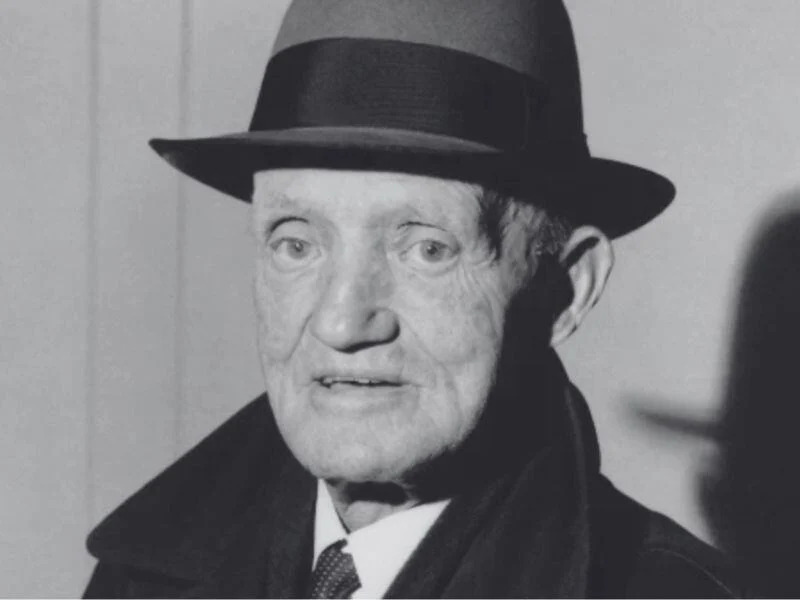
ROSS FITZGERALD & DICK WHITAKER tell the story of Arthur Stace, a down-and-out drunk who found Christianity and for decades wrote, in chalk, the word “Eternity” more than half a million times around Sydney.
Arthur Malcolm Stace is one of the more remarkable people in the rich tapestry that makes up the story of Australia.
He was a down and out drunk – on the “White Lady” (methylated spirits mixed with water) – and was destitute, roaming the streets of 1920s Sydney with no fixed place of abode.
His eventual recovery and conversion to Christianity makes a fascinating story.
Stace (1885-1967) had the odds well and truly stacked against him from the beginning, being born into an alcoholic family, and as a boy forced to steal and eat food scraps from garbage bins to survive.
His education was minimal and he is recorded as being illiterate, although it appears he could at least write his name. He worked for a local two-up school as a “look out” or “cockatoo” to warn when there were police in the area. He also acted as a scout for his sister’s brothels – inviting passers by into their establishments.
When fully grown he was only a diminutive 160 centimetres (5’3’’) tall, likely a result of his mother’s drinking. He became a ward of the state, a chronic alcoholic, and was then sent to jail at 15 years of age for petty theft and vagrancy.
In 1916 Stace enlisted as a soldier in World War I, and surprisingly passed the medical despite his unusually small height and alcoholism. He was sent to France, but spent much of his time in military hospitals suffering from pleurisy and bronchitis and was eventually discharged from the AIF in 1919 on medical grounds.
Following his discharge, he returned to his alcoholic ways around the streets of Sydney. He became a perambulating drunk for the next 10 years, descending to the lowest level of the street drunk – that of a metho drinker.
However, in 1930 he converted to Christianity after hearing a sermon by the reverend R Hammond given at St. Barnabas’ Anglican Church in Broadway, and was able to give up alcohol.
However, an even bigger change occurred one evening in 1932 when he heard a sermon given by the evangelist John Ridley, who spoke about eternity to his congregation.
Ridley was a returned World War I soldier, wounded at the battle of Fromelles and awarded the Military Cross. After the war, he became a well-known Baptist minister.
Ridley challenged his congregation: “Eternity, Eternity, I wish that I could shout that word to everyone in the streets of Sydney. You have got to meet it; where will you spend Eternity?”
At that point Stace claimed he received a “powerful calling from the Lord”, to take that message of eternity on to the streets of Sydney – not by shouting it, as Ridley had asked – but by writing it.
For the next 35 years he would arise early and visit various locations around the city, writing in chalk the word “Eternity” in an immaculate copperplate style.
This contrasted sharply with the rather poor handwriting visible on his signature. He believed that the Lord was guiding his hand each time he wrote “Eternity”.
Because he firmly believed that he was doing divine work, he dressed only in his best outfit for these expeditions – a threadbare suit, battered felt hat, carefully polished shoes, collar and tie – a diminutive shadowy figure moving around in the early morning light of Sydney.
He wrote on footpaths, seats, billboards and doorways – in fact any flat, smooth surface that would take chalk.
The regular appearance of this distinctive graffiti all around town aroused immense curiosity among Sydneysiders – who was writing this and what did it mean?
Then one day the mystery was solved. Stace was seen by the reverend Lisle Thomson writing the word on a footpath and he notified a newspaper reporter.
His story eventually appeared in the Sydney Sunday Telegraph in June 1956 – to the delight of the Sydney public.
Stace became an instant celebrity, dubbed “Mr. Eternity” by the media. He died in 1967 aged 82, a remarkable innings for a man who had formerly embraced the White Lady.
It is estimated that Arthur Stace wrote “Eternity” more than 500,000 times.
Early on New Year’s Day 2000 his incredible work was celebrated when the word “Eternity” appeared in a spectacular light display on the Sydney Harbour Bridge. The letters were 18 metres (60 feet) high and written as a giant replica of Stace’s work. It was seen by a worldwide television audience of an estimated two billion people.
Ross Fitzgerald AM is emeritus professor of history and politics at Griffith University. Dick Whitaker is a widely published author and lecturer in the fields of meteorology and Australian history.
News all day, every day at CityNewsQBN.com.au.




Leave a Reply