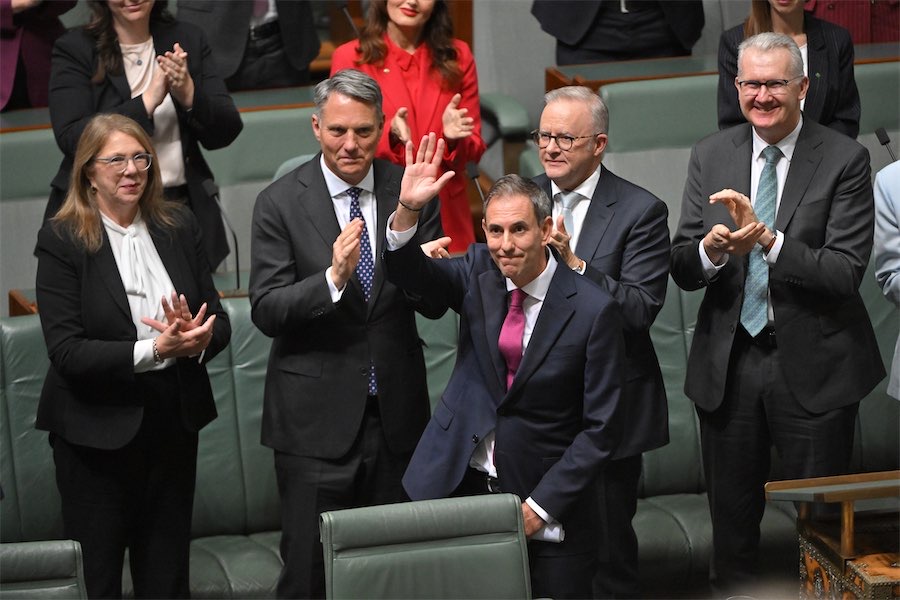
“Something struck me as I watched Jim Chalmers deliver his Budget speech… he failed to mention another type of intergenerational equity: government debt, which is now approaching $1 trillion,” writes political columnist ROBERT McMAHON.
Treasurer Jim Chalmers drew heavily on “intergenerational equity” to frame last Tuesday’s Budget – his fifth since Labor took office in 2022.

So relentless was his use of this term or slight variations that a quantitative data review shows he used it 10 times in his Budget speech and supporting papers, and a staggering 104 times since the beginning of 2026 in the lead-up to Budget night.
The frequency of these references is such that one might ponder whether, in addition to his doctoral research on Paul Keating’s political leadership, the treasurer might also have studied 19th-century marketing theory – particularly its emphasis on message repetition!
If anyone missed that this Budget was about “intergenerational equity”, they were surely living under a rock.
This narrative underpinned the government justifying breaking previous promises to the electorate – made in both 2022 and 2025 elections – to not modify Capital Gains Tax or negative gearing tax breaks for non-business investors.
Now, through the lens of intergenerational equity, these tax breaks are now cast as unacceptably unfair to young Australians doing it tough, whose tax contributions are, in part, subsidising them.
While there is nothing to suggest that this intergenerational inequity has worsened in the year since Anthony Albanese and Jim Chalmers both promised a re-elected Labor government would not change CGT or negative gearing, debate can reasonably be had about whether these breaks – concessions, as economists call them – advantage those on higher incomes disproportionately.
While it’s true such tax breaks aren’t triggered until a taxpayer hits incomes that attract higher taxes, it’s equally true these breaks can distort investment decisions across the economy.
But something struck me as I watched Jim Chalmers deliver his Budget speech. While he justified the removal of these tax breaks on grounds of re-balancing the economic opportunities of older, more successful generations (think Boomers and Gen X) against those of younger and future cohorts (Millennials and Gen Z), he failed to mention another type of intergenerational equity: government debt.
Government debt is now approaching $1 trillion. That’s 1000 billion dollars. Or, for more numerally-minded readers, $1,000,000,000,000. Have you ever seen so many zeroes? It’s almost like a child got to their parent’s calculator and kept pressing the zero button. But it is such a large figure that most modern calculators cannot even display it. Yet, we owe it. Each and every one of us.
It is unthinkable that, in the two decades since net government debt was eliminated in the final years of the Howard government, it has crept up again under successive governments – rising during the GFC stimulus of the Rudd years, surging with pandemic-era subsidies under the Morrison government, and escalating further since 2022 under the Albanese government, particularly on social programs.
As a percentage of GDP, net government debt has gone from zero to around 35 per cent in the space of just 20 years.
To make matters even more stark, this figure does not take into account what’s called off-budget debt. It is a relatively new phenomenon – or perhaps just more popular with governments in recent years – used by the federal government to finance the NBN, renewables infrastructure conversion, manufacturing subsidies and housing funds.
Including the NBN, it now exceeds $100 billion; although it is extremely difficult to get clear information about the size of these funds and their debt (which I rather suppose is one of the attractions to the government in using them).
Just like our home loans – or what might be a more fitting analogy, credit cards – these borrowings have to be re-paid. With interest. And so, Australian governments across the board are now dedicating massive amounts of their annual expenditure to servicing past debt.
In our little jurisdiction of the ACT, former chief minister Jon Stanhope and treasury official Khalid Ahmed have detailed in these pages in recent weeks that this debt servicing is now approaching 10 per cent of the entire annual ACT budget. Every year. And growing year on year.
But this is only likely to get worse. Because governments are evincing no sudden spike in fiscal rectitude and citizens no reduced expectation for government services. And so, spending will climb and debt to fund it. To be re-paid by future generations in future high taxes and reduced services.
So when the treasurer opines about “intergenerational equity”, it would be useful for him to also fess up to the intergenerational debt inequity he and other politicians are bequeathing to young Australians – and those not even yet born. And that strikes me as less an inequity than a profound travesty.
Dr Robert McMahon PSM is a visiting fellow at the Australian National University, adjunct professor at the University of Canberra, and former assistant secretary of the Department of the Prime Minister and Cabinet.
News all day, every day at CityNewsQBN.com.au.




Leave a Reply