By Helen Musa
The fascination with all-things Jane Austen continues unabated as Canberrans look forward to at least two Austen-inspired shows this year.
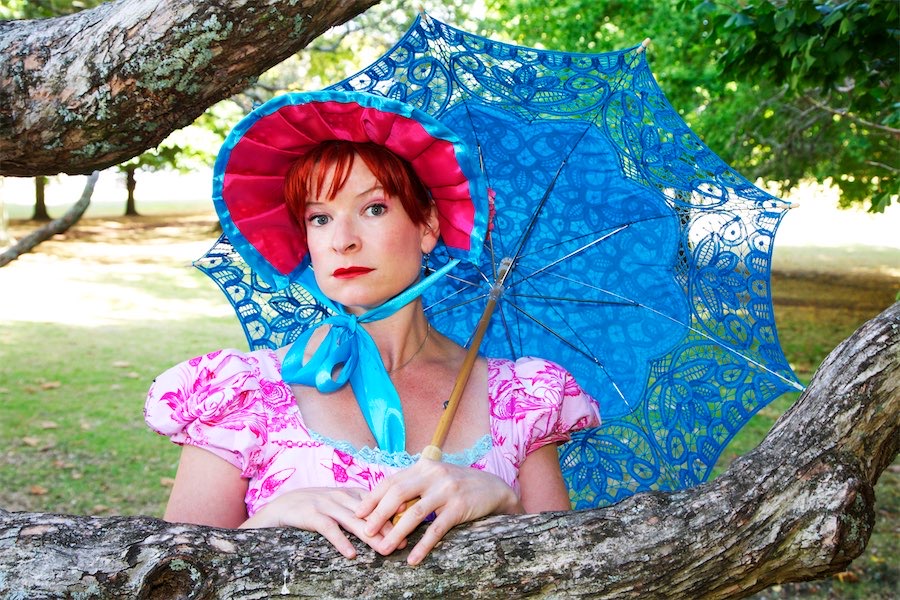
The first is the solo musical, Promise and Promiscuity, described by the Irish Times as “a posthumous collaboration with Jane Austen”.
The show is the brainchild of actor Penny Ashton, who has represented NZ in Theatresports and Performance Poetry and has performed by invitation at The Glastonbury Festival and Jane Austen Festival in Bath.
Ashton can claim to be the fifth great-niece – via her Australian mother – of Thomas Langlois Lefroy, Austen’s youthful flirtation and the man often said to have inspired Mr Darcy, a subject canvassed in Jon Spence’s biography and the film, Becoming Jane Austen.
As well as performing the show, Ashton will give a talk at The Street Theatre titled How I’m Related to Mr Darcy, in which she predicts she will rail against Austen being dismissed as “silly women’s stuff”.
On the contrary, Ashton argues, Austen was a proto-feminist literary star who invented a new style of narrative and remains hugely engaging and sharply satirical.
When I catch up with Penny Ashton via WhatsApp in Auckland, I discover she has now performed the show more than 600 times. The last time she brought it to Canberra, every performance sold out – and The Street Theatre is already advertising extra shows.
Ashton weaves classic songs, including Greensleeves, into the production, accompanying herself on the ukulele. She also dons semi-historical costumes involving corsets and a bonnet she made herself with a hot-glue gun – a prop, she notes proudly, that has “stood the distance”.
A comedian by inclination with a love of literary themes, Ashton has also created a Charles Dickens show and a comedy poetry performance which, she says with understatement, “does not sell as well as Jane Austen”.
“I did well in English at school and started an English degree,” she says. “But I had a horrendously boring lecturer, so I swapped to drama and Classics, and ended up with a Classics degree.”
Researching Jane Austen’s life proved so fascinating that when somebody suggested she turn it into an improvised show in 2008, Ashton jumped at the chance.
“It was so much fun, and it sold out,” she says. “So then I wrote the solo show initially to be a bit silly – a bit of a nudge-nudge, wink-wink.”
“As the title suggests, it’s a little bit saucy and full of Jane Austen quotes invested with double entendre.”
When I ask Ashton what she means by describing Austen as a proto-feminist, she explains that Austen negotiated her own publication terms at a time when women could not openly publish under their own names because it was considered unseemly for a gentlewoman. Austen’s gravestone, she points out, does not even mention her novels.
“People say silly things about Jane Austen, but I say she wrote about the world she knew,” Ashton says. “She did it for the women who had no agency in her world, where all people cared about was getting married. It was the only thing that gave women freedom.”
But, Ashton adds, Austen made it funny.
The search for love at the heart of many Austen novels is also what keeps them relevant today.
On the whole, Ashton says Austen avoids politics. But she admired the abolitionist William Wilberforce and loved the radical poet William Cowper.
Ashton is particularly knowledgeable about Austen’s struggles with publishers over her Gothic novel Northanger Abbey, the rights to which Austen eventually bought back herself.
Austen never married, though she did flirt with Ashton’s ancestor, Thomas Langlois Lefroy, even if nothing ultimately came of it.
Austen’s sister, Cassandra Austen, meanwhile, was once engaged, but her fiancé died of yellow fever. Ashton says Cassandra devoted her life to caring for their mother so that Austen could write.
“If not for Cassandra, we might not have had the books.”
In the show, the heroine Elspeth writes novels under a male pseudonym while encountering characters resembling Mr Bingley, Mr Darcy, Lady Catherine de Bourgh and Mr Collins.
But there were limits. Austen’s world still observes rigid moral standards, where the principle that “a fallen woman can never stand again” is constantly reinforced.
“That’s the world she lived in. That moral ridiculousness reflects the society she grew up in,” Ashton says.
“She was indeed a very exemplary gentlewoman.”
Promise and Promiscuity: A New Musical by Jane Austen and Penny Ashton, Street Two, May 23-24.
News all day, every day at CityNewsQBN.com.au.


Leave a Reply