It’s 2031 and humans no longer remain on earth. Amid the debris, tiny Lego people are creating a new society, building new homes inside the waste left behind. That’s the premise of a record-breaking, new exhibition, reports HELEN MUSA.
It’s hard enough to imagine a world without Lego, that remarkable building system invented by a Danish toymaker in the 1930s.
But what if, in the future, Lego was pretty well the only cultural artefact left behind?
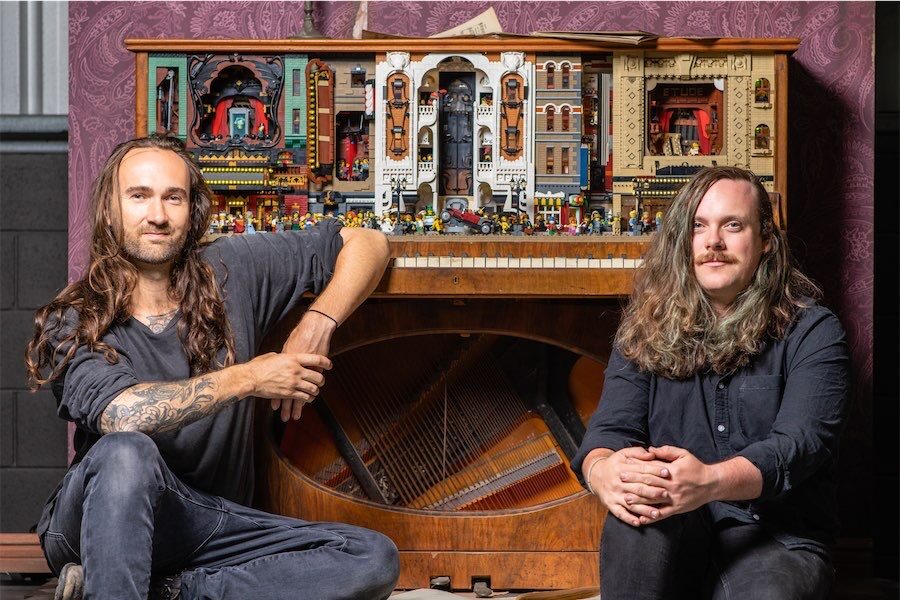
That’s the scenario dreamt up by creative directors Alex Towler and Jackson Harvey for Relics: A New World Rises, a record-breaking exhibition already seen by more than half a million people across Australia and NZ, and now, after Canberra, bound for the US.
In their world, the year is 2031 and, for reasons unexplained, humans no longer remain on earth. Amid the debris of a destroyed civilisation, tiny Lego people are creating a new society, living among the relics of the old world and building new homes inside the waste left behind.
When I catch up with Towler and Harvey, old high school friends from Perth, 15 miniature worlds are beginning to emerge from apparent chaos.
Towler later became an environmental engineer, while Harvey pursued a career as a mural and tattoo artist. Together, with a team of artisans, they have transformed thousands of Lego pieces, wires, cords and discarded objects into intricate civilisations.
They are keen to stress that while they have spoken with Lego, there is no formal arrangement with the company. Lego does not sponsor, authorise or endorse the exhibition.
After being crowned Lego Masters Australia champions in 2020, they found themselves with a platform from which to conceive an exhibition that has become their full-time occupation for the past five years. This year they returned to win Lego Masters Australia: Bricktacular.
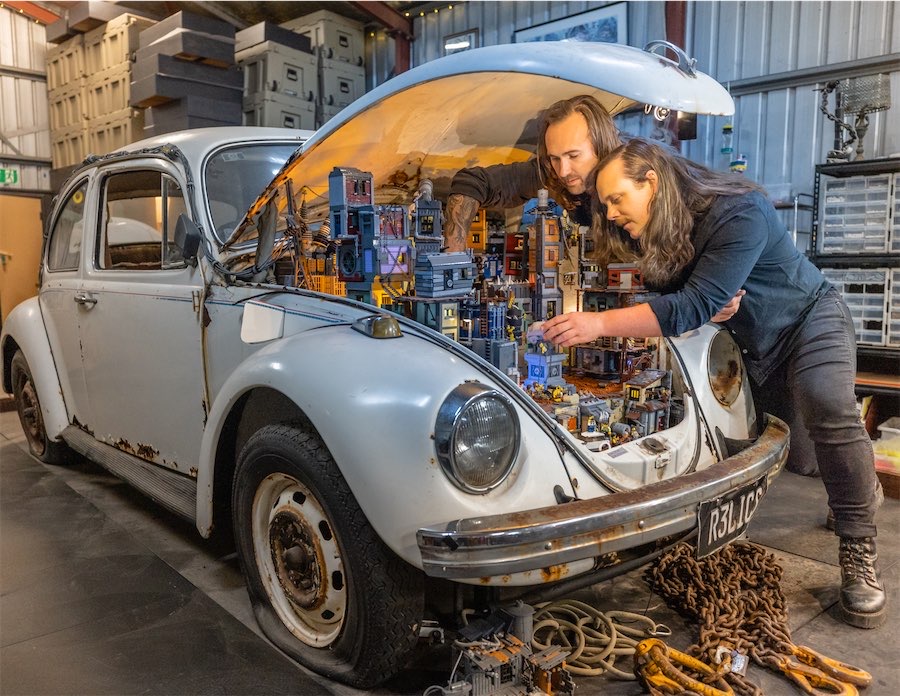
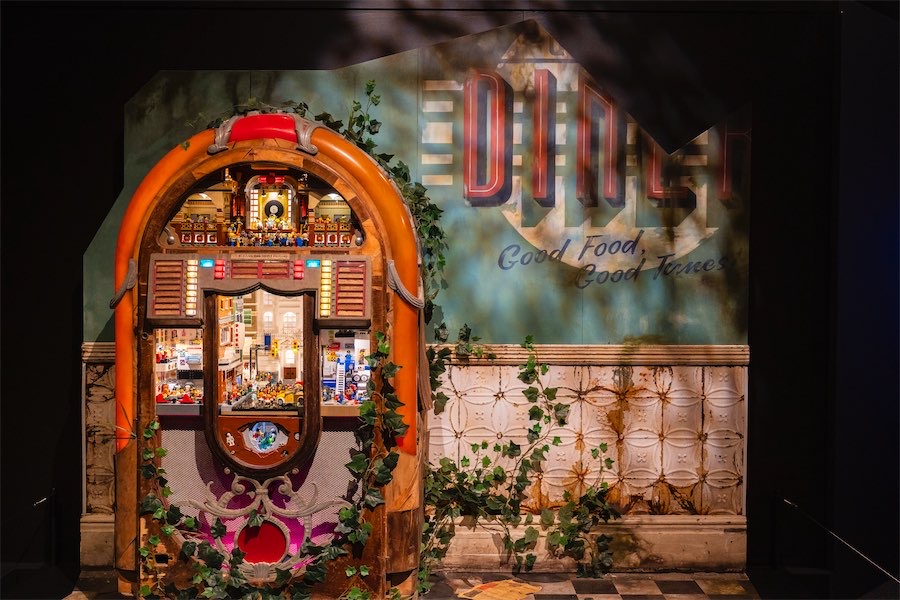
Both declare a special fondness for a repurposed jukebox, although another crowd favourite is an old Volkswagen Beetle. Their pride and joy, however, is the 1945 Wurlitzer jukebox, discovered in Perth when an elderly German man was clearing out his garage.
The appeal of Relics is almost universal because Lego itself has become a universal cultural phenomenon.
The word, invented by founder Ole Kirk Kristiansen, comes from the Danish phrase leg godt – “play well”. What began as wooden toys in the 1930s evolved into plastic bricks in the 1950s and has since become part of global culture.
Its longevity is part of the appeal.
“The family-owned connecting mechanism hasn’t changed in 70 years,” they say. “You can fit old and new parts together; people pass Lego down to their kids.”
“You can keep putting it together and making something different,” Towler adds.
Both men were Lego fanatics as children but drifted away during what they jokingly call “the dark ages when you don’t play”. Fortunately, most people return to it eventually, as the success of the exhibition demonstrates.
Each of the 15 installations represents a Lego civilisation informed by the object chosen.
Among them is a refrigerator transformed into a cryogenic facility, an arcade machine reimagined as an intergalactic space station, a piano inhabited by an opera singer and the magician The Great Linguini, an abandoned jet ski housing the Flamingo Links Golf Course.
Many of the installations carry environmental messages. The VW Beetle, Harvey admits, is still fuelled by oil drawn from a rapidly depleting nearby oil tank.
The jukebox, however, is simply for fun. Inside the Super Deluxe 1945 Wurlitzer are a diner and a ballroom.
Another popular attraction is a bank of old television sets that prompt visitors to identify the first TV they remember from childhood.
“It’s fun for everybody,” they say. Many visitors spend three or four hours exploring the exhibition and there are plenty of repeat visits.
“Every piece is authentic,” Harvey says, revealing that even the tiny Lego newspapers on display come directly from Lego’s vast catalogue, which today offers a colour palette far removed from the primary colours many of us remember.
Some of the ideas are wonderfully eccentric. Cathode Studios, housed inside an old television set, screens unexpected films starring “Lint Eastwood Westwood” and “Queen McSteve”, with Lego figures animated using stop-motion techniques.
A 300-year-old grandfather clock becomes a time machine, while a historic bookcase provides the setting for piratical adventures and medieval tales.
And, yes, there is a place where visitors can get their hands on Lego themselves. Conceived for children, it is likely to attract just as many adults.
“The objects themselves are full of nostalgia,” Towler says, “and the stories we’re telling have a lot of references that only adults will understand.”
The accompanying Relics Design Competition asks entrants to create a miniature brick civilisation inside an everyday, used or second-hand object inspired by Canberra and the surrounding region.
Relics: A New World Rises, Canberra Museum and Gallery, until January 31.
News all day, every day at CityNewsQBN.com.au.


Leave a Reply