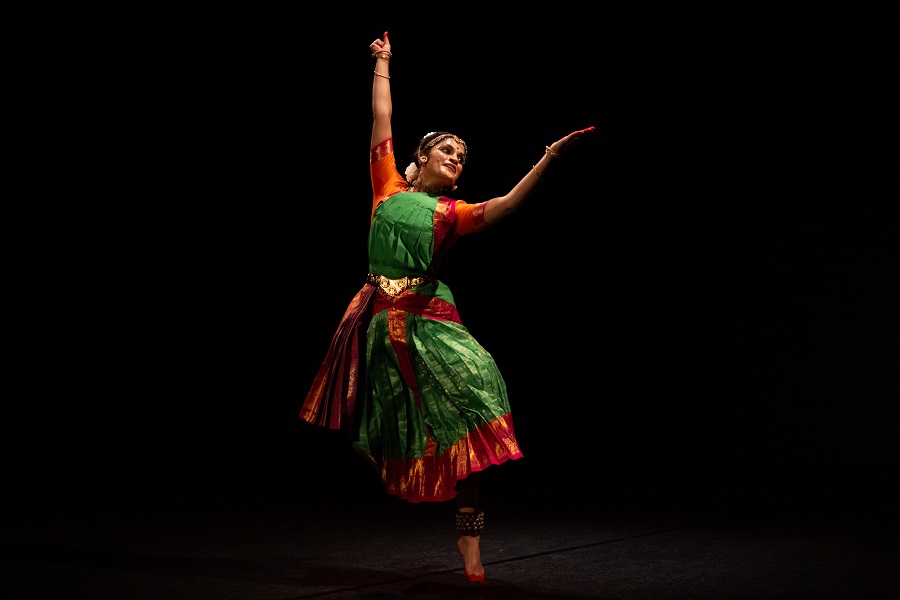
Dance / Smaranam – Memory Embodied, by Vaidehi Subramanyan. Quantum Leap Theatre, November 15. Reviewed by HELEN MUSA
A combined reflection on motherhood and the joy of dance was the basis of Vaidehi Subramanyan’s performance for The BOLD Festival on Sunday.
With its exquisite refinement and extraordinary athleticism, bharatanatyam is the classical ballet of Indian dance, although its character is quite different from ballet, and its intent is devotional.
Dancer Vaidehi Subramanyan, returning to her practice after giving birth to her now one-year-old son, who was in the audience, attracted an audience of aficionados alert to every nuance of the more virtuosic movements in her dance.
The granddaughter of the formidable Thangamani Nagarajan, a dancer and teacher at the renowned school of art Kalakshetra in Chennai, Vaidehi described how she grew up with a sense of having been born with the seeds of dance within her.
Her opening Varnam, Rupamu Juchi, was a very demanding piece, a kind of dialogue between the dancer as supplicant and the deity with whom she seeks union, expressed through a mixture of pure dance and storytelling.
This called upon Vaidehi’s expressive skills, or Abhinaya, as she traversed the emotions of pleading, personal defiance and sheer pleasure in dance. One of the joys of Indian dance is the note of self-appreciation that comes from executing a beautiful movement.
Most of the time, her feet were firmly attached to the ground, with sharp, angular movements interspersed with graceful, downward-sloping arm movements. But there were off-the-ground points when she displayed the athleticism mentioned earlier, prompting applause from the obviously well-educated audience.
Of special interest was the fact that the sollukattu, or rhythmic vocalisations accompanying the more difficult passages, came from a recording of Vaidehi’s late grandmother’s voice.
The second, shorter piece, Jagadodharana, was a padam involving more drama, or Natya. Appropriately enough, given the dancer’s own life, it depicted Yashoda, the mother of baby Krishna, playing with her child, totally unaware that he is the supreme saviour of the universe.
Here Vaidehi achieved a convincing level of characterisation, transitioning rapidly between mother, naughty child and deity, with her very precise hand movements, or mudras, adding another level to the language of the narrative.
Finally, she performed Nach Rahe Gori, set to a rhythmic Thillana, the traditional fast-paced conclusion to a bharatanatyam performance. This was a short, joyous piece, proving, as the dancer herself said, that she had done the right thing in returning to dance.
News all day, every day at CityNewsQBN.com.au.



Leave a Reply