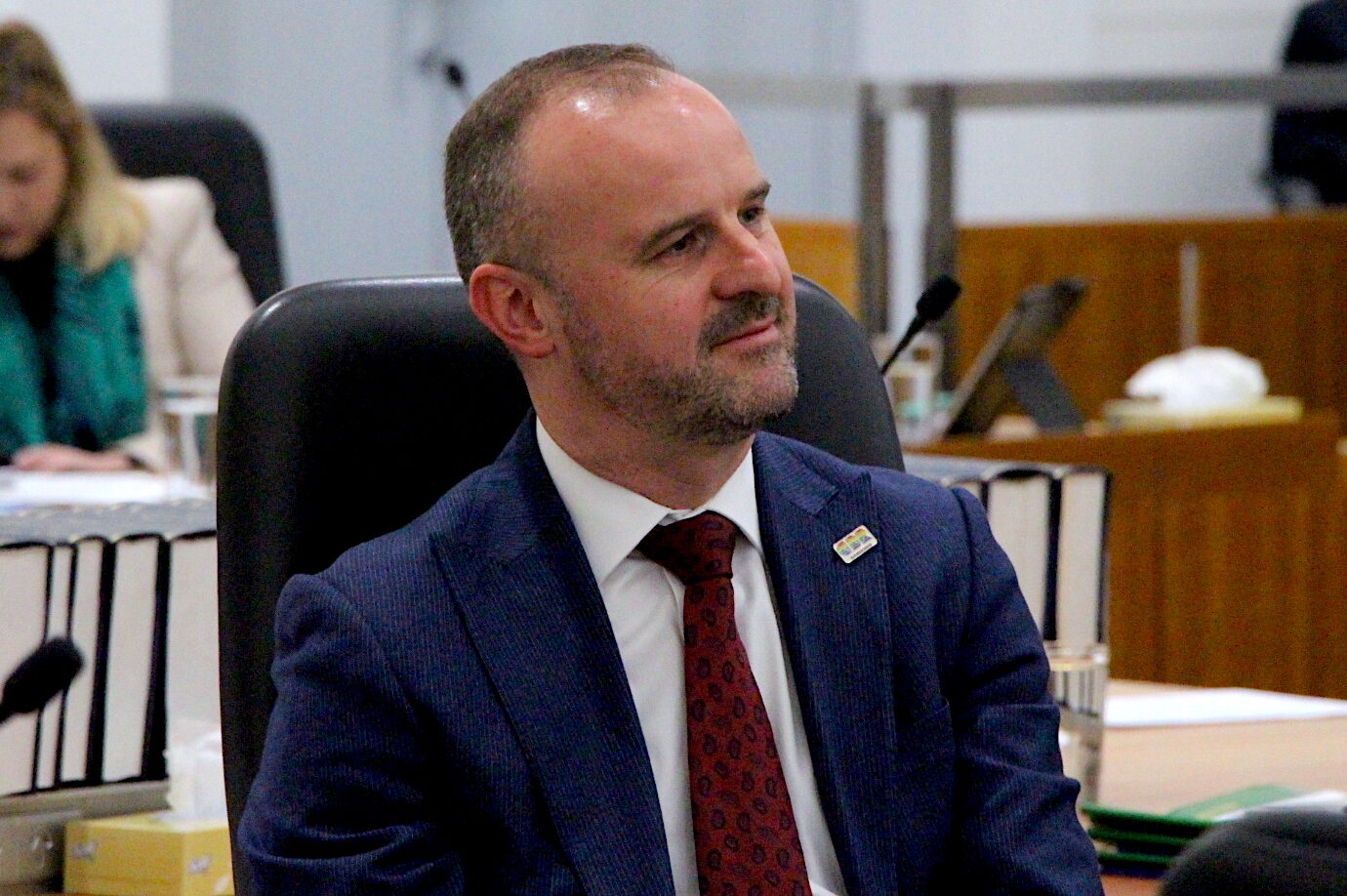
Andrew Barr… the chief minister’s response was described as “a stretch”. Photo: Danielle Nohra
“The ACT Government ‘has never been influenced by the CFMEU’ was a recent statement made in answer to a question in the Legislative Assembly by Chief Minister Andrew Barr. It was received with guffaws across the chamber.
The expectation of the government’s response to the Kingfisher Report of the ACT Integrity Commission was that action would be taken to prevent such corruption in the future.
Michael Moore.
And yet, the influence of the CFMEU in the flawed decision-making has not been effectively addressed.
The immediate outcome of the Kingfisher Report was the demotion of then Deputy Chief Minister Yvette Berry to the back bench. Additionally, a head of the Education Directorate and a ministerial staffer who were named in the report are no longer ACT employees.
The ACT Government “has never been influenced by the CFMEU” was a recent statement made in answer to a question in the Legislative Assembly by Chief Minister Andrew Barr. It was received with guffaws across the chamber.
However, Mr Barr justified the statement to a reporter, arguing: “The fact that an organisation supports a policy does not establish that it caused the policy.
“ACT government decisions are made by elected representatives, informed by advice from the ACT public service, consultation, evidence, stakeholder engagement and consideration of the public interest.”
This flies in the face of the Integrity Commission’s Kingfisher Report. Had the decisions been made that way, Yvette Berry would still be the deputy chief minister.
The government argues it had already commenced making changes regarding integrity in response to an earlier Auditor-General report that had raised a series of questions regarding the tender for buildings at the Campbell Primary School.
Although there is some overlap with the Integrity Commission’s report into the same issue, there is much more to be done.
Opposition Leader Mark Parton described the chief minister’s response as “a stretch”.
He pointed out that one of the ministers remained a card-carrying member of the CFMEU and described the ACT Labor government as being “in damage control”. Two other ministers used their inaugural speeches to thank the CFMEU for its support.
“In a democracy,” argued Andrew Barr, “every stakeholder seeks to influence public policy. Business groups do it. The Property Council does it. The Master Builders Association does it. Community organisations do it. Environmental groups do it”.
Such influence needs to be managed with integrity.
The response to Kingfisher points to a series of steps being taken by the ACT bureaucracy to improve integrity in procurement processes. There has been a shot across the bows of the Labor government. Is it attempting to take some action or is it attempting window dressing?
The government’s response contended that the Memorandum of Understanding on Procurement of Works and Services by the ACT Government was agreed with UnionsACT in 2015, and has now been replaced with Secure Local Jobs Code.
The Secure Local Jobs Code, the government suggests, “provides a transparent and accountable framework to promote high standards of workplace safety, industrial relations compliance and ethical employment practices by employers engaged in ACT Government procurement.”
The CFMEU is one of seven organisations on the advisory council of the code, along with two other union representatives. There is a government appointee from Access Canberra along with two business representatives and the registrar, who is a non-voting chair. The Canberra Business Chamber and the Master Builders’ representatives can easily be outvoted.
The then secretary of the CFMEU’s ACT branch, took credit for the introduction of the code in a members’ magazine in November 2019.
He wrote: “This code – fought for and won by our unions – has successfully utilised the government’s procurement powers to protect the rights of workers and their unions, and continues to be a huge success across the construction industry.”
The government response to the Integrity Commission relies largely on reforms since 2022 along with the introduction of a review of the Legislative Assembly (Members’ Staff) Code of Conduct for Ministerial Staff and Staff of Other Office-holders Determination 2015. This part of the review is to test if this code of conduct remains fit for purpose.
There are other platitudes and more reviews. It seems the government sees these as actions.
“Creating a pro-integrity culture is an ongoing work program for the ACT Public Service” and later includes a review of “whole-of-government policies to ensure they are contemporary and consider matters raised in the Operation Kingfisher Report”.
Platitudes and reviews are a first step – they don’t stop corruption.
Michael Moore is a former member of the ACT Legislative Assembly and an independent minister for health. He has been a political columnist with “CityNews” since 2006.
"Walk into a waiting room in a Canberra emergency department and ask the patients whether the doctors or nurses treating them were inefficient." JON STANHOPE & KHALID AHMED look at where they think Saul Eslake's report misses the target.
"The apparent convergence between Shoebridge and Trump is striking because their political philosophies are so dissimilar. Yet, both risk reducing pressure on Moscow while placing additional burdens on Ukraine," writes ROBERT McMAHON.
Anthony Albanese’s offer of an extra staffer to One Nation’s David Farley has sparked accusations of political interference and renewed scrutiny of the prime minister’s staffing powers, writes political columnist MICHELLE GRATTAN





Leave a Reply