Emerson’s selectively retelling campaign’s history
ACT election 2016… “The casino decision was the final straw in a broader dispute. Reducing that history to clubs protecting poker-machine revenue suits Mr Emerson’s narrative, but does not fairly describe the campaign I ran,” writes Gwyn Rees.
“Unions are entitled to defend their members, oppose policies and campaign for a sympathetic government. Industry associations perform a comparable function. Calling their advocacy ‘self-serving’ tells us little,” writes GWYN REES in reply to MLA Thomas Emerson’s proposal to prohibit political contributions from the gambling industry.
Independent MLA Thomas Emerson’s proposal to prohibit political contributions from the gambling industry raises a larger democratic question than whether people approve of gambling.
Gwyn Rees.
Institutional political spending may create a risk, or perception, of undue influence.
But spending money to advocate for an organisation’s interests does not, by itself, establish impropriety. Every union, industry association and advocacy group entering an election campaign is attempting to influence public opinion and government policy.
Mr Emerson has described the community clubs’ campaign I ran in 2016 as “weaponised”, “self-serving” and a “targeted personal attack” on Chief Minister Andrew Barr.
ClubsACT sought to influence voters, change policy and contribute to a change of government. That was the stated purpose. Seeking political influence is not the same as exercising undue influence.
His account is selective. He lifts the casino dispute and the campaign’s strongest political language, while giving little attention to what we actually said about the cumulative burden of taxes, fees and charges. Those concerns were on the public record before the campaign. Clubs were maintaining sporting grounds and community facilities while facing rising commercial rates, liquor licence fees, water charges and other costs.
Plenty of Canberra business operators in 2026 will recognise those pressures. Some might also be looking to their representative bodies to do something beyond attending more meetings or writing more submissions to government.
The casino decision was the final straw in a broader dispute. Reducing that history to clubs protecting poker-machine revenue suits Mr Emerson’s narrative, but does not fairly describe the campaign I ran. Subsequent club closures deserve examination alongside those costs. Gambling revenue does not guarantee financial security.
The less examined part of the 2016 story is the scale of union participation, another part missing from Mr Emerson’s account.
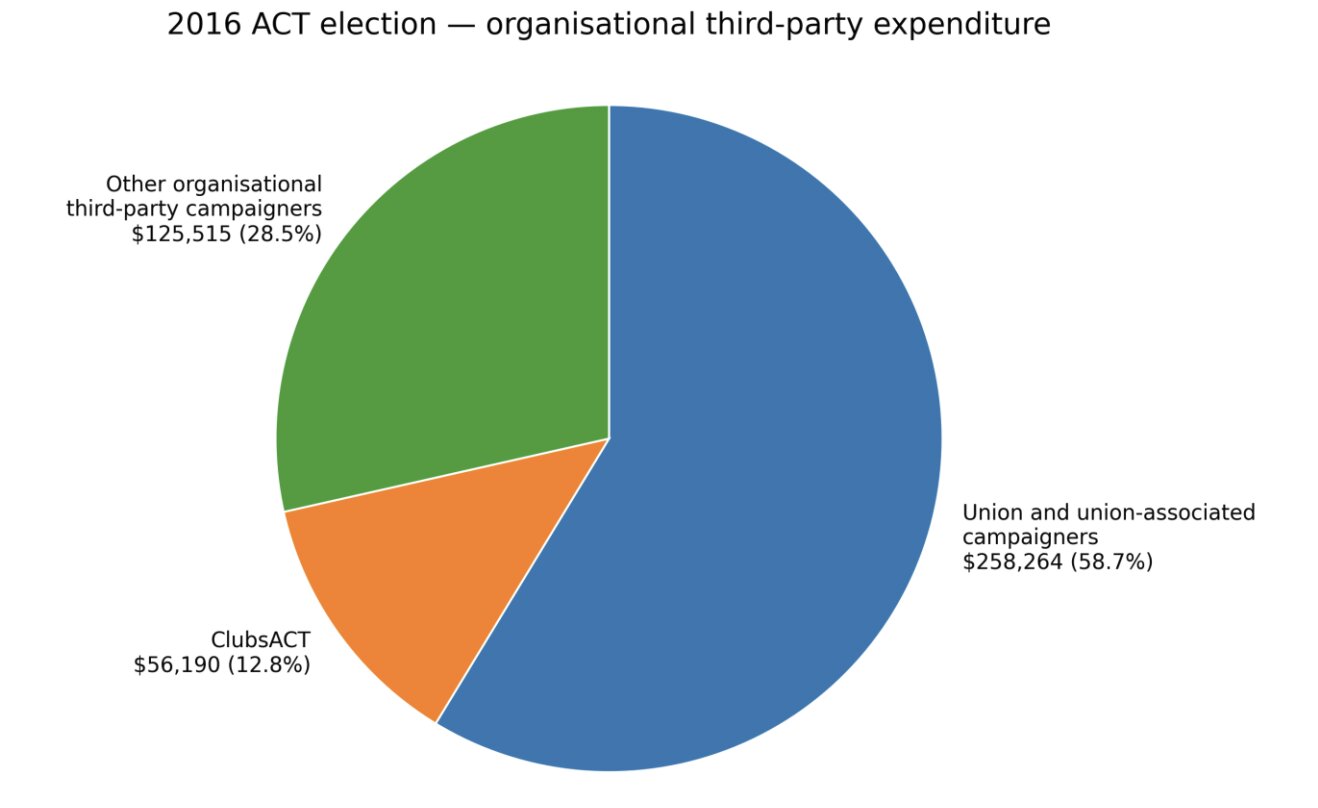
My analysis of Elections ACT returns identified nine union or union-associated third-party campaigners reporting about $258,000 in electoral expenditure.
That represented almost 60 per cent of the organisational third-party expenditure identified in those returns, and about 4.6 times ClubsACT’s own reported expenditure of about $56,000.
ClubsACT also contributed $195,000 to Canberra Community Voters. That was a contribution to a separate political party, rather than ClubsACT’s own third-party campaign expenditure.
Separately, ACT Labor disclosed at least $542,000 in union receipts, monetary gifts and in-kind support across the financial years from 2012-13 to 2016-17. That is a five-year figure, covering the lead-up to and immediate aftermath of the 2016 election.
That reporting period also covered the ACT Government’s much-discussed 2015 memorandum of understanding with UnionsACT, which provided for sharing government tenderer lists with unions.
When Mr Barr claimed in Assembly Question Time last month that the CFMEU had no influence on his government, laughter erupted, fuelled by the pure nonsense of the claim.
None of that, by itself, establishes undue influence. But it makes Mr Emerson’s selective focus harder to defend. If contributions, access and formal agreements warrant examination, apply that examination consistently.
Unions are entitled to defend their members, oppose policies and campaign for a sympathetic government. Industry associations perform a comparable function. Calling their advocacy “self-serving” tells us little. Representing members’ interests is what these organisations exist to do.
The law may distinguish between organisations presenting different risks. Parliament need not wait for corruption before acting but the distinction should rest on evidence and a consistently applicable test, rather than political approval of one participant and disapproval of another.
Canada provides a useful comparison. Federally, corporations, unions and associations cannot contribute directly to parties or candidates. Contributions are restricted to eligible individuals, subject to limits. This does not prohibit all organisational campaigning; donations and independent campaign expenditure are different things.
The ACT does not have to adopt that model but its relevance is that the donation rule applies across institutions. Gambling harm justifies regulating gambling; it does not, by itself, establish that a club’s political contribution creates a greater risk of improper influence than a union’s.
If Mr Emerson’s argument is that gambling money compromises political decisions, he needs to explain why the same concern does not extend to other organisations funding politicians who make decisions affecting their interests.
If institutional contributions create an unacceptable risk, make the case for a neutral rule.
Political spending warrants transparency and scrutiny. Having been through the scrutiny of the 2016 campaign, I can assure readers it was examined. But seeking to change policy, or the government itself, does not establish that policy was purchased or an improper relationship existed.
I have set out the campaign’s history and supporting records in my personal submission to the Assembly’s inquiry into the Electoral (Gambling Industry) Amendment Bill 2026, published as Submission 021.
Democracy is not strengthened by selectively retelling a campaign’s history to justify excluding its participants. If political influence is the concern, apply the rules equally.
"The notion that anyone in an ODPP would not only ignore their own media guidelines but single out a sitting judge for a concocted false story beggared belief two years ago." And the saga rolls on without resolution, reports HUGH SELBY.
DAVID TURNBULL marks former ACT politician Michael Moore's 20th anniversary as a CityNews political columnist with this remarkable profile. If you think you know Michael Moore… you don't.






Leave a Reply