By Farid Farid
A stencil artist has called out the “mindless destruction” of a commonwealth cemetery in Gaza where the graves of Australian soldiers were desecrated.
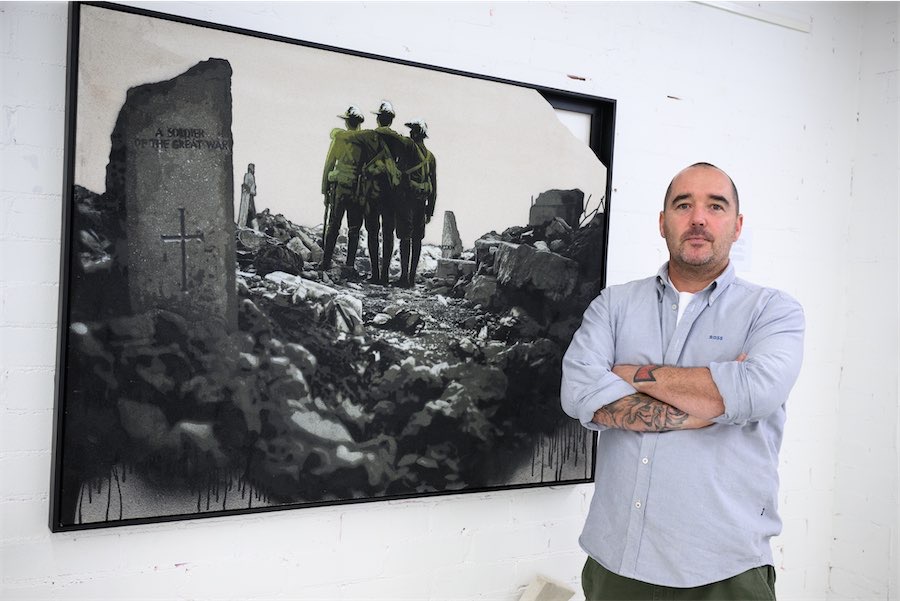
Former Canberran Luke Cornish won the $20,000 Gallipoli Art Prize on Wednesday for his canvas No Rest (The Vandalism of Deir al-Balah) pointing to Israeli forces destroying nearly 150 out of 263 graves in its protracted bombing campaign.
More than 72,000 Palestinians have been killed including more than 20,000 children in a sustained retaliatory assault, after the October 7 Hamas attack on Israel where 1200 were killed and 250 hostages captured.
“The whole embodiment of the Anzac spirit is to stand up for your mates, stand up for the people who can’t stand up for themselves – whether that’s a bunch of dead guys in a cemetery or a population of Palestinians,” he told AAP.
“If we call out our own war criminals, we should be calling our war crimes across the board and destroying a war cemetery is the least Israel has done.”
His great-uncle Alfred Cook of the Australian Light Horse Regiment was buried in Deir al-Balah after his death in World War I aged 21.
Using traditional composite techniques, the artwork is painted on board and then rendered with acrylic cement to give the appearance of sandstone to replicate headstones.
Black dripping paint at the edges, a core element of graffiti culture, drives the point home that they have been vandalised in act of “mindless destruction”, Cornish said.
“The destruction of a war cemetery is more than damage to stone and soil. It is a violation of memory,” the 47-year-old said.
“When the resting place of the dead is disturbed, it unsettles the living as well. It tells us even in death there is no refuge from violence.”
Anthony Albanese raised the destruction of the graves during Israeli president Isaac Herzog’s visit in February, which he pledged to investigate.
Asked about fears of a backlash after other Australian artists and authors have been cancelled for explicit criticisms of Israel, Cornish said creative producers cannot and should not be silenced.
“We should be encouraging dialogue, not shutting it down or else we end up with fascism,” he said.
Cornish also won the prestigious prize in 2024 with an artwork entitled The Pity of War, depicting a woman and a hooded figure huddled together wearing gas masks.
His works have been exhibited at the National Portrait Gallery and the Australian War Memorial.
News all day, every day at CityNewsQBN.com.au.




Leave a Reply