
“The bushland ring surrounding Parliament House was a central element of the original design… Any substantial intrusion into this perimeter warrants careful public examination”. GEORGE WILSON has concerns about the tram route to Woden.
The “dog-leg” alignment on the eastern side of Parliament House has dominated debate around the proposed Light Rail Stage 2B route, particularly in relation to tunnelling and its approach to the parliamentary precinct.
However, this focus has tended to obscure potentially significant impacts on the western side of the precinct, including the nationally significant bushland perimeter surrounding Parliament House.
The Deakin Residents Association (DRA) recently led a public walking tour around State Circle and Parliament House to examine the route on the ground and highlight aspects of the proposal that, in our view, have received insufficient public scrutiny.
Participants were struck by the extent of native vegetation that could be affected, and by the scale of bridge and engineering works likely to be required beneath Federation Mall and across State Circle. Many commented that they had not previously understood the full scope of the proposal until seeing the site firsthand.
The DRA’s concerns include:
- Impacts on the heritage and environmental values of the parliamentary precinct.
- Damage to the circular bushland perimeter that is a defining feature of the original award-winning Parliament House design.
- Additional traffic lights at the top of Adelaide Avenue and on State Circle, with consequent increases in travel delays.
- Major construction disruption in one of Canberra’s most important national landscapes.
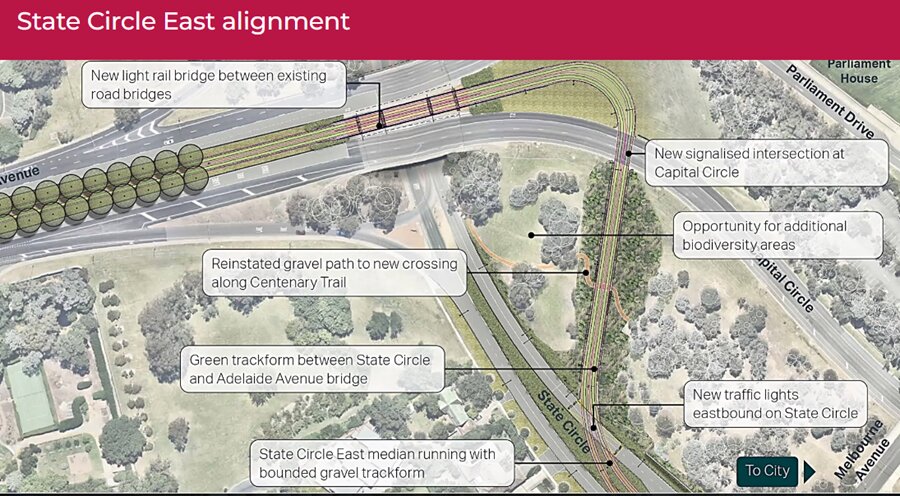
Recent ACT Government statements have added to these concerns. In particular, we question references to proposals for “an inner-running track between Sydney and Adelaide Avenues to keep light rail off median strips” and whether this implies construction through the bushland perimeter itself.
The parliamentary landscape was not accidental. The bushland ring surrounding Parliament House was a central element of the original design concept, intended to visually connect Capital Hill with the surrounding landscape and frame the national institutions within a natural setting. Any substantial intrusion into this perimeter warrants careful public examination.
The financial implications are also becoming harder to ignore. Stage 2B may ultimately cost in the order of $5 billion or more, driven by tunnelling, bridge reconstruction, a crossing of Lake Burley Griffin, and extensive modifications to existing infrastructure.
This is very different from Stage 1, which was largely constructed on flat ground with limited bridge works. Stage 2A alone is already approaching $1 billion. Each extension beyond Commonwealth Park becomes progressively more complex and expensive.
Supporters of the project argue that Adelaide Avenue could evolve into a high-density corridor similar to Northbourne Avenue or Flemington Road. However, Adelaide Avenue is fundamentally different. It is a six-lane arterial road without traffic lights, bordered by embassies, schools, established institutions, protected open space and The Lodge.
Unlike Northbourne Avenue, there are limited opportunities for redevelopment and only a small number of proposed stops servicing Deakin and Yarralumla.
The DRA strongly supports improved public transport and active travel infrastructure. However, we believe Canberra residents deserve a clearer understanding of the costs, impacts and alternatives before irreversible decisions are made affecting the parliamentary precinct.
The 2024 report 21st Century Public Transport Solutions for Canberra (available on the DRA website) examined a range of alternatives and questioned whether current technologies and travel patterns justify the scale and cost of Stage 2B
It also raised concerns about long-term ACT Government debt and whether emerging transport technologies – including on-demand autonomous vehicles – may provide more flexible and cost-effective solutions.
Many participants in the walk commented that they had not previously appreciated the likely impacts on the parliamentary landscape or the traffic implications for Adelaide Avenue and State Circle. Seeing the route on the ground was important.
In response to strong public interest, the DRA is planning further inspection walks and hopes federal and ACT politicians will attend. We would particularly welcome members of the Joint Standing Committee on the National Capital and External Territories, including Senator David Pocock and committee chair Alicia Payne MP. Senator Katy Gallagher and relevant ACT Ministers would also be welcome to inspect the site directly.
The committee has the capacity to inquire into matters affecting the Parliamentary Zone and amendments to the National Capital Plan. The DRA believes the proposed route and its impacts warrant such an inquiry.
If you are interested in encouraging the JSC to seek a mandate for an inquiry, or to participate in future walks, please register via the Deakin Residents Association website.
George Wilson AM is president of the Deakin Residents Association.
News all day, every day at CityNewsQBN.com.au.



Leave a Reply