
“To the end of December, expenses exceeded revenues by $736 million. That is, the ACT Government exceeded the full year deficit forecast of $681 million in a mere six months.” JON STANHOPE & KHALID AHMED reveal what the treasurer won’t.
Remember Treasurer Chris Steel trumpeting a $632 million turnaround in the budget in February?
His claim came after the 2025-26 Mid-Year Budget Review, and was based on the first two quarters’ results, ie, as at the end of December.
We wondered at the time whether this was an early April Fool’s joke perpetrated by, or perhaps even played on, the mainstream media.
As we noted at the time the government’s published document, revealed that the budget had in fact gone backwards by $101 million in just six months.
Data from the ABS to December 2025 is now available and it reveals that the outcome for the full year (2025-26) is likely to be worse than the government has forecast, in a repeat of its flawed forecast in the previous year.
The data we are referring to is from the ABS report on Government Finance Statistics released in March, which provides the results for the first two quarters of this financial year across all jurisdictions.
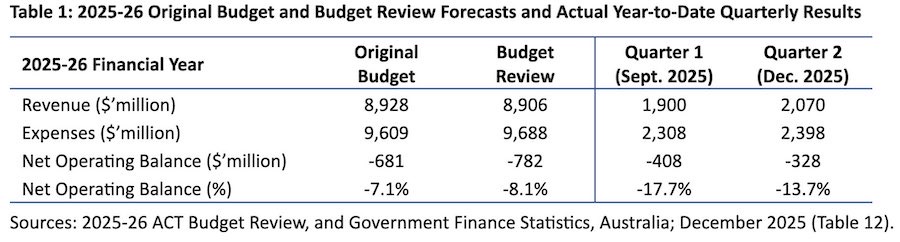
Table 1 details the forecasts of revenue, expenses and the Net Operating Balance (NOB) in the original ACT budget and the Budget Review update, and the quarterly year-to-date results for the September and December quarters of 2025.
The first two columns of figures (original Budget and Budget Review) were published in the 2025-26 Budget Review. The last two columns of quarterly results are from the ABS publication referenced above.
The ABS advises that the quarterly figures reported by jurisdictions are unaudited, and as such could be subject to changes once the full year audited results are compiled and reported in its annual publication.
The year-to-date figures are nevertheless relevant, and one is entitled to rely on their authenticity. They also, of course, form the basis of revisions to the full year forecasts as in the ACT Government’s Budget Review.
The table highlights that the government had posted a deficit of 17.7 per cent in the first quarter of 2025-26, and one of 13.7 per cent in the second quarter of the financial year.
Cumulative to the end of December 2025, expenses exceeded revenues by $736 million. In other words, the ACT Government exceeded the full year deficit forecast of $681 million in a mere six months.
Steel’s Budget Review increased the deficit forecast by $101 million to $782 million, under an implicit assumption that, having incurred a deficit of $736 million in the first six months of the year, he will contain the deficit in the remaining six months to just $46 million – an improvement of 94 per cent!
It is possible that the treasurer may achieve his forecast if he is able to collect around a billion dollars more in revenue in the second half of the year compared to the first half – which might, of course, occur if budgeted revenues come in late in the year.
Or, as we noted previously, if he can get a special dispensation from the Commonwealth to redirect federal health funding to budget repair – albeit short-changing health services. He could, in principle, also have greater control over spending in the second half of the year.
While all that is possible, it is more likely that we will see a repeat of the previous year. In 2024-25, the original budget forecast a deficit of $855 million. That forecast had been reached, in fact exceeded, in the first two quarters, to a deficit of $887 million.
A further $512 million was added to the deficit in the second half (January to June 2025), of the financial year, with the final deficit being a record $1.4 billion.
Based on this precedent, the ACT is very likely heading for another billion-dollar deficit.
As deficits became a norm for the ACT, the government has often argued that all jurisdictions’ budgets are in trouble, and that the ACT is in the same boat as others. This is a fallacy of false equivalence as we have previously highlighted through interjurisdictional comparisons.
There are indeed jurisdictions that are not performing well, however, the ACT remains an outlier as Chart 1 shows, which compares the first two quarter’s results for the ACT and the total state and local government sector.
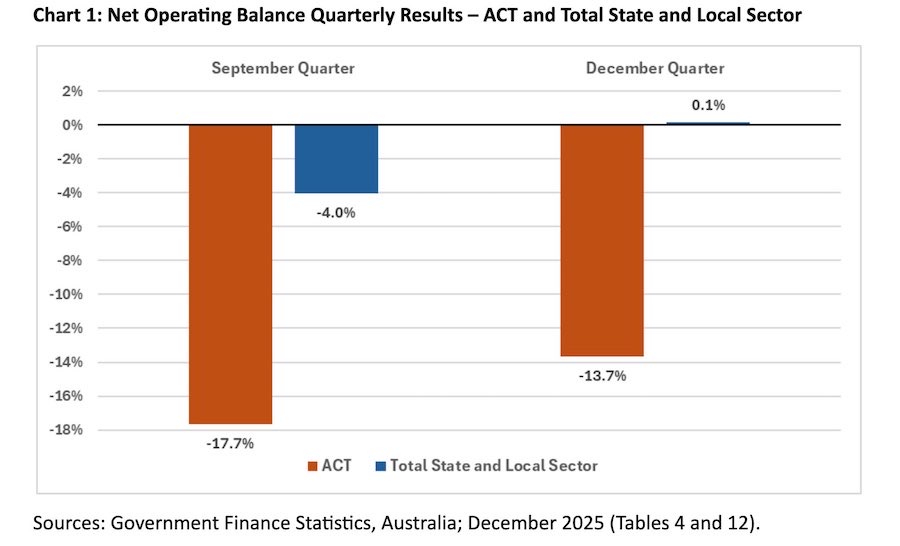
Across both quarters, the ACT’s deficit is about 14 per cent greater than the weighted average of all jurisdictions. In fact, in the December quarter, the total state and local sector is essentially in balance (0.1 per cent surplus), while the ACT posted a deficit of 13.7 per cent.
The rest of Australia, while in the same water, appears to be in a different boat.
Jon Stanhope is a former chief minister of the ACT and Dr Khalid Ahmed a former senior ACT Treasury official.
News all day, every day at CityNewsQBN.com.au.




Leave a Reply