This is why it matters when Albanese breaks his word
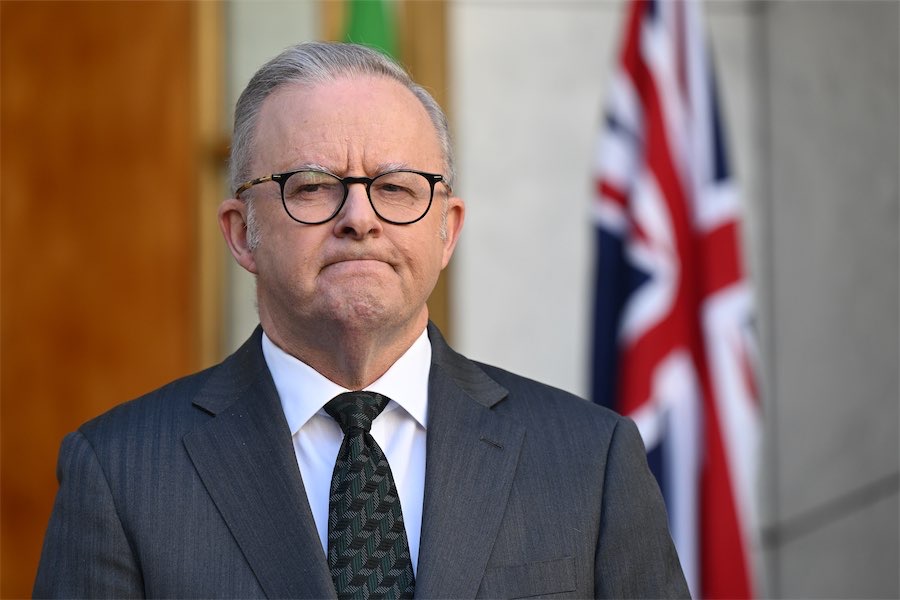
Prime Minister Anthony Albanese… “My word is my bond. I’ve always been a man of my word, and I believe that when you go to an election and you make commitments, you should stick to them.” Photo: Lukas Coch/AAP
“Put bluntly, our prime minister has wilfully and knowingly misled Australians about some of the most important aspects of their livelihoods – their investments and retirement savings”, writes political columnist ROBERT McMAHON.
“Trust me!” How often do we hear this term, exhorted to invite our confidence in circumstances ranging from the everyday banal to matters’ solemn?
Dr Robert McMahon.
On the one hand, it is a term deployed by salesmen with such casual airiness as to lack much credibility. On the other, we provide great trust to lawyers to protect our rights and to doctors to safeguard our health.
Because “trust” is contextual, framed by the relationship of the parties to the assurance and the importance of the issue at hand.
That’s why the prime minister’s recent broken promises to axe negative gearing for existing homes bought after Budget night and to increase capital gains tax may well deal a fatal blow to Australians’ trust in whatever promise he makes again.
Because, put bluntly, our prime minister has wilfully and knowingly misled Australians about some of the most important aspects of their livelihoods – their investments and retirement savings.
This harsh assessment is factually warranted because these promises, given before the 2022 election and again before the election last year, were uttered in unambiguous terms. And when asked whether he was considering breaking these commitments, the PM chided those who dared challenge the veracity of his assurances.
To justify my charge, let’s re-cap some history. On May 9 2025 – just before Australians cast their ballot last year delivering Labor a landslide victory – the following exchange took place between the PM and a journalist:
Journalist: PM, you bounced around answers on this question before. Can you just be really clear – can you rule out any changes to negative gearing and capital gains tax settings if re-elected?
PM: Yes. How hard is it? For the 50th time.
Scripture tells us Peter denied Christ thrice before the rooster crowed. St Peter surely had nothing on Prime Minister Albanese, who clocked up 47 more denials that a re-elected Labor government would not change negative gearing or increase CGT.
This also from the man who, on July 10 2022 on the Seven Network’s Spotlight program, solemnly and mistily-eyed assured voters:
“My word is my bond. I’ve always been a man of my word, and I believe that when you go to an election and you make commitments, you should stick to them.”
So, in good faith, people went on to make decisions affecting their livelihoods, their businesses and their investments based on his promises. Which he then broke.
And this is why the PM could now be in so much trouble.
Much of the noise since these promises were broken has inevitably gone to their effect on taxpayers’ investment arrangements, on entrepreneurial behaviour for new “start-up” ventures and on so-called “death tax” testamentary trusts.
While these are valid policy responses, something much larger is at play here. And that is now the prime minister’s inherent credibility and the impact it may have on his government for the remainder of this term and into the future.
Put simply, the prime minister has now created the very real risk that we can no longer believe promises and undertakings he makes. More broadly, this may undermine our confidence in him and his judgment – our trust in him.
Because this was not some flippant “trust me” exhortation by a 22-year old at Good Guys assuring that an air-fryer will cook chips crispily well; it was a promise from our prime minister – our national leader – on matters affecting Australians’ livelihoods and investments.
Yet, such broken promises may also be symptomatic of a gradual and continued decline of Australians’ trust in politics over the last 20 years, as demonstrated in ongoing academic research and surveys.
So when the prime minister so blatantly breaks his word to us, it not only affects our confidence in him, it may also undermine our confidence in broader democratic institutions.
It erodes the social compact between citizens and politicians – the understanding that when we elect leaders, we can trust them to do as they say. That we trust them to govern us. This is fundamental to the very tenets of democracy and the confidence with which we hold those institutions – and our precious role in them as voters.
The negative gearing and CGT broken promises may well shore up the federal Budget by acquiring extra revenue, but they may come at a very high price indeed; a high political price for the PM, but perhaps a bigger civic price for us as citizens in the exacerbated fracturing of our confidence in our political institutions now and into the future.
Dr Robert McMahon PSM is a visiting fellow at the Australian National University, adjunct professor at the University of Canberra, and former assistant secretary of the Department of the Prime Minister and Cabinet.
Evidence for the ‘wilfully and knowingly misled Australians’ rather than changed his mind as a result of political pressure ????
There has been considerable public and political pressure (clearly evident in the media) from the Greens, from young people, from groups representing vulnerable Australians and homeless people, along with a wide range of others over the past few years to get rid of negative gearing and CGT.
This issue had obviously become one that needed to be investigated and addressed one way or another with more current analysis of its impact on the housing market, on younger Australians and their ability to buy a home as they became more numerous, louder and more powerful as a voting block.
The attack on Helen Haines has forced politicians to confront the ugliness of political discourse, but lasting change will require a broader reckoning with society’s growing incivility, writes political columnist MICHELLE GRATTAN.
For political columnist MICHELLE GRATTAN, Mathias Cormann’s warning against imitating populists carries a pointed message for the Coalition as it struggles to counter One Nation’s growing appeal.





Leave a Reply