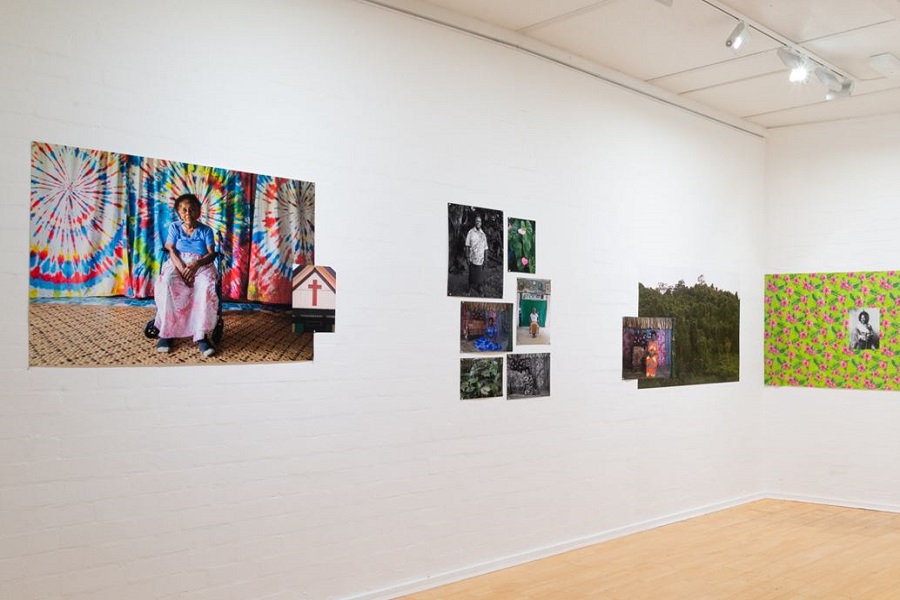
Photography / Nanuma by Karlina Mitchell. At the Huw Davies Galleries, PhotoAccess, until May 23. Deadpan Artefacts by Melita Dahl. At the ANU School of Art and Design Gallery, until May 15. Reviewed by CON BOEKEL.
These two exhibitions are nested in the history, theory and practice of portrait photography. There is something of a chasm between the paths taken in the two exhibitions.
The sum of the two exhibitions is vastly more powerful than the parts.
Mitchell juxtaposes two sets of images. The first set consists of photographs taken of Fijians during the colonial era. We don’t know the names of the subjects or of the photographers.
The second consists of photographs of Fijians today. These were captured by Mitchell. Most are of family members and all are named.
Fabrics are a feature of the hanging. They are used to frame and perhaps to define a notion of ‘real’ Fijian’. Further, the framing uses images of Fijian plants and what might nearly be called contemporary environment shots – jungles, coconut palm, hibiscus, and elephant ears.
The colonial images are standard European colonial tropes: the native woman as exotic sex object, the noble savage complete with traditional weapons, the young women dressed in traditional clothes, and the coolie plantation worker. All are posed.
Several of the words used above would these days require parentheses to indicate that the writer understands that the terms used are now offensive. These include savage, native and coolie. I use them as they would have been applied by colonials in colonial times.
The modern images are posed images of family members. They wear contemporary Fijian clothes. The images show a degree of engagement by the subject in how they wished to be represented. Mutual trust between subject and photographer is evident.
This is a spare exhibition. Even so, it does not quite hold itself together. The implicit binary: domination by way of the colonial gaze versus modern mutual respect appears to be too simplistic. It is possible to read the facial expressions of the colonial subjects and see that the subjects are not merely passive objects.
One of the women looks sullen. Across the ages, she is still signalling that she does not like what is being done to her. She is mute, but not entirely without a voice. Another woman looks as if she is rather enjoying the photography process. Perhaps she and the photographer had a relationship of mutual respect.
On the other hand, the plantation worker is giving the photographer deadpan. It is possible to imagine that the colonial photographers’ approaches here ranged from respectful engagement to arrogant humiliation. In a turn of history’s dusty wheel, the photographers are not named. They have disappeared.
The juxtaposition of respectful portraiture of the artist’s Fijian family members works well but within a limited scope. Creative contextualisation is provided by framing the images with fabrics, with appropriate motifs and with Fijian vegetation. Ironically, at least one of the Fijian plant forms used to frame modern portraiture is a highly invasive plant: Elephant Ears.
Dahl’s exhibition Deadpan Artefacts: creative experiments with facial expression recognition in photographic portraiture adds intellectual heft to portraiture practice and theory by analysing the impact of digital and computational processes. Her analyses of the holdings of the National Portrait Gallery are a conceptual and pictorial wonder to behold.
Dahl juxtaposes the artistic tradition of deadpan with the null hypothesis around the concept of neutral. There can be no neutral portraits, as is also demonstrated in all of Mitchell’s portraits.
News all day, every day at CityNewsQBN.com.au.


Leave a Reply