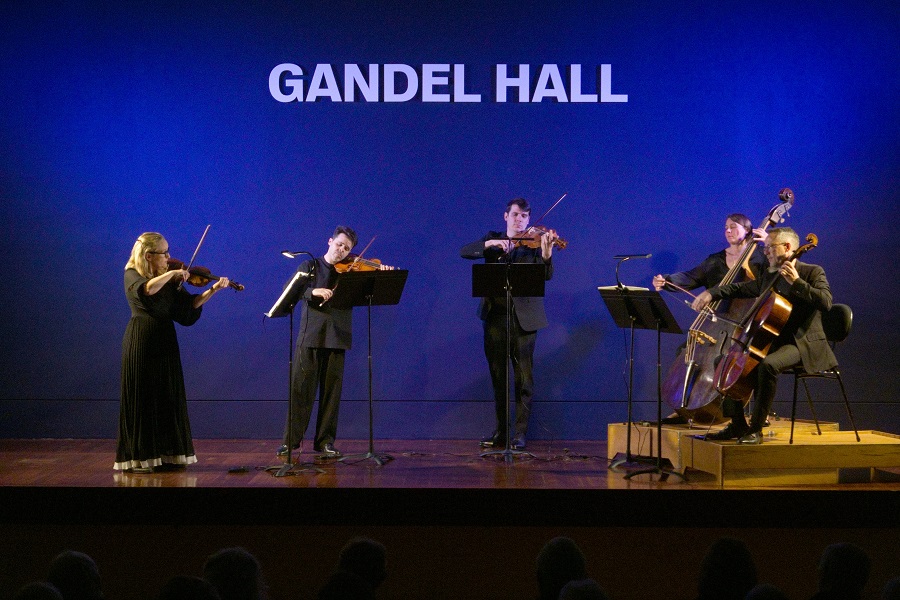
Music / Beethoven’s Fourth, Australian Haydn Ensemble. At Gandel Hall, National Gallery of Australia, May 7. Reviewed by MICHAEL WILSON.
If you were to insist on only seeing Beethoven’s Fourth Symphony performed in its original form, with a full symphony orchestra, you could be waiting a while.
Not because it isn’t a fine piece of music, but it doesn’t have the grandeur of the Third, Fifth or Ninth of Beethoven’s symphonies, and also lacks signature melodies. Orchestras don’t choose to program it routinely.
It was the same in Beethoven’s day, and in the decades following his death in 1827. The continued popularity of his symphonic works owes much to their adaption by arrangers for smaller ensembles. It is easier (and cheaper) for them to travel, so the works reached a wider audience and were more regularly performed.
William Watts, instrumental in founding the London Philharmonic, provided this septet arrangement of the Fourth – equally as charming as Giambattista Cimador’s arrangement of Beethoven’s Eighth performed by AHE last October. Watts uses the same techniques used to bring forth an orchestral feel from seven skilled and very busy musicians.
Beginning with single pluck from the first violin (artistic director Skye McIntosh), the work opens with the gentlest open long notes from flute (Melissa Farrow) and single viola (Rafael Font), before Beethoven hands each instrument a refreshing solo line in succession. In the adagio, each musician worked hard to provide depth and texture with constant semiquaver accompaniment or – for the cello (Daniel Yeadon) and double bass (Pippa Macmillan) – fast-moving continuo lines. But each had to come forward for solos and duets as well, making for a daunting workload, especially for John Ma (second viola) whose part throughout the work was almost entirely plucked rather than bowed!
The allegro was a bit like watching a marble run, with complex cascading lines more characteristic of Beethoven than the other movements.
The first half of the concert set the scene with Boccherini’s String Quintet in A minor Op.25 No.6, with the five players displaying a magical balance and perfect blended sound. Macintosh drove key changes very deliberately, biting into the strings with each new phrase, the cello and double bass punctuating the largo cantabile with elegance and delicacy.
Mozart’s Symphony No.35 ‘Haffner’ in D followed, in Cimador’s septet form, the ebullient opening feeling very much like an opera overture. The second movement, while very short, gives the “pulse” to the violins, cello and bass, with violas and flute carrying the melody from the middle.
AHE’s players are always consistently capable, and committed to expressing the music as it would have been heard by audiences at the original premieres. Font was particularly sensitive and silky on his mellow Simon Brown viola, and Farrow – as the only wind instrument – performed with great subtlety and sympathy.
Amidst the AHE’s certain earnestness, John Ma and Daniel Yeadon were having such fun in the Beethoven that it lifted the spirit and visual interest of a very fine concert.
News all day, every day at CityNewsQBN.com.au.


Leave a Reply