By arts editor HELEN MUSA
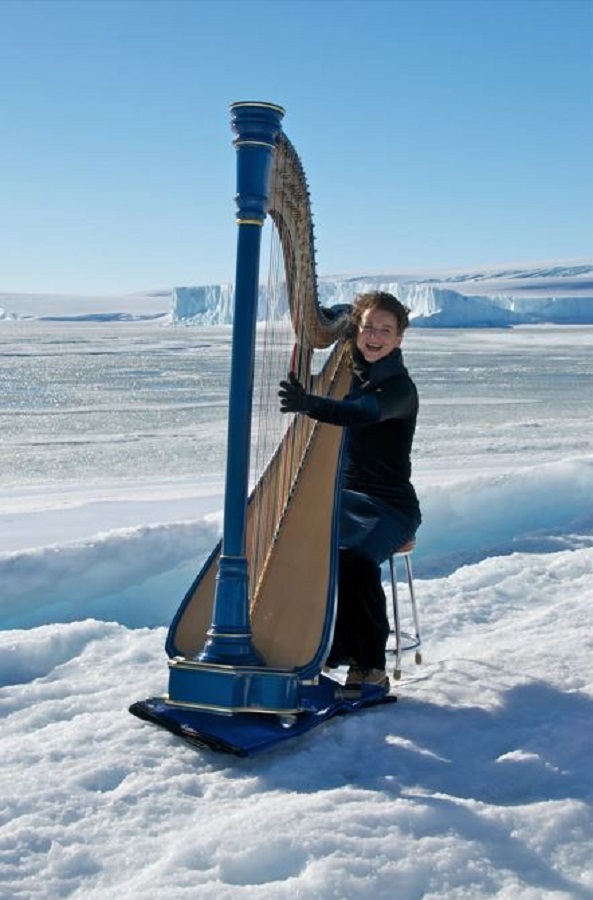
Yes, I know, the title of the concert, Alice in Antarctica, has definite overtones of Lewis Carroll. But Alice Giles truly is a harpist — arguably Australia’s best-known — and she really has been to Antarctica, where she played her harp out in the wild.
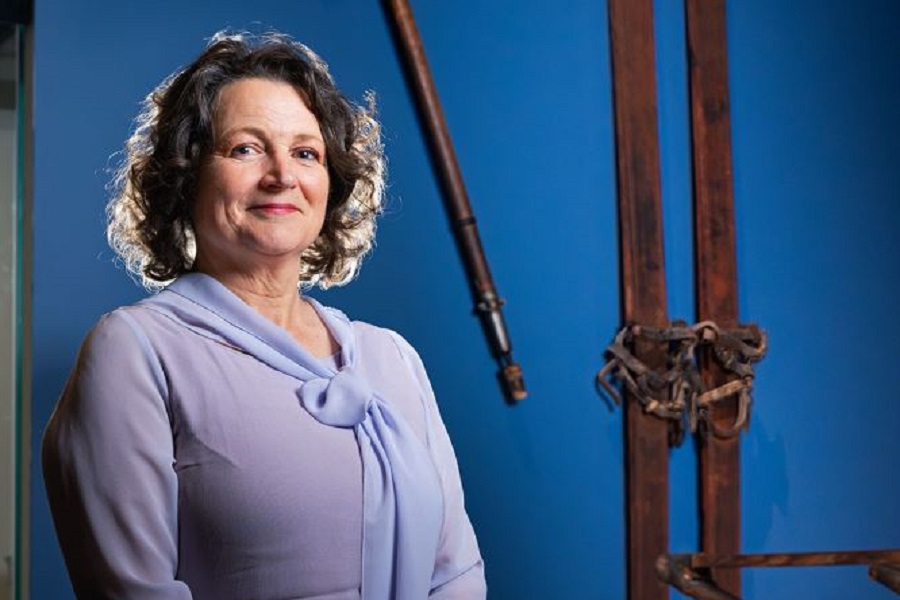
She’s only been to the great southern continent once, in 2011, she tells me when we catch up in the middle of the National Museum of Australia’s blockbuster Antarctic exhibition. The show is drawing such crowds that we can hardly move.
Giles travelled south with a smaller touring harp — taking a full-size concert harp onto the ice would have been a bridge too far. The original plan was to livestream a performance from Antarctica, but the technology wasn’t quite there yet.
Almost immediately after returning, she presented a Canberra concert with the enticing Lewis Carroll-style title Alice in Antarctica. Drawing on footage filmed during the expedition; it evolved into a multimedia performance.
“It was almost Alice in Antarctica: The Film,” she jokes.
A version of the show later toured for Musica Viva and was turned into a touring schools program called Adventures in Antarctica. now Giles is preparing to perform it again in the Gandel Atrium at the National Museum, where it will complement the museum’s blockbuster Antarctic exhibition. National Museum director Katherine McMahon will introduce the evening, followed by a Q&A with the CSO’s Rachel Thomas.
“I’ll be playing two harps — my concert harp and the little harp I took to Antarctica,” Giles says.
If you’re wondering where the inspiration came from, the answer lies partly in family history. Giles’ famous grandfather, Antarctic explorer and scientist Cecil Thomas Madigan, never met his granddaughter, but his diaries have helped shape the narrative of the concert.
“He was always a hero figure in the family,” she says. “I’d read biographies about him, especially the parts about the blizzard journey, and then I contacted a cousin who was transcribing his diaries.”
The concert itself has a much deeper purpose than simply recounting Giles’ Antarctic adventure. Alice in Antarctica was originally created to mark the centenary of Sir Douglas Mawson’s Australasian Antarctic Expedition of 1911-14, on which Giles’ grandfather served as meteorologist.
Performed by Giles, the work combines music, spoken word, film and environmental sound. Spoken interludes are drawn from Madigan’s notebooks and diaries, while film and audio material comes from Giles’ own journey to Davis and Mawson stations in 2011 as an Australian Antarctic Arts Fellow aboard the Aurora Australis.
“It became a way of bringing together my grandfather’s Antarctica and my own,” she says.
Madigan’s journals provide a direct link to one of Australia’s greatest scientific adventures. Although expedition members were encouraged to keep diaries, publication was discouraged and much of the material remained largely unseen for decades. Now those writings are helping Giles tell the story of both the human and scientific dimensions of Antarctic exploration.
The concert combines conventional and contemporary music. Canberra composer Jim Cotter, disappointed that plans for him to travel south never eventuated, wrote Not Dancing with Penguins, while former ANU composition student Joshua McHugh contributed Billions of Penguins, a work that premiered in Antarctica.
One could be forgiven for thinking Giles had penguins on the brain, and she notes that Madigan’s diaries contain plenty of references to the birds.
Adding to the atmosphere are recorded sounds from the Antarctic environment itself — penguins, cracking ice and the wild winds of the continent. Giles also performs Martin Wesley-Smith’s Little Things.
“I wanted to highlight the Madigan story, but also an unsurpassed expedition in scientific terms,” she says.
As for her own Antarctic adventure, Giles recalls “an incredible buzz”.
“I was on a huge adrenalin high. I played in the middle of the night. They took me there by helicopter. It was so thrilling — it brought out a different side of me.”
The experience changed her as a musician, too.
“The outdoors changed my playing,” she says.
Alice in Antarctica, Gandel Atrium, National Museum of Australia, September 24. Bookings here.
News all day, every day at CityNewsQBN.com.au.


Leave a Reply