Dance / Aladdin, Victorian State Ballet. At The Playhouse, until April 24. Reviewed by MICHELLE POTTER
This is a surprising presentation of the story of Aladdin, a young man whose life is transformed by a magic lamp that he discovers when lured into a cave by a sorcerer.
The scenario is somewhat complicated and involves a lot of traditional mime by the leading characters ̶ Aladdin (Michael Scott-Kahans); Jafar the Sorcerer (Tristan Gross); a Genie (Daniel Sierra), who obeys the holder of the magic lamp; Aladdin’s mother (Charlotte Jones); and Princess Jasmin (Elise Jacques), whom Aladdin eventually marries. Those mime gestures included ‘beautiful woman’, ‘to marry’, ‘to dance’ and others. I did wonder whether the narrative was clear to those whose knowledge did not include those gestures, which are rarely used and so probably little-known these days.
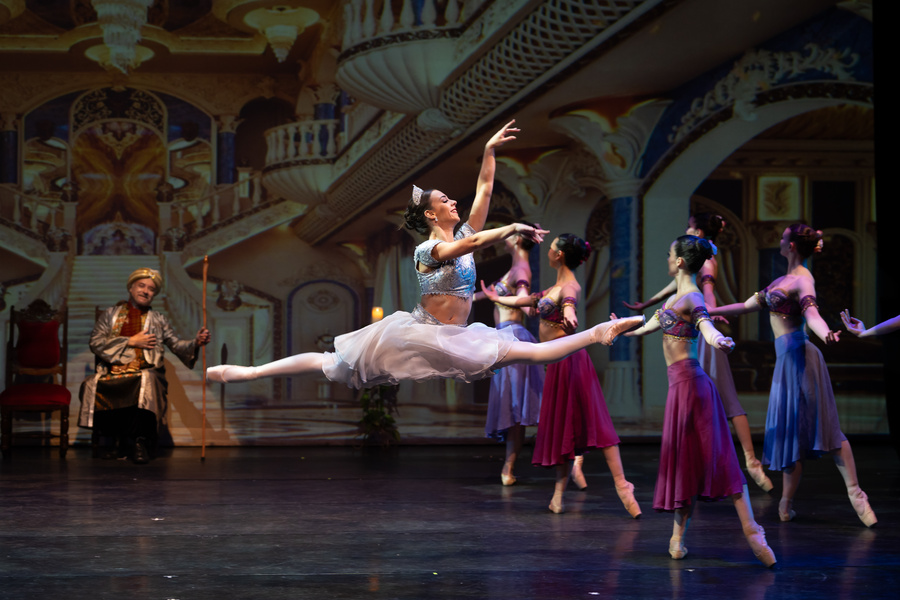
Nevertheless, the leading characters performed strongly both in terms of their dancing and in the development of the relationships between them. Scott-Kahans gave an exceptional performance as Aladdin. His dancing was filled with outstanding elevation and expressive partnering in which he always seemed to have a caring relationship with the woman he fell in love with. His fluid arms and upper body were just beautiful to watch and are characteristic of the work of Victorian State Ballet.
Gross maintained a certain mysterious quality as the Sorcerer until he managed to extract the magic lamp from Aladdin. After this the Sorcerer became a nasty individual who was eventually overcome.
Jacques danced beautifully throughout as Princess Jasmin and the only main character whose performance needed a little more work was Sierra as the Genie. I found his movement often quite static and his hands stiff and overly stretched. Sometimes, too, his partnering looked a little as though he was struggling to lift his partner.
Choreographic highlights came from the four duets representing the jewels that Aladdin found in the cave that he was lured into by the Sorcerer ̶emeralds, sapphires, rubies and diamonds. The dancers performing the duets were each accompanied by three dancers also dressed as those jewels. They filled the background during the duets and showed well the approach to using the space of the stage by the choreographers (Michelle Cassar de Sierra and Martin Sierra Robles).
The quite large corps de ballet (large perhaps only for the Playhouse stage space?) also related well to each other when dancing and when standing at the side of the stage while the story progressed. They were costumed by Felicity Kerr, Jill Kerr and Jan Tredrea. Costumes were mainly Arabian-style outfits in a stunning array of colours and decorative elements.
Lighting was by Martin Sierra who (perhaps?) was also responsible for the imagery that took the place of a standard backcloth. Especially in Act II the backgrounds were remarkable visions of the palace in which Princess Jasmin lived.
The production took me back to some recent reading on the development of ballet in Russia in the late nineteenth century. It also made me realise how much dance has changed since that era. Although this production of Aladdin was more than interesting watch, we have moved on to a less fussy and certainly more minimalist approach to ballet.
News all day, every day at CityNewsQBN.com.au.



Leave a Reply