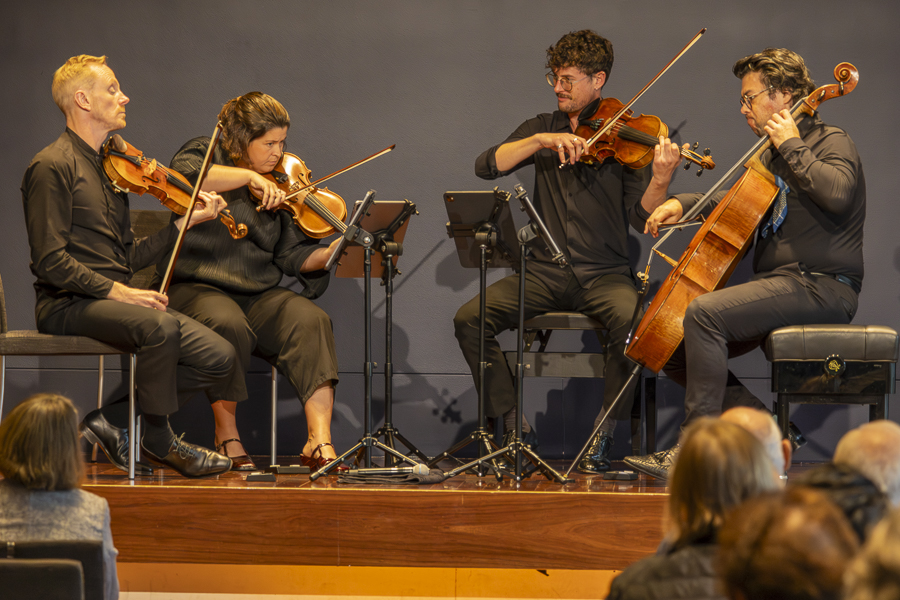
Music / Interwoven, Australian String Quartet. At Gandel Hall, May 17. Reviewed by NICK HORN.
The Australian String Quartet wove together strains from the history of the string quartet from its classical 18th century origins (Franz Joseph Haydn) through its 19th century mid-romantic phase (Clara Schumann), to the mid-20th century (Sergei Prokofiev) and the 21st (Elizabeth Younan).
For this performance, the quartet consisted of Dale Barltrop (1st violin), Jenny Khafagi (2nd violin), Chris Cartlidge (viola) and Michael Dahlenburg (cello). Regular 2nd violinist Francesca Hiew was not available, but at short notice, Khafagi knitted into the group seamlessly.
Australian composer Younan’s String Quartet No. 1, Interwoven, is a through-composed study of emotional nuance, in three sections: Brooding/Darkly/Vivacious. Motivic fragments are distributed democratically, with a prominent role given to the viola/cello in duo. The Brooding section was dissonant, with dramatic mood changes, and Cartlidge’s sensuous viola solo threatened to steal the show. The viola and cello started the second section, playing in a Darkly foreboding character. We then heard Vivacious, rapid passage work from all players, with a rhythmic change later on offering fresh air after such gothic intensity. The ASQ’s excellent performance demonstrated the quality of this passionate work.
Haydn’s String Quartet in A Major (Op. 20 No. 6) would perhaps be better suited as a light introduction to the program. But ASQ’s performance was charming as it shifted gear to a more spontaneous style. After a slightly rushed opening, the quartet played with panache, evoking the wit of Haydn’s short phrases and unexpected stops. Highlights were Barltrop’s lyricism in the Adagio, and the final fugue, with each player demonstrating their dexterity before an abrupt unison thematic statement ended the work.
The stand-out of the afternoon was Prokofiev’s String Quartet No. 2 in F major. The ASQ, strongly led by Barlstrop, clearly relished the driving Russian traditional music of Karbadia from which the work is woven, with modal harmonies, crunchy dissonances and compelling rhythms evident during a furious 1st movement. In the 2nd movement a yearning love song emerges on viola (and later cello). Drama returns with the folk dance strains of the final movement; Dahlenburg starred here with fine passage work and a stunning solo. Everyone leant into Prokofiev’s fierce rhythmic spirit to create an exciting and memorable performance.
An evocation of Clara Schumann’s piano Variations on a Theme by Robert Schumann (arranged Éric Mouret) ended the program, although maybe we would have better appreciated its subtle qualities without those robustly rendered folk tunes ringing in our ears. That said, the ASQ did full justice to a well-balanced arrangement of Clara Schumann’s treatments of her husband’s theme (composed as a birthday present). The lyrical theme—detectable throughout—was effectively evoked in a series of different moods: flowing; urgent; reflective; now with a wonderfully fast-moving cello line, now with a counter-subject in the 2nd violin, followed by a slower, loving take on the theme in the 1st violin; finally, in the Coda, rising to a pizzicato chord. A delightful gift!
News all day, every day at CityNewsQBN.com.au.


Leave a Reply