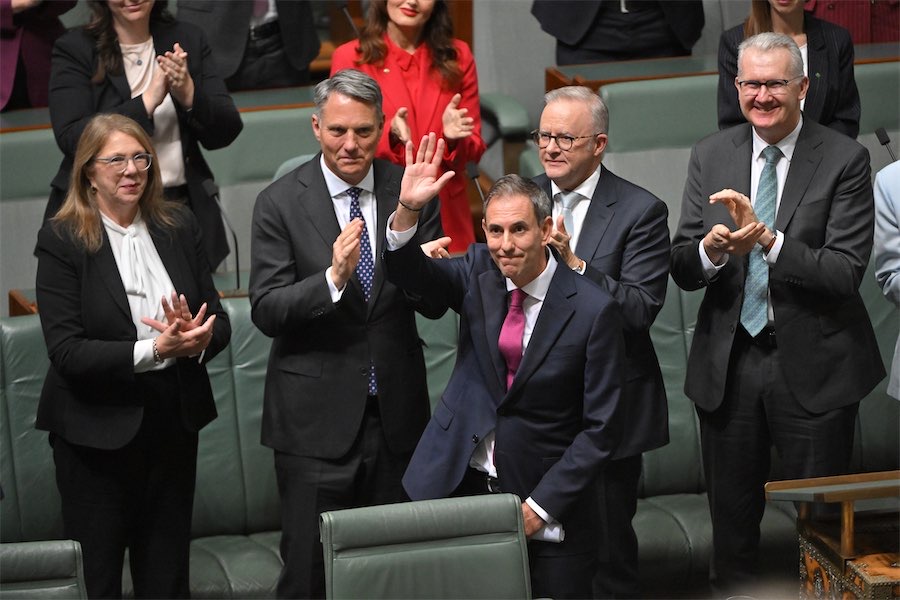
The treasurer has ‘totally’ squibbed it in making changes to unsustainable superannuation benefits, says letter writer IAN DE LANDELLES.
While I recognise that Treasurer Jim Chalmers has done much to undo the damage created by Howard and Costello in housing affordability, he has totally squibbed it in making changes to the ongoing issue of unsustainable superannuation benefits.

As a long-term, self-funded retiree, I continue to benefit from the largess that Howard and Costello lavished on us baby boomers.
Prior to retirement, I was able to make contributions to my super fund which were taxed at 15 per cent. In addition, my wife was also able to salary sacrifice up to $50,000 annually.
Now that we are in the “pension” phase, we pay no tax on the withdrawals from the fund, nor do we pay the Medicare levy, even though at our age, we are major users of health services.
Additionally, we qualify for the Commonwealth Seniors Health Card, entitling us to receive pharmaceuticals at the heavily subsidised rate available to those who have concession cards.
I was hoping that Dr Chalmers would “seize the nettle” and at least attempt to rectify this egregious situation.
To keep the current policy settings is only continuing to add to the ballooning deficit that will further burden our children, grandchildren, and great grandchildren, long into the future.
To quote Dr Chalmers from his speech: “We can’t continue to kick the can down the road”. However, that’s exactly what he’s done in this instance.
If having a thumping majority, and up to two years out from the next election, isn’t the right time to make changes to this totally inequitable and unsustainable superannuation model, then when will be a good time?
Ian De Landelles, Murrays Beach, NSW
Figures warrant open and respectful conversation
I am writing to express deep concern regarding recent figures obtained under a Freedom of Information request from the ACT Maternal and Perinatal Data Collection.
They show a troubling number of babies being born alive following attempted abortions.
According to the data, there were 19 neonatal deaths recorded between 2016-2018, 20 between 2019-2021, and 27 between 2022-2024.
This upward trend raises serious ethical and medical questions that deserve far greater public attention.
A baby born alive, regardless of the circumstances of their birth, is a patient deserving of the same care as any other baby.
The increasing number of neonatal deaths in this context suggests that we must examine whether adequate medical care and legal protections are being provided to these babies born after an abortion.
This issue transcends political lines and speaks to our shared humanity. What protocols are in place to ensure that babies born alive receive appropriate medical intervention? Are healthcare professionals supported and guided to prioritise the wellbeing of these infants? And why is there so little transparency and public discussion about these outcomes?
At the very least, these figures warrant an open and respectful conversation within our community. Greater accountability, clearer reporting, and a reaffirmation of the duty of care owed to every newborn are essential steps forward.
Regardless of one’s position on abortion, surely we can agree that any child born alive deserves compassion and medical care. We urge policymakers, medical authorities, and the public to reflect seriously on these findings and to ensure that no child is denied the basic right to life-saving treatment.
Finally, it is important to add that ACT Right to Life promotes the value and dignity of life from conception until natural death.
John Kennedy, president, ACT Right to Life
The government isn’t listening to us
I refer to Ric Hingee’s letter (“Seriously, we need better people to represent us“, CN May 12). I think he summed up the situation with our local politicians aptly.
We certainly are not getting value for money. In particular, proper planning processes are lacking in terms of information and transparency.
The ACT Government is not into communicating or listening to what the community would like or their ideas.
We rely on our two independent members, Fiona Carrick and Tom Emmerson, to keep us informed. They earn their salaries!
Yes, we need a balance-of-power group of independents.
Penny Moyes, via email
Angus decided to ignore the promises
On his election as leader of the Liberals in February, Angus Taylor promised he would work hard to reform the party, end “politics of convenience”, and regain voter trust via a “change or die” strategy.
He never admitted that he and his party executive would assume that voters have the memory of a gnat.
It is clear from the Liberals’ Farrer by-election campaigning and genuflections to the noisy yet hollow One Nation brigade that Taylor and Co decided to ignore the promises, and the continuing pleas from some well-respected Liberal stalwarts about moving the party to what they called the “sensible” or “civilised” middle ground.
Both Coalition parties unashamedly preferenced an unashamed “party shopping”, One Nation candidate in Farrer over a more trustworthy and policy oriented community-backed independent.
While criticising One Nation and its candidate, and resorting to insidious dog whistling to attract potential One Nation voters, the Liberal Party also relied on its customary lazy approaches to promote ad hoc policy thought bubbles.
The Liberals sought to excuse the preferencing order as making a choice about “the least worst option”. When hinting before the by-election that these latest party shenanigans were just a political strategy to help a Liberal more easily wrest back Farrer in 2028 should One Nation win it in 2026, did the party consider the risks of a preferencing strategy possibly turning the seat into a safe one for One Nation?
Any earnest, hand-on-heart claims made by individual federal Liberal candidates, including those standing in the ACT, about listening, valuing and building trust and committing to substantial change in the public interest, will simply ring hollow as long as Liberal leaders continue to grovel to One Nation.
Sue Dyer, Downer
Fashion makers have got a lot to answer for
Big thanks to Caroline Swee Lin Tan and Saniyat Islam for exposing the wasteful truth behind recycled polyester clothing (“Polyester clothes are on a one-way trip to landfill”, CN May 7).
In short, plastic bottles turned into clothing go to landfill next – while bottles recycled back into bottles can be recycled and reused several times over.
The fashion industry needs to work out how to recycle its own fabric rather than shifting the problem downstream. And all of it needs to be made by something other than climate-polluting crude oil.
Fashion companies have got a lot to answer for – it’s high time they threaded more carefully.
Amy Hiller, Kew, Victoria
Where will these Belconnen houses be located?
Re May 2026 “Our CBR”, aka The Barr Bugle.
Page 3 has an article on more affordable homes for Belconnen – 420 to be precise. No specifics on location. I scanned the QR code as directed. No reference to this particular article was revealed.
Why won’t the Barr government tell us where this housing will be located?
Are they once again seeking to prevent community groups from lodging reasonable protest?
Bill Brown, via email
Truer words were never spoken!
Two letters (CN May 7) from Mike Quirk and Sue Retcher in calling for clean energy, strangely neither mentioned nuclear energy.
Emissions-free, baseload power and new transmission lines destroying the countryside are not needed for this modern technology that is increasingly being used around the world by other smart countries.
Scientists have told us we can’t get to net zero without the use of nuclear energy.
Mr Quirk tells us China, Japan and South Korea are seeking to reduce their dependence on gas and oil, but doesn’t say all three countries are significantly increasing their nuclear production, driven by the need for energy security, decarbonisation targets and rising electricity demands.
Ms Rechter tells us Sweden, Canada, Portugal, US and Brazil have begun using green hydrogen but not that all of those countries except Portugal use nuclear power with it being a major part of their energy mix in Sweden, Canada and the US.
US technology companies are turning to nuclear energy to power the massive demands of electricity required for artificial intelligence and cloud-computing data centres.
This stupid current government won’t even entertain the thought of nuclear energy with its leaders particularly Albanese and Bowen burying their heads in the sand at the mention of it.
If Australia delays this clean, green form of energy we will fall even further back then we already are with regards to the energy crisis.
As Ms Rechter states: “Big picture thinking, backed by timely action, is needed now.” Or as Mr Quirk states: “To reduce our reliance on fossil fuels, the government’s response has to be based on evidence and free from undue influences.”
Truer words were never spoken.
Ian Pilsner, Weston
Energy independence won’t come from drilling
Mike Quirk is right. The US war on Iran has exposed our dangerous dependence on fossil fuels (“Iran lesson is up the incentives for renewables”, CN 7/5).
Extracting more Australian oil and gas would be a costly backward step, increasing greenhouse emissions while slowing the shift to cleaner, cheaper renewable energy.
The most sensible solution comes from Tony Wood, Energy Program Director at the Grattan Institute. His plan includes accelerating electric transport and machinery while rejecting government support for new oil exploration and refineries.
Wood notes that “the energy to run electric cars, buses, trucks and mine equipment can be made locally using renewables and storage, with backup gas plants.”
Such independent advice is invaluable because it is devoid of political point scoring or party obligations to fossil fuel companies who make large political donations.
Energy independence in the 21st century will come not from drilling deeper, but from electrifying smarter.
Ray Peck, Hawthorn, Victoria
A lynch mob is still a lynch mob
The abduction and subsequent alleged murder of Kumanjayi Little Baby was a heinous and evil act, but the shameful behaviour we in Australia, and the rest of the world witnessed afterwards, took depravity to a whole new level.
Random looting, a crazed mob burning police vehicles, attacking and injuring police and first responders, all allegedly, in the pursuit of “justice”.
But what justice and for who?
We, Australians citizens all, irrespective of creed, race or colour are subject to and benefit from the systems of a democratic society: a progressive public health system, comprehensive social services and a robust criminal justice system.
These systems, particularly the criminal justice system, cannot and should not be superseded by unwritten laws based on archaic tribal practices.
Yes, this was a highly emotive crime, and the mood was tense in Alice Springs after the police had found the body of the five-year-old girl, following an intensive search, which led to the arrest of the alleged perpetrator.
But a lynch mob is still a lynch mob in whatever cultural norm you choose to disguise it.
Of course there is a much greater ill inherent in this horrific murder and it’s not just the condition of town camps around the outskirts of Alice Springs, it’s the scourge of domestic violence that continues to haunt all Australian families across all demographics and one that we need to address united, not divided.
Declan McGrath, via email
Out of step with our community’s values
While the ACT Government has always maintained that its annual “cull” of kangaroos and wallabies is “humane”, the reality is that it is beyond cruel and that it amounts to sadistic violence.
During last year’s cull at Gungaderra Grasslands, a group of kangaroos was shot, then I heard one of them get stabbed twice and then hit. I will never forget those terrible sounds.
Alarmingly, this is not an isolated incident. An autopsy report on a young male kangaroo who was interred from a burial pit after the 2012 cull found that it was shot through the jaw, bludgeoned on the head, stabbed in the neck and had its throat cut. It died from exsanguination (severe blood loss) or asphyxiation. The vet concluded that it suffered “severe pain and distress” during the attack before finally dying.
There are other examples of unthinkable cruelty.
Treating any animal in this way is simply unacceptable, and completely out of step with our community’s values.
Rebecca Marks, via email
More letters
News all day, every day at CityNewsQBN.com.au.


Leave a Reply