Julius Caesar: a daring and brave return to the caldron
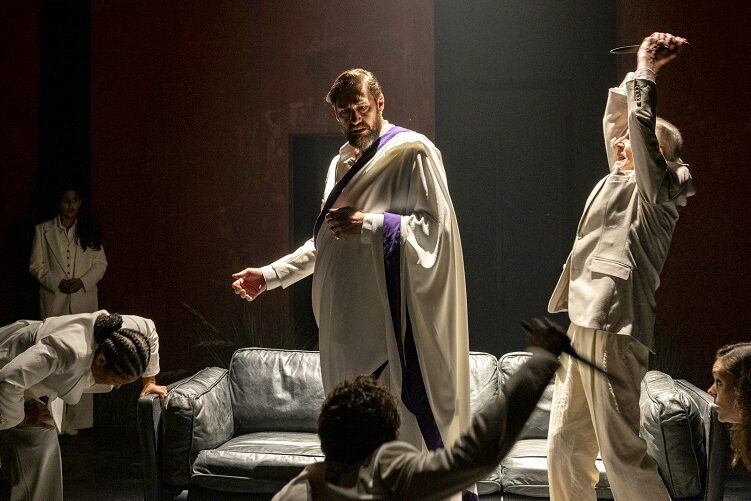
Septimus Caton as Julius Caesar and Peter Carroll as Casca. Photo: Brett Boardman
Theatre / Julius Caesar by William Shakespeare, directed and designed by Peter Evans. At The Playhouse until April 18. Reviewed by JOE WOODWARD.
There are lessons to be learned from Bell Shakespeare’s production of Shakespeare’s very awkward play with no empathetic characters but having a huge iconic significance.
Those lessons may be taken from the performances of Leon Ford and Peter Carroll and direction and design by Peter Evans.
Actors in our Western-based theatre traditions find the access to deep and dark motives for their characters a very difficult proposition. Technique to get them through the night is more the norm. Elocution and physical focus is usually enough for most theatre productions.
Rarely do we find that extra dimension that can terrify and signal cultural and personal darkness that is at once captivating, compelling and resonating with something beyond most of our experiences. At best we see the actor exhibiting skills so exquisite that we marvel at their talent. At worst, we see pretence and ego foisted as talent! Yet theatre is a mercurial beast. You can’t get multiple takes to get that one shot right.
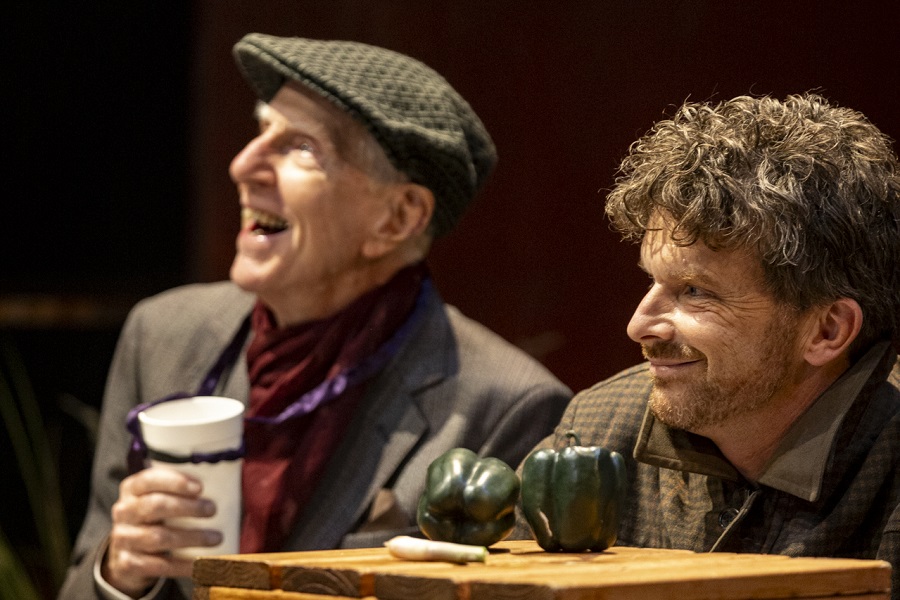
From left, Peter Carroll and Leon Ford. Photo: Brett Boardman
Bell Shakespeare is world renowned for its comedy and lightness when approaching Shakespeare’s works. However, it has had great difficulty in accessing the depths of tragedy with works that even stumped the great John Bell himself.
So in attempting Julius Caesar for a second time only eight years since Bell’s last attempt, it was very daring and brave of Evans as director to return to the caldron; stirring up the cultural and artistic psyches that inhabit Shakespeare’s universe for contemporary audiences.
The pressure must have been huge; given how unforgiving audiences and benefactors can be. The design concept proved to be a stroke of genius. The red pillars were Roman in the extreme. The set pieces were totally functional allowing actors to be present and cutting unnecessary delays in scene transitions. The costuming by Simone Romaniuk provided visual contrast to complement the focused staging. Evans created a mature production so advanced from the rambling and unfocused work of eight years earlier.
While Evans may well go on to replicate and advance on the legendary work of John Bell, one can be reminded of the incredible substance and essence of Peter Carroll’s contribution to Bell Shakespeare and to Australian theatre more generally. His performance of Casca illustrated how a seemingly less significant character could be the vital link in a sequence of monumental importance and significance.
Carroll takes acting to another level. Formerly a senior lecturer at NIDA in the 1970s, Carroll’s connection with Bell and Shakespeare goes back a long time. His moment as Feste in Twelfth Night torturing the hapless Malvolio in 1977 at Nimrod Theatre cemented his place in the annals Australian theatre history. In Julius Caesar, you can see Carroll responding to every moment and making the comedy lines truly sing; producing applause after his opening monologue from the opening night audience.
Leon Ford, a former drama student from Narrabundah College in Canberra, managed to draw significant and sincere energy from the depths of one’s passion for culture and for cultural survival.
Playing Cassius, Ford mined the motivations for tyrannicide. While Ford played with vocal dexterity “trippingly on the tongue” as Shakespeare suggested in Hamlet, he added dimensions that might never have occurred in Shakespeare’s context. Ford, like Carroll, was able to ground his character in deeper motivations imbuing his character with a life beyond the stage. Ford overturned the cliché of “fake it till you make it”; rather Ford was making it with his interactions with Brutus.
While it was unclear why this deeper connection was lost, Ford’s otherwise well-crafted yet deeply emerged performance faded in the vital scene with Brutus towards the end of the play. This seemed endemic as part of the play’s diminution. It all suddenly seemed theatrical. Mark Antony’s great oration gone, Cassius was left to console Brutus and we were back to theatre. No Brechtian style alienation! Just elocution and actors being performative…
The famous oration of Mark Antony was a marvel of directing. The use of the speaker’s platform and mics gave the sense of something bigger and extraordinary.
Mark Leonard Winter’s Mark Antony gave an ambiguous and nuanced perception of Antony’s motives and agenda. Yet he didn’t over-play the moments. He managed to keep contradictory elements consistent with Antony’s purpose. He gave the Antony oration, almost a cliché in theatre, a new and multi-dimensional flavour consistent with the overall design and context of the production.
There is much in Bell Shakespeare’s Julius Caesar to recommend it. If you were made to study it in school or if you simply enjoy the play, this production won’t disappoint. There are elements as good as you will get anywhere. Peter Carroll’s and Leon Ford’s performances are extraordinary while Mark Leonard Winter’s Antony oration is presented in a most original way.
And one thing I noticed, do we want our politicians to be “kings”?
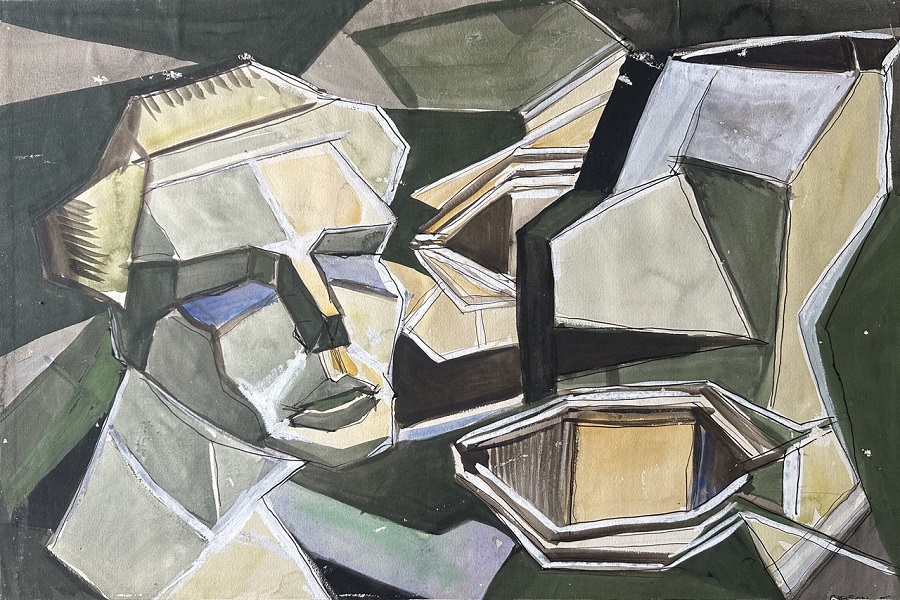
After more than 70 years of drawing, painting and designing buildings, Queanbeyan architect and artist Trevor Gibson will stage his first exhibition at the age of 85, writes arts editor HELEN MUSA.



Leave a Reply