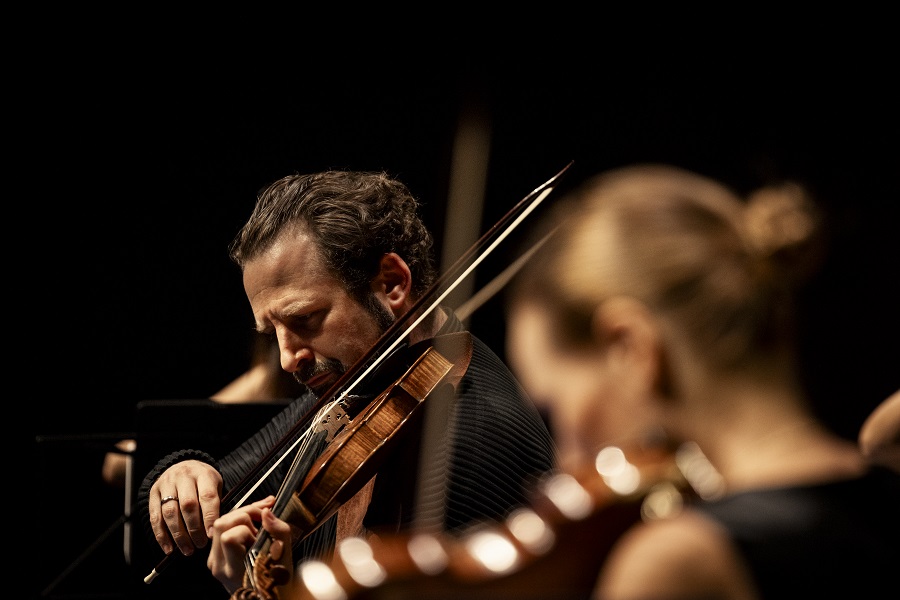
Music / The Devil’s Violin, Australian Chamber Orchestra. At Llewellyn Hall, March 28. Reviewed by NICK HORN.
In this program, the Australian Chamber Orchestra – led by guest violinist Ilya Gringolts in a baroque string ensemble of just 13 players – interleaved baroque and contemporary works.
The ensemble achieved an intense, raw, immediate sound, with gut strings, baroque bows, and lower pitch tuning throughout. A continuo group of harpsichord, theorbo (a giant lute)/guitar, cello and bass provided a solid foundation for a superb string ensemble performance.
Johann Paul von Westhoff’s early baroque D minor violin sonata (imitation of bells, with brilliant arpeggio string passage-work) was a perfect prologue, followed by a smooth transition to Antonio Vivaldi’s D minor violin concerto in which von Westhoff’s bells are themselves directly imitated. Gringolt’s playing had a furious chopped energy, using the raw power of the gut strings. The 3rd movement’s arrogant double-dotted rhythms had us all sitting up straight.
Sofia Gubaidulina’s 1987 String Quartet No. 2 (arranged for string orchestra) deployed the gut strings to explore the timbral contrast between instruments. A single tone was carried from cello, to viola to violin, with trembling strings, bass interventions and isolated chromatic gestures. The work built to a climax like swarming cicadas, gradually moving to silence hung from the highest, almost inaudible notes of the violin.
The ensemble moved smoothly into Giuseppe Tartini’s Violin Sonata in G minor, with the memory of the previous work in our ears as we listened to the baroque sonic textures. After a graceful first movement, Gringolts led the group strongly to bring out the drama of the 2nd movement, with his fiendish double-stopped “Devil’s trills” forming the centrepiece of a furious finale.
After the interval, Mieczsław Weinberg’s 1942 aria drew a luscious warm sound from the ensemble, with a yearning lyrical line, and a lovely passage from violist Stefanie Farrands at the end.
Then we were into the fireworks of Vivaldi’s Concerto for Two Violins in D minor, starring Gringolts and Vänskä. The 1st movement highlighted the power of Vivaldi’s unison string sound. The 2nd movement featured beautiful duet playing from the soloists, standing on either side of the ensemble. A perfectly balanced conversation between two master violinists turned competitive in the 3rd movement as each challenged the other in breathtakingly rapid gestures.
The final two works featured an ancient ground bass progression, La Follia, in versions by Australian Paul Stanhope (Giving Ground) and 18th century Italian Francesco Geminiani.
Bass steps are heard at the start of Stanhope’s work, thumping down the hall from far away. A harsh astringent feel permeates, melodic lines climbing up then sliding down, with the fixed progression finally breaking down, cascading to an almost Russian theme in conclusion.
The Geminiani was by turns stomping, chopping, graceful, virtuosic and lyrical, with notable solo turns by Simon Martyn-Ellis (guitar) and Timo-Veikko Valve (cello), and Ilya Gringolts himself capping off an artfully constructed program with a typically bravura turn.
News all day, every day at CityNewsQBN.com.au.



Leave a Reply