Playback (Or, A Play About But Not Starring a Famous Politician). At The Street Theatre until May 31. Reviewed by HELEN MUSA.
Tom Glassey’s Playback is much more than a play about former prime minister Scott Morrison.
Although Morrison’s presence hovers over the entire production and largely inspired it, this is a sophisticated work full of shifting perspectives.
Glassey, a rare combination of playwright and working journalist with podcasting credentials, uses the full scope of his verbal and imaginative powers to conjure up a theatrical world that is at times three and even four-dimensional.
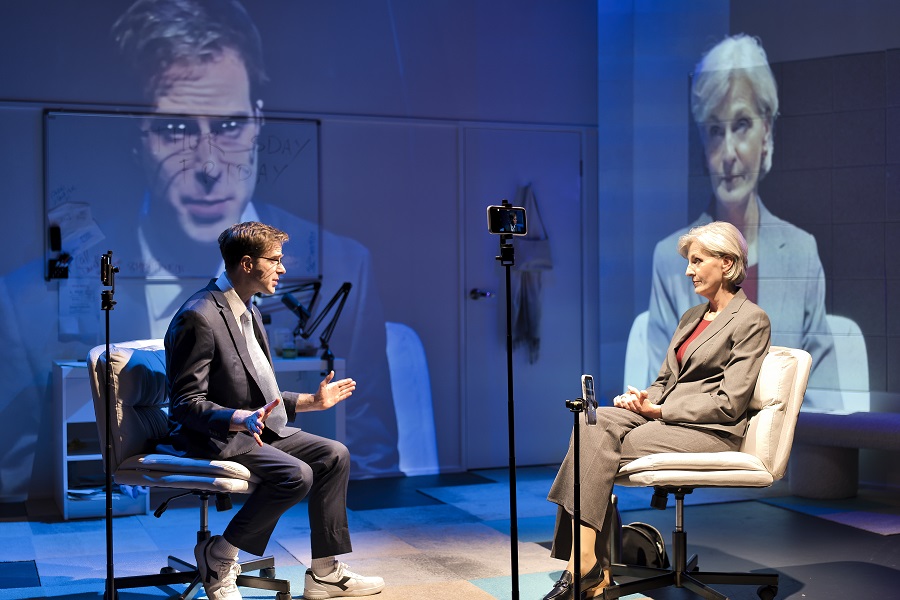
The videography becomes an extra character in the play, notionally set in the fictional Proper Gander podcast studio around February 27, 2024, when Morrison delivered his valedictory speech to federal parliament.
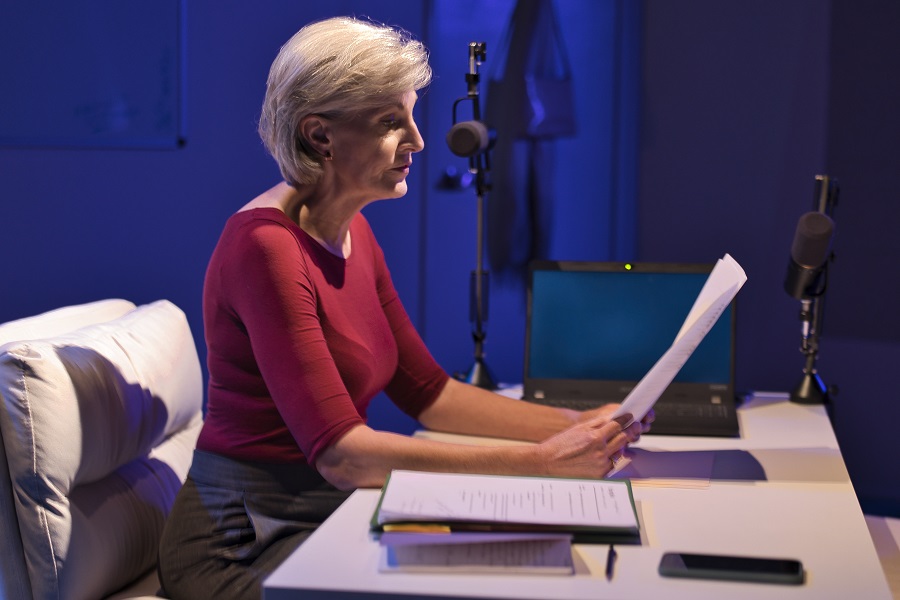
The casting of former broadcaster Andrea Close as ageing journalist Deborah, determined to cement her reputation through a scoop interview with the outgoing Prime Minister, is a serendipitous choice. With all the tricks of the trade and a touch of deeper emotion, Close makes a meal of the role.
Equally serendipitous is The Street Theatre’s choice of director Craig Alexander, a well-known videographer and filmmaker who, aided by videographers Luke Patterson and Shelly Higgs, brings his skills to bear in a series of staged interview scenarios where actions and reactions are simultaneously replayed on huge screens around the stage.
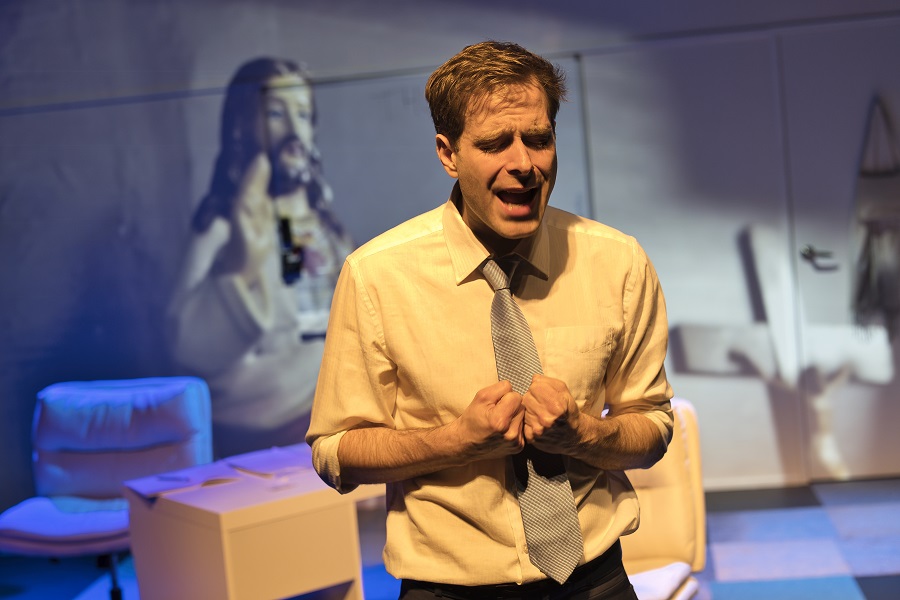
Then there is Tyler Jenkins, a skilled professional improviser in the role of the unnamed, seemingly feckless yet ruthlessly ambitious young man determined to break into the political sphere. Jenkins’ chameleon-like qualities are well suited to playing both a young man who has never heard of Scott Morrison and the equivocal prime minister himself, variously Scotty from Marketing, Scomo, daggy dad and, in one scene, devout charismatic Christian.
Some of the play’s most brilliant moments come as Jenkins’ character stays up all night doing a crash course on Morrison’s life, accompanied by video illustrations. Later, more threateningly, Jenkins/Scomo looms large on the hovering screens, peering at his antagonist over the rims of his spectacles.
Glassey is a natural playwright. His dialogue is swift and incisive, intercut with endless repetitions of familiar Morrison phrases, as Deborah and her aspiring temporary staffer conduct a series of practice interviews with the Prime Minister, who may or may not appear at any moment. The video clips, too, involve deliberate repetitions.
But as the play progresses, we learn that just as the young man has a plan to make his way into Parliament House, Deborah also has an agenda. She is driven not only by looming personal debt and the need to prove herself one last time as a journalist, but also by sheer, unrelenting anger.
The play begins with Deborah reading from a case study relating to the notorious Robodebt scheme. In the denouement, she contemplates the shifting moral ground behind the treatment of asylum seekers on Christmas Island and the victims of Robodebt — instances in which innocent people were treated abominably in the name of high-minded governing.
Glassey’s sharp play ends abruptly, leaving us to ask the Morrisonesque rhetorical question: how good was that?
News all day, every day at CityNewsQBN.com.au.



Leave a Reply