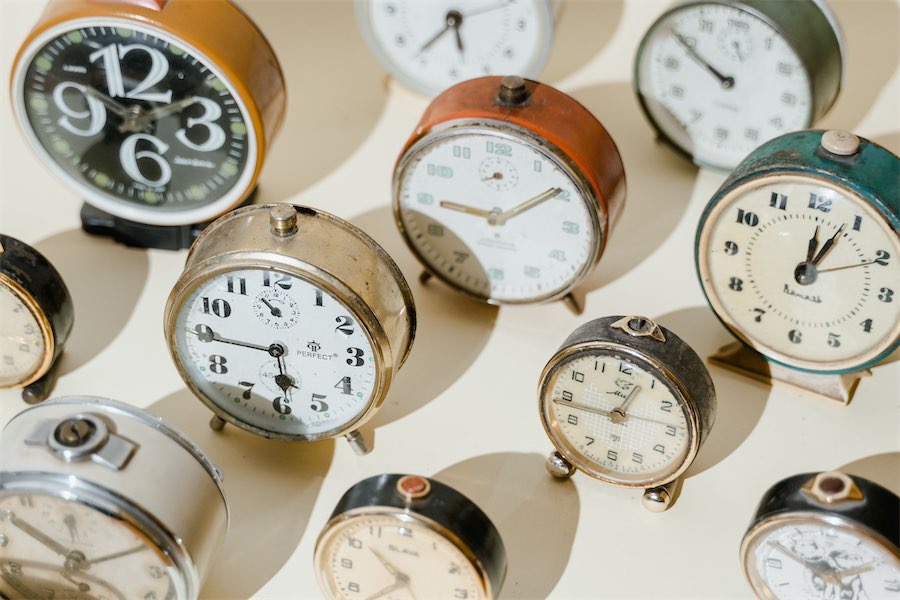
The idea of variable time emerged with Einstein’s theories of relativity. Photo: Tima Miroshnichenko
“Modern physics has revealed a surprising truth: time can vary, depending on motion, gravity and the structure of the universe,” writes Whimsy columnist CLIVE WILLIAMS.
“A French five minutes is 10 minutes shorter than a Spanish five minutes, but slightly longer than an English five minutes, which is usually 10 minutes. –Guy Bellamy
We think of time as a universally fixed period and, in everyday life, time passing feels steady and constant.
Clive Williams.
A second seems like a second anywhere on earth. And we know that today will be yesterday tomorrow. For centuries, this view shaped science as well. But modern physics has revealed a surprising truth: time is not constant.
Time as we once understood it
Isaac Newton viewed time as absolute – flowing at the same rate for everyone, everywhere, regardless of circumstances. This idea works extremely well for normal daily life.
For ordinary speeds and weak gravity, time behaves as if it were constant. This is why classical physics and common sense remain useful in almost all everyday situations.
Einstein changes the picture
The idea of variable time emerged in the early 20th century with Albert Einstein’s theories of relativity. Einstein showed that time is intertwined with space, forming a single fabric called spacetime. How time flows depends on how you move through space and how strongly gravity affects you.
This isn’t philosophy or speculation – it has been confirmed repeatedly by experiments and practical technology.
Motion and time dilation
According to special relativity, time slows down for objects moving at high speeds relative to others. This effect, known as time dilation, becomes noticeable only when speeds approach the speed of light.
For example, a clock on a fast-moving spacecraft would tick more slowly than a clock at rest on Earth. To the astronauts aboard the spacecraft, everything feels normal – their heartbeat, thoughts, and biological processes proceed as usual. But when compared later, the travelling clock shows less time has passed.
This effect has been measured using highly precise atomic clocks flown on aircraft and satellites. Even commercial airline flights experience tiny but measurable differences in elapsed time compared with clocks on the ground.
Gravity and time
Einstein’s general theory of relativity revealed another way time can vary – through gravity. The stronger the gravitational field, the more slowly time passes.
A clock closer to Earth’s surface ticks more slowly than one at higher altitude, where gravity is slightly weaker. Again, the difference is tiny – billionths of a second – but it’s real and measurable. Atomic clocks placed at different heights agree with Einstein’s predictions.
This gravitational time dilation has practical consequences. GPS satellites orbit high above Earth, where gravity is weaker and their clocks tick faster than clocks on the ground. Engineers must correct for this effect; otherwise, GPS positions would drift by kilometres each day.
Does time ever stop?
In extreme conditions, time can slow dramatically. Near a black hole, where gravity is immense, time for an outside observer appears to nearly stop at the event horizon (the boundary around a black hole within which nothing can escape – not light, not signals, not matter). However, for an object falling into the black hole time passes normally.
What time variation means
The laws governing time dilation are precise and mathematically well defined. Time still flows forward, and cause precedes effect. The effects become significant only at extreme speeds or in gravitational fields far beyond human experience.
The big picture
So, is time constant? In practice, for our everyday lives, yes. For all human activities on Earth, time behaves as if it were universal and unchanging – but science tells a subtler story. Time can vary, depending on motion, gravity, and the structure of the universe.
On a lighter note
At 9.30pm there’s a knock on the door. Couple John and Alice are getting ready for bed. John is still showering and asks Alice, in her dressing gown, to answer the door.
Alice is a very shapely woman. When she goes to the door, it’s their neighbour Ron who asks if he could borrow a bottle of liqueur.
Ron has always admired Alice’s shapely figure and says when she returns with the liqueur bottle: “If I give you $200 may I admire your breasts?”
Alice thinks about the housekeeping and rationalises that she had once had a holiday job as a topless waitress. So, she undoes the top of her dressing gown and shows Ron her magnificent bosom.
“Wow, amazing,” says Ron and hands over the $200.
Later John asks who was at the door. Alice says: “It was our neighbour Ron, wanting to borrow some liqueur.”
“Oh,” says John, “did he happen to mention the $200 he owes me?”
"Those who want to froth about the inadequacy of this sentence would do well to note that there is no rehabilitation in our ACT prison system. That is the fault of the current ACT Government," writes legal affairs columnist HUGH SELBY.
"Jim asks his acolytes to swap their livery for Nick Cave T-shirts and their rung on the ladder to be shared by those with fewer opportunities." writes Kindness columnist ANTONIO DI DIO.
"Once infrequent, there are now more motions passing through the ACT Legislative Assembly than through the portaloos at the Multicultural Festival," writes SHUSH CAPITAL in this week's KEEPING UP THE ACT.






Leave a Reply