“Cigarette smoking in Australia has been on the decline for more than 30 years. This drives Big Tobacco apoplectic, and they constantly look for new ways to influence government policy,” writes political columnist MICHAEL MOORE.
Big Tobacco is writhing in pain as Australia leads the world in reducing smoking. Don’t believe a word they say!

Big Tobacco would have you believe smoking is on the rise because of black-market tobacco. In fact, Australians are smoking less.
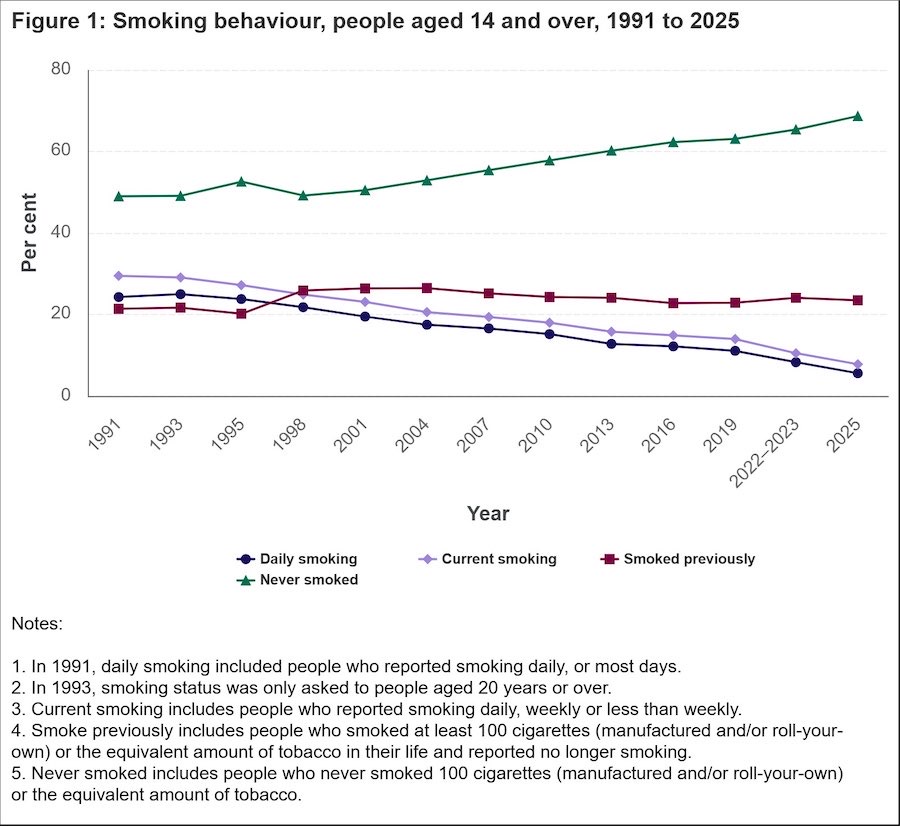
The most recent report on Australia’s smoking rates by the Australian Institute of Health and Welfare (AIHW) demonstrates Australian policy settings for tobacco control are working well. Smoking rates continue to decline.
Australia can now report that daily smoking rates for all people over the age of 14 years has dropped from 25 per cent in 1996 to just 5.6 per cent this year. What an achievement! Governments of all colours in Australia across federal, states and territories have played a key role in this achievement.
The Australian Institute of Health and Welfare (AIHW) conducted its triennial National Drug Strategy Household Survey (NDSHS) with more than 17,500 people participating during the last six months of 2025. The reduction to 5.6 per cent in daily smoking is remarkable, particularly considering that in 2001 there were 19.5 per cent of Australians over 14 years who were daily smokers.
According to Malcolm Baalman, the Policy and Advocacy manager of the Public Health Association of Australia: “The real heroes behind these statistics are the millions who have quit smoking and the teenagers who have not commenced.”
Cigarette smoking in Australia has been on the decline for more than 30 years. It is largely driven by people resisting taking up smoking, and by the increase in people quitting smoking.
This drives Big Tobacco apoplectic, and they constantly look for new ways to influence government policy. Even more infuriating for their future business is that 14 to 17-year-old smoking has reduced from 15 per cent in 2001 to just 1.8 per cent in 2025.
Big Tobacco have been the masters of spin and lies. Only a few decades ago Big Tobacco leaders appeared before the US Congress Committees and denied the health impact of smoking. Now Big Tobacco, and their front organisations, seek a reduction in excise to make their products competitive.
Big Tobacco jumped on “experimental estimates based on ‘nicotine metabolite concentrations’ detected in wastewater samples” that suggested 80 per cent of tobacco and e-cigarette products are sourced illicitly.
The evidence from the National Drug Strategy Household Survey (NDSHS) indicates an increase in use of illicit tobacco from 10 per cent in 2019 to 34 per cent last year. Illicit tobacco does need to be addressed, even though it is used by just 1.6 per cent of Australians. Illicit tobacco needs to be addressed as a criminal rather than a health issue.
AIHW spokesperson Louise Gates pointed out that “daily smoking rates have more than halved over the past two decades, alongside a decline in overall nicotine use, pointing to sustained progress in reducing tobacco use across the population”.
Contrary to those in Big Tobacco who argue increased use of tobacco is caused by the illicit market, the reality is that government policies across all jurisdictions are having an appropriate impact in reducing smoking.

Malcolm Baalman reiterated the importance of resisting the influence of Big Tobacco: “The International Framework Convention on Tobacco Control, developed by the World Health Organization and adopted almost universally, prevents governments from negotiating policy with Big Tobacco. Australia’s success includes maintaining this approach.”
The success of tobacco policies is not just a single intervention. Advertising was initially a key factor. In 1990, tobacco advertising was banned from print media and this was followed by a full ban on advertising in 1993. Governments could apply the lessons to the harm associated with gambling.
By 2003 all of Australia had smoke-free dining, although this was achieved much earlier in the ACT. Smokefree areas, and increases in taxation were accompanied by extremely graphic health warnings on tobacco packs. Eventually, Australia’s world-leading legislation on plain packaging of tobacco followed.
Through this time the tobacco excise continued to rise. Each time there was in the order of a 10 per cent increase in excise, there was a significant increase in people quitting smoking.
This reduction cannot be attributed to the introduction of e-cigarettes in Australia.
According to the NDSHS report: “Daily e-cigarette use remained relatively stable at 3.6 per cent in 2025, compared with 3.5 per cent in 2022-23. However, fewer people are using e-cigarettes weekly or monthly, contributing to an overall decline in the proportion of people using e-cigarettes”.
There is a simple message. Australia’s long-standing approaches to tobacco and the strict regulation of e-cigarettes are working.
Michael Moore is a past president of the World Federation of Public Health Associations, a former member of the ACT Legislative Assembly, and an independent minister for health. He has been a political columnist with “CityNews” since 2006.
News all day, every day at CityNewsQBN.com.au.




Leave a Reply