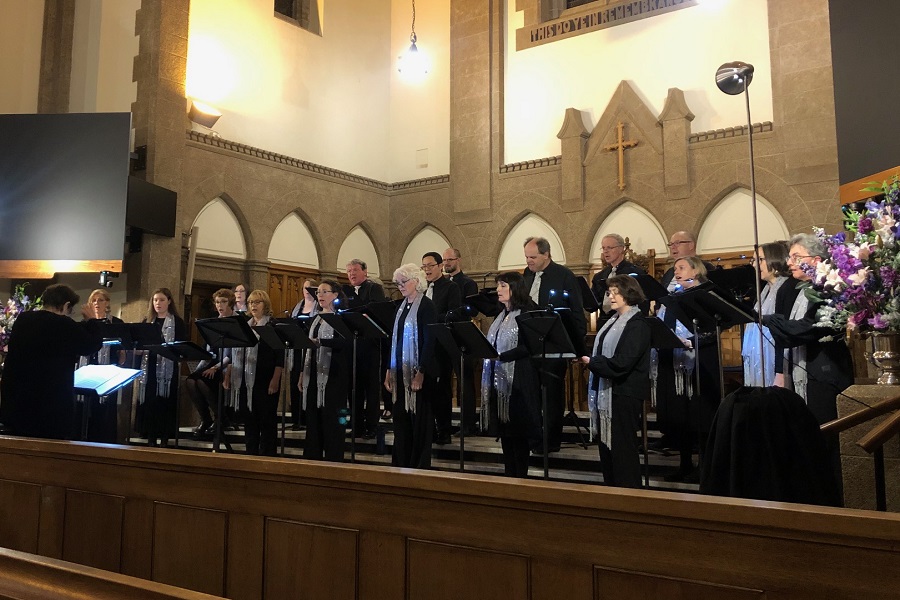
Eternal Light, The Resonants. At St Andrew’s, Forrest, June 20. Reviewed by HELEN MUSA.
The Resonants, Helen Swan’s vocal ensemble, marked its return after many years to St Andrew’s in Forrest with a formidable concert of sacred music, allowing accompaniment, where needed, by Esther Arthur on the church’s organ and by Emily Leong on piano.
The upbeat tone of the concert was immediately revealed in the program’s titles, Exultate Deo, Jubilate Deo and Lux Aeterna, which gave the title, Eternal Light, to this concert.
You didn’t need a doctorate in music history to understand that the works chosen spread across many centuries, but musical director Helen Swan did not choose a chronological progression of music for this complex concert, which began with the Venetian choral master Gabrieli, then moved backward and forward in time, concluding with a contemporary work by Karl Jenkins.
It was notable that the works selected were overwhelmingly positive in tone, without the drama that might, for instance, be found in a performance of The Passion.
The acoustics of St Andrew’s allowed a light, gentle, unaccompanied opening for Gabrieli’s Jubilate Deo (1613), before a flash forward to 1865 and Fauré’s Cantique de Jean Racine, Opus 11, set to words by the famous French playwright Racine, in which the male voices had the lion’s share of the vocal work.
Then it was back to 1584 and Palestrina’s elaborate Exultate Deo, full of the composer’s characteristically pleasing overlapping of musical phrases.
The centrepiece of the first half was Fauré’s Requiem, Opus 48, full of musical contrast, partly explained by the fact that Fauré had added to this piece from 1877 to 1890.
Two solo parts stood out: Michael Wilson’s bass-baritone part in The Offertorium and the Libera me (“deliver me”), were both delivered straight and clear, as befitted the solemn nature of the Requiem, While Maia Hehir’s Pie Jesu soprano rang pure and clear through the vaults of the church. Arthur’s careful phrasing ensured the organ punctuated, rather than competed with, the voice.
The Requiem concluded with the ecstatic In Paradisum, in which the light sopranos perfectly captured the celestial sound.
The second half of the program also featured a major requiem in American composer Morten Lauridsen’s Lux Aeterna, a five-movement work written in 1997. Most impressive to me was the third movement, O Nata Lux (“O Light from Light”), in which Swan and Leong on piano held the choir in perfectly modulated control, avoiding false histrionics. A quiet reflection on the subject of the concert, eternal light, it came to a close with a slow Alleluia and Amen.
In a clever piece of programming, the concert then swung back to Schubert’s pleasing The Lord is My Shepherd from 1820, before the concluding work, Healing Light by Karl Jenkins, ended the concert with an optimistic message of peace as Leong beat out the rhythms on a hand drum. The unusual Amen was notable as this complex concert drew to a close.
News all day, every day at CityNewsQBN.com.au.


Leave a Reply