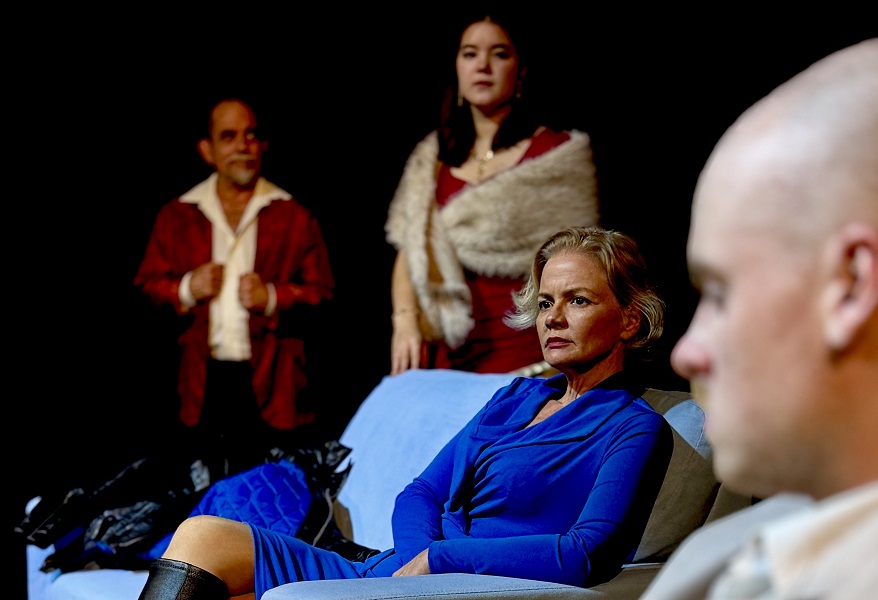
Theatre / No Exit by Jean-Paul Sartre, directed by Céline Oudin. At Belconnen Arts Centre, until April 18. Reviewed by GRACE CASSIDY.
What would you do, if someone locked you in a room with people who were specifically selected to drive you mad? In all likelihood, you’d try to leave. But what if leaving isn’t an option? The room has no windows, the door is locked, the air is stifling, and you can never fall asleep again.
Jean-Paul Sartre’s No Exit was first staged at the Théâtre du Vieux-Colombier in May 1944. Today, Mockingbird Too has brought it to Canberra for a one-week run at the Belconnen Arts Centre. In an intimate space, containing three lone couches and a flickering exit sign, director Céline Oudin brings Sartre’s one-act play to life – or death, as it were.
Our story begins with a man showing three recently deceased individuals to the room where they will spend eternity; the Charon of this tale is not a ferryman, but a valet (Peter Fock). Likewise, the afterlife is strangely devoid of fire and brimstone, and instead seems to be a collection of ordinary rooms connected by an endless corridor. It’s almost mundane. The room’s occupants find this deeply suspicious.
Garcin (Eli Narev) arrives first, blustering in and assaulting the valet with questions. Of these: “Why did they take my toothbrush?” is by far the most pertinent. A steely-eyed Inez (Victoria Tyrell Dixon) is next; bursting with a biting wit, she’s immediately hostile to Garcin.
Finally, they are joined by Estelle (Phoebe Chua) who’s young, dripping in diamonds and at a loss with no mirrors to check her appearance.
It’s a bit of a slow start, but the pace quickly ramps up as tensions build between the cohabitants. Before long, they begin to realise there’s a reason no torturer is coming – they’re here to torture each other.
Despite being 82 years old, No Exit is a story that feels surprisingly modern. It’s also very compelling.
With a tight 75-minute run time and a strong cast, the play deftly balances existential dread with glittering moments of dark humour. Hell is other people, according to Jean-Paul Sartre, but to the audience, it’s glaringly obvious that none of the characters would be suffering if they weren’t overanalysing every facet of their situation.
So, the greater point of the story might be that hell isn’t just other people, but also a space we create within ourselves.
News all day, every day at CityNewsQBN.com.au.




Leave a Reply