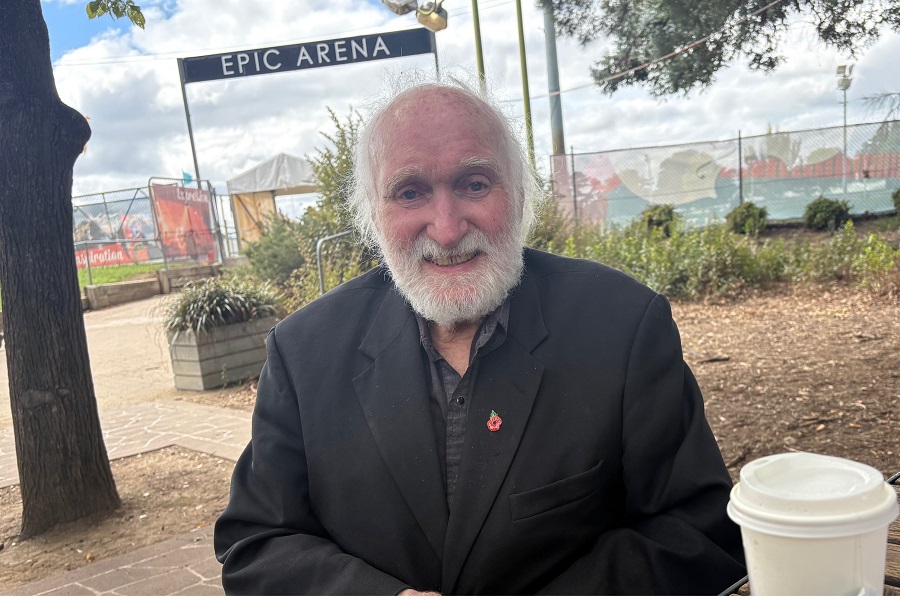
Arts editor HELEN MUSA meets British folk singer Martyn Wyndham-Read, who was awarded a Lifetime Achievement award the National Folk Festival.
British folk musician Martyn Wyndham-Read is sitting just outside the sessions bar at the National Folk Festival when I catch up with him, watching people drift between tents, guitars slung over shoulders.
Given that this is the 60th anniversary of the festival, it is unsurprising that the organisers have history on their mind, and Wyndham-Read is a walking example of that history.
This year, he is a co-winner of the Lifetime Achievement Award, recognising a career that stretches across decades, continents, and more than 30 solo albums. On opening night, he stood on stage and performed Never Never Land, drawn from a 1901 poem by Henry Lawson.
When I say British, Wyndham-Read, once condescendingly praised in the British press as “the best thing to come out of Australia since tinned peaches,” is not Australian at all. He comes from Sussex.
But one Aussie journalist described him as: “One of the few singers who can do justice to our bush ranging and convict songs. His style is polished and rounded, full blown almost, yet it escapes the theatricality which seems to creep into the work of some of our classically trained folk singers.”
Over the weekend on Radio National, co-artistic director Holly Downes credited Wyndham-Read as one of the figures present at the event’s beginnings.
When asked, he confirms the story, picturing those early conversations, kitchen table gatherings with people like Shirley Andrews and Glen Tomasetti, talking about the possibility of a festival at Port Phillip. In 1967, it becomes the Port Phillip District Folk Festival. Now, it had grown into something much larger.
As a teenager, Wyndham-Read’s life already nudged toward Australia. His grandfather, a thoroughbred horse judge, had travelled the world visiting studs, including those in Australia and NZ. That connection leads to Wyndham-Read being sent out as a young man to work with the Falkiner family, who owned Haddon Rig in NSW and Emu Springs near Tintinara in SA, where he became a jackaroo.
He remembers the journey clearly, stressing that he came by boat, though not as a 10-pound Pom.
From Spencer Street Station, he took a train into the countryside, arriving at Tintinara at four in the morning. There was almost nothing there, a hotel, a store, and open land stretching in every direction. By seven, a man in a ute pulled up, gave him quick instructions, and sent him straight to work.
“Put your gear in the shed. Get the horses and dogs. Round them up.”
He was exhausted but he was 18 so he did it anyway.
Music entered his life a few years earlier, when his grandmother had bought him a guitar at 14 to play skiffle. Luckily, when he came to Australia, he brought the guitar with him.
At a station barbecue celebrating Australia beating England at cricket, Wyndham-Read sang a couple of songs. Then he heard the station hands singing songs like Click Go the Shears. Something shifted.
He never turned back.
When Emu Springs is eventually shut down, he found himself without work and homeless until another jackaroo offered him a place to stay in Glenelg. From there, Wyndham-Read moved to Sydney and into the music scene, first informally, singing at Sydney’s Royal George Hotel with the Push.
Then Tom Lazar, Hungarian-born restaurateur associated with the Reata and Little Reata restaurants in Melbourne, invited him to sing during summer at a Cafe at Portsea where there was a vacancy. “I sang at the restaurant every night, then other places opened up,” he says.
Then, in 1967, just as things were beginning to settle, his mother asked him to come home, sending him the fare. Thirty-five days later, he was back in England.
For 10 years, Wyndham-Read immersed himself in Australian material, collecting songs, reading magazines, writing lyrics down. He performed them in England and describes the strange experience of singing Australian songs in a “green, fertile land,” telling the stories behind them to audiences who had never seen the places he was singing about.
At first, he did not see himself as a strong storyteller, but he worked at it, shaping not just the songs but the way he delivered them. Over time, more than 90 per cent of his repertoire became Australian.
In the late 1970s, an invitation came from Australian folklore guru Warren Fahey and others to return and tour Australia. That visit became the beginning of many more.
He noticed something as well. While American, Scottish, and Canadian folk songs often remained close to their English roots, Australian folk music had developed a distinctly different tone and varied lyrics, shaped by a different history and landscape.
He became especially interested in stories about Ben Hall and the figure behind The Wild Colonial Boy, asking, Who was he, really? Did he exist? In 1869, songs about outlaws were banned, yet the legend endured.
In recent weeks, Wyndham-Read has been back in Australia again, invited by Fahey and Clare O’Meara. Arriving in February and spending time in places such as Kiama with old friends, he performed Bushwhacked, Bothered and Bewitched in rural towns alongside Fahey, Marcus Holden, and Garry Steel. He also appeared in Down the Lawson Track at the National Library of Australia with Fahey and historian Bill Gammage on April 1.
Now, as the festival draws toward its close in Canberra, he reflects on how much, and how little, has changed.
He loves coming back. It is still the same country he encounters at 18.
“There’s one big difference though,” he tells me. “In my day, people would not admit to having convict ancestry, but now it is worn as a badge of pride.”
The 60th National Folk Festival, Exhibition Park, closes April 6.
News all day, every day at CityNewsQBN.com.au.




Leave a Reply