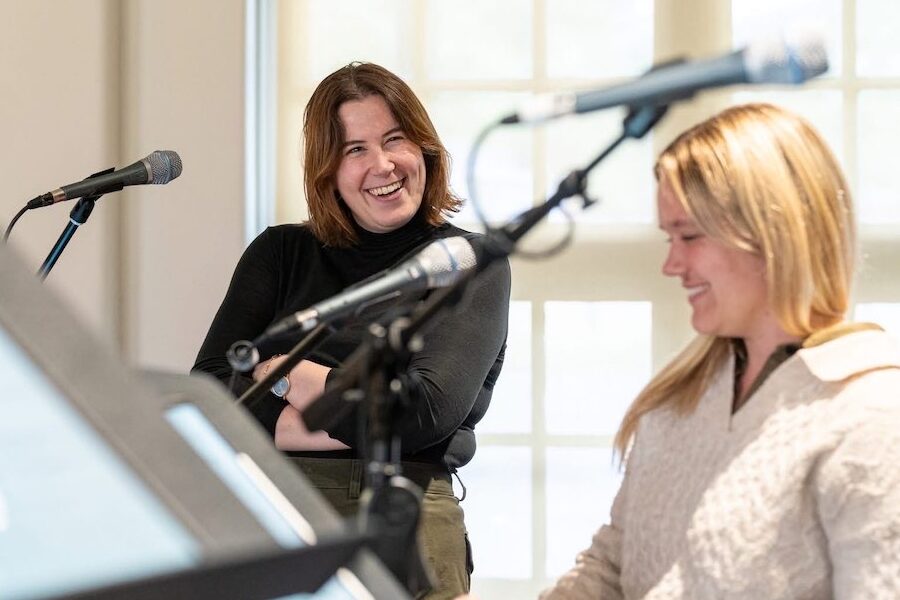
When Luminescence Chamber Singers step on to the stage for Luminescence and the Machine, they won’t just be singing – they’ll be revamping what a vocal ensemble can be, writes HELEN MUSA.
Premiering in partnership with The Street Theatre, Luminescence and the Machine takes the a cappella ensemble in the “opposite direction” to something far more radical than amplification.
Each singer will be performing with a custom-built electronic system that allows them to manipulate their voice in real time.
The singers remain fully autonomous, yet are also embedded in a web of live processing that reshapes their sound as they perform.
“Singing is a human, bodily thing,” says artistic director AJ America. “We’ve spent years exploring a cappella music – no machines, no accompaniment. This is the opposite direction.
“It’s not an add-on. The machine is part of the performance. We control it – but it also pushes back. It’s a very provocative encounter.”
Unveiling 12 world premieres, America says the project is the ensemble’s most ambitious undertaking.
Two years in the making, it brings together a rich mix of collaborators in Melbourne-based sound artist Tilman Robinson, Grammy award-winning Americans William Brittelle, of New Amsterdam, and Cameron Beauchamp, from Roomful of Teeth, with a cohort of Australian composers, Damien Ricketson, Olivia Davies, Dan Walker, Jessica O’Donoghue, Sam Weiss, Marcus Whale and Jess Green.
For America, the project began as a conceptual provocation.
She had been following the US ensemble Roomful of Teeth for some time and was curious to find out about the relationship of machine to human.
She emailed co-founder Brad Wells saying: “We’d love to work with you” and asking him to be their art mentor.
To her amazement, Wells got back to her straight away, leading to remote collaboration, then live sessions at The Street Theatre for which, on Wells’ suggestion, Brittelle and Beauchamp travelled to Canberra twice for extended development periods. Their presence, alongside Robinson’s technical and compositional input, made all the difference.
“When we met Tilman, we just clicked,” America says. “He built the system with us; it’s exceeded anything we imagined.”
That process was not without uncertainty. Even late into development, the ensemble didn’t know if the technology would cohere.
“In August, we were still testing the limits,” she says. “It was a wonderful challenge – no fear, just exploration.”
What has emerged is a performance environment in which the human voice is stretched, layered and refracted in real time, creating a sonic world that is at once organic and electronic.
A vocal ensemble, America suggests, is already a kind of machine, interdependent parts working together. This project simply extends that idea into the digital age, which evidently they do not fear.
Importantly, the work does not abandon Luminescence’s roots in early and unamplified music. Instead, it expands them.
“This is an electric turn for us,” America says. “It opens up entirely new sound colours.”
There is also a strong sense of place underpinning the project. Luminescence and the Machine has been developed entirely in Canberra, a fact America is keen to emphasise.
“People always assume work like this would happen in Sydney or Melbourne,” she says. “But it’s been built here. The Street Theatre has given us the time, space and technical support to realise a really bold vision.”
“It’s a statement,” America says. “Our most ambitious work can and should happen here.”
As the premiere approaches, there is a palpable sense that the ensemble – AJ America, as mezzo soprano; Lucien Fisher, baritone; Rachel Mink and Josephine Brereton, sopranos; Alasdair Stretch, bass-baritone, and Dan Walker, tenor – is standing at a threshold.
“I feel like this body of work is on the brink of something… It’s no exaggeration to say that this is our hot take,” she says.
“It sounds completely different – but it’s still us.
Luminescence and the Machine, The Street Theatre, April 30 and May 3.
News all day, every day at CityNewsQBN.com.au.




Leave a Reply