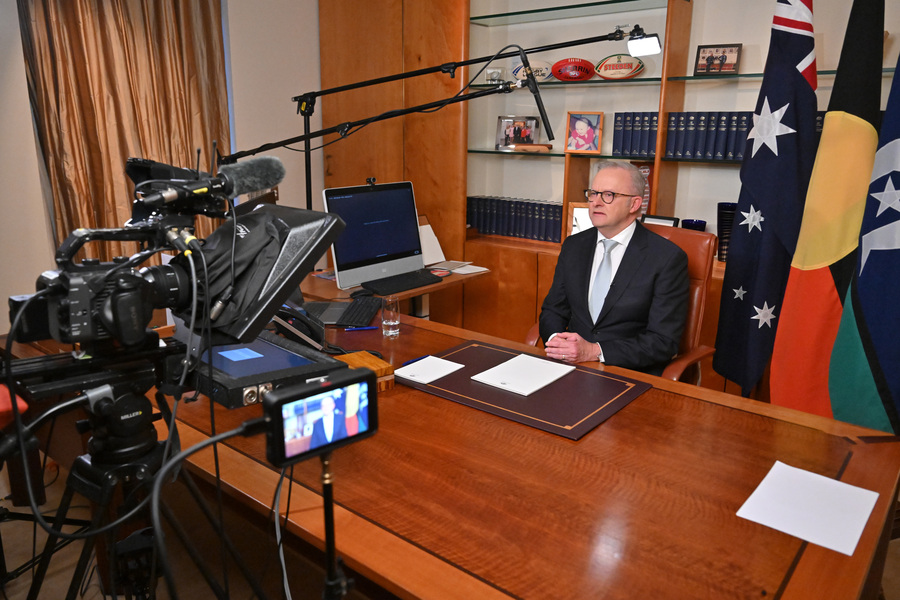
“Prime Minister Albanese’s address to the nation on Wednesday, blanket broadcast across all networks, left me wondering what I had just watched and why,” writes ROBERT McMAHON.
In 2012, then Minister for Transport, Anthony Albanese, (in)famously plagiarised a national address by fictional US President Andrew Shepherd, played by Michael Douglas, in the Hollywood film, The American President.

Albanese later explained away the blunder as a “stuff-up” within his office. Whatever the cause, the speech was well worth copying. A call to the national interest based in substance and values, framed in soaring oratory. The sort of speech you’d wish politicians would give in real life.
Fast forward to 2026, Prime Minister Albanese’s address to the nation at 7pm on Wednesday, blanket broadcast across all networks, left me wondering what I had just watched and why.
Short on detail other than measures already announced – such as cutting the fuel levy by 26 cents and pausing the heavy vehicle road user charge – the PM exhorted us to be judicious in our use of our cars and to use public transport where possible. Well, I don’t think anyone who has just spent $3-plus a litre filling their tank needed this prime ministerial hint to embrace frugality in motor vehicular usage.
The address also sought to re-assure us. We were told that the government was doing everything it could and, while times ahead might become tough, there was no need to panic.
So what might the government expect us to actually do with this call to cool-headedness or, as PR types call it, “re-assurance framing”? Again, the government has been, variably, expressing these lines for the last couple of weeks – so why the need to interrupt our evening viewing to hear this asserted assurance once again with no new information.
The style of the message jarred me, too. A friend, travelling overseas but concerned that a national address by the prime minister might portend an announcement of some importance, took time to watch the address online. He texted me afterwards saying he’d like now to see the “grown-ups version”.
Perhaps a little harsh in a modern world of less formal communication; but was it really necessary for the prime minister to refer to “servos” and “truckies” in an address to the nation, especially given that many in the audience might be from non-English speaking backgrounds unfamiliar with such slang?
But there was something more substantial that caught my attention about Albanese’s address. National broadcasts of this ilk are triggered by the Commonwealth’s management of what’s called the Central Advertising System: a platform in which broadcasters receive government advertising in return for, among other things, assurance that in times of national emergency or on matters of critical importance, they will interrupt normal programming to run the government’s message without demur.
It’s designed as a critical national information apparatus available to rally Australians to do something in times of national emergency or when public safety is at risk.
Wednesday’s national address did not reach that threshold. It didn’t get near it. Rather, the PM used the opportunity of a national address – utilising the reciprocal obligation of broadcasters and the good grace of viewers and listeners – to tell us things he and others had already told us.
And if these messages were so very important to convey (or to reiterate as the case is), why not do so in the nation’s parliament? It is, after all, presently sitting in Canberra and any address by the PM could have been included in morning newssheets and evening news broadcasts.
True it is people often lament these days that politicians make too little effort communicating with the populace about difficult issues; that politics is reduced to superficial five-second grabs.
Perhaps the PM’s address to the nation was an attempt by him to address that gap. But taken together, I was left with the uneasy feeling that the PM’s address was somehow unnecessary, unwarranted and did not meet the threshold of an issue justifying urgent address to the nation across its whole broadcast media.
Dr Robert McMahon is a visiting fellow at the Australian National University, adjunct professor at the University of Canberra and former assistant secretary in the Departments of the Prime Minister and Cabinet, and Communications.
News all day, every day at CityNewsQBN.com.au.


Leave a Reply