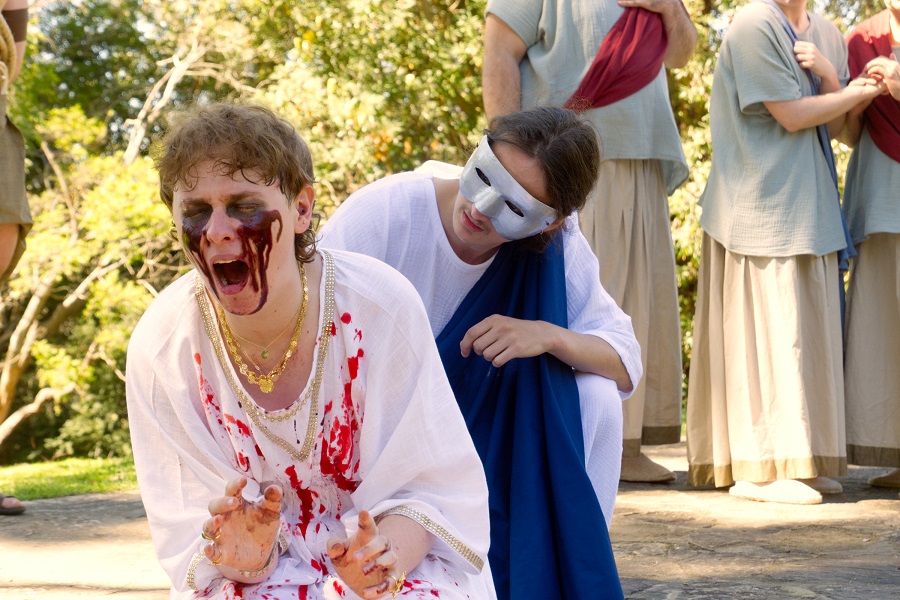
Theatre / Oedipus the King, Greek Theatre Now. At Australian National Botanic Gardens, April 1-6. Reviewed by HELEN MUSA.
Director Michael Smith and his company Greek Theatre Now have presented a powerful, almost operatic production of Sophocles’ Oedipus the King.
Staged in the near-perfect autumnal surroundings of the Burbidge Amphitheatre in the Australian National Botanic Gardens, this production is one of the easiest to listen to that I have witnessed in a long time, with every piece of dialogue packing a punch.
I say operatic because the play deals with larger-than-life emotions, as Oedipus, the brilliant solver of riddles, embarks on his own undoing.
The play has often been described as a detective story, with the difference that the criminal is also the investigator himself. This is known to the audience from the outset and leads to many moments of heavy irony, as when Andrew Mackenzie, visibly young as Oedipus, addresses the chorus as “my children”, although they are mostly his elders.
While the emotions are mostly larger than life, the machinery of what Aristotle considered the perfectly constructed play occasionally creaks. It is inconceivable, for instance, that Oedipus has heard no details of the death of his predecessor, King Laius, and the constant use of the interrogative to extract background information can be a little frustrating, although these are theatrical conventions overridden by the exceptional power of the main characters.
The clever costuming by Priya Pandya and the changeable masks by Ben Smith Whatley allow the actors to take on multiple roles in keeping with the traditions of ancient Greek theatre.
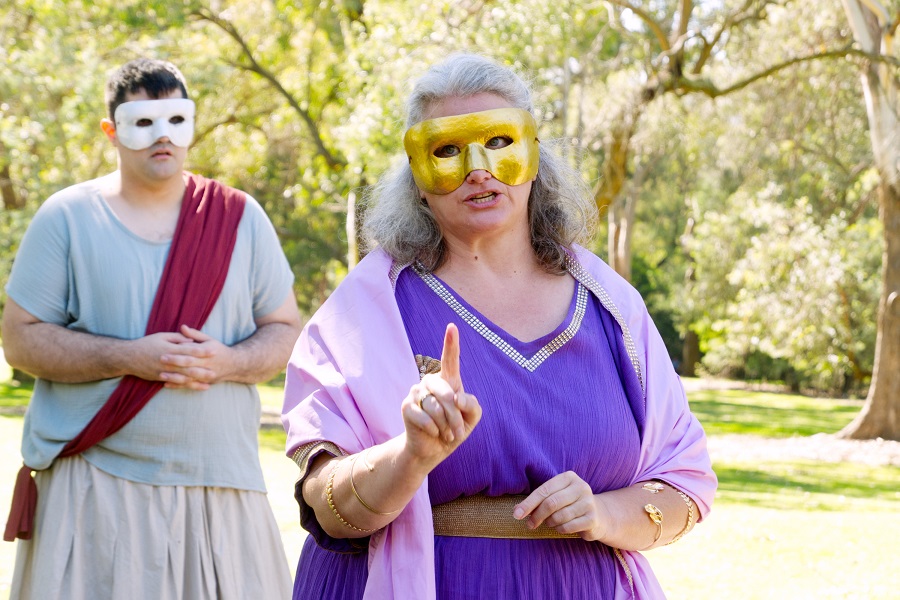
This reaches its apogee in the casting of Kate Blackhurst as the Palace Messenger. Having earlier played an attractively mature Jocasta, wife and mother to Oedipus, she effectively narrates her own death, a very clever touch.
Another inspired decision by Smith was not having two actual little girls appear on stage as Oedipus’s daughters, Antigone and Ismene, thus creating the impression that he might be imagining their presence.
Sophocles excels in scenes of confrontation, among which in this production is Oedipus’s stand-off with the prophet Teiresias, played by Owen Maycock, where we see exactly how he could have killed an old man in a burst of temper.
The explosive confrontation with his brother-in-law is another strong moment, with Maycock doubling as Creon and righteously defending himself. Most pointed of all, and most ironical, is the scene in which Queen Jocasta, as mother and wife, attempts to counsel the hot-headed Oedipus into a kind of agnostic acceptance of the world; she is wrong, of course.
Oedipus the King teeters between the realistic and the formal, or ritualistic, and it is here that Smith as director may have gone a step too far.
The chorus of ordinary Thebans, led by George Belibassakis and Roslyn Hull, is strong in poetic choral ode mode but weak and distracting when breaking into casual chatter, no doubt intended to make them more human; instead, it creates a disjunct.
Having said that, the company manages to recover from these moments, so that the ultimate impression is indeed one of a powerful tragedy.
News all day, every day at CityNewsQBN.com.au.



Leave a Reply