“The most restrictive refugee policies anywhere – including being the only country to incarcerate people in offshore camps – have not stopped One Nation from becoming the most popular Australian conservative force at the moment,” writes JOHN MINNS.
Polls showing that around a quarter of Australians intend to vote for One Nation and that just over half would consider voting for them have shocked many political observers.

The research shows the question of immigration has been central to this. But perhaps we are simply catching up to a global trend.
This century – and especially over the last 10 years – far-right parties have either joined or propped up governments in Austria, Denmark, Finland, Greece, Italy, the Netherlands, Norway, Sweden and Switzerland.
In addition, they are the second highest polling parties in the UK, France and Germany. It is the greatest resurgence of the far-right since World War II. And, of course, Donald Trump is the most important of them all.
While there are local peculiarities in each of these movements, they have a few things in common. The first is the idea that they represent “the people” – a virtuous and homogenous group who are the heart of the nation and constitute its true greatness. They are the dominant racial, ethnic or religious group – the “real” Americans, French, Australians etcetera. The “people” are hardworking, law-abiding, family-oriented, nationalist and extremely proud of their country, not overly intellectual – but endowed with abundant “common sense”. They are not dependent on state support and are heteronormative.
A second category is “the elite” – who have disdain for “the people” and undermine them. The definition of this group is fluid. Academics, some journalists, public servants, scientists and other intellectuals are often part of it, but it can also include more vague characteristics such as cosmopolitan and “woke” types and even inner-city dwellers.
The third and crucial category of people in this far-right mindset are “the other”. This is a group either already present or who are attempting to enter the nation. The “other” does not share the historic culture and values of the “people”. Indeed, they are a threat to it – to “Australian values”.
To the supporters of the far-right, the “other” are given privileges and benefits that are not available to the ordinary “people”.
The “others” are usually largely defined by ethnicity, nationality or religion – as foreigners. But there can be exceptions. The “undeserving” poor sometimes appear in this category and indigenous people do as well. The “other” is a scapegoat for all the ills of society and all the complaints coming from “the people”.
This “other” as the source of social problems – high housing prices, cost-of-living problems, cultural insecurity, crime and even potential terrorism can also be fluid.
When One Nation’s Pauline Hanson first ran for federal parliament in 1996, her first speech in parliament claimed that we were being swamped by Asians. When she returned to the parliament in 2016, her first speech claimed that we were being swamped by Muslims. The dangerous “other” had changed, but the venom directed at them had not.
All the far-right parties of Europe have had anti-immigrant and anti-refugee policies at the heart of their politics. The issue used to build their base has not been simply the number of immigrants allowed – but their ethnic, cultural and religious origins.
Here too, the real political question being raised by One Nation – and now by the Liberal and National Parties as well – is not just the number of immigrants we should have but whether they, as Opposition Leader Angus Taylor says, are “good” migrants or whether they share “Australian values” – whatever these are and however that could be determined.
In Europe, the influx of refugees from the Middle East in 2015 and 2016 was the point at which far-right parties started to form or to grow. But being “tough on refugees” by the centre-right and centre-left parties did not undermine the far-right; it simply legitimised them and brought them into the mainstream.
The most restrictive refugee policies anywhere – including being the only country to incarcerate people in offshore camps such as in Nauru – have not stopped One Nation from becoming the most popular Australian conservative force at the moment.
But there is also considerable resistance to the far-right anti-immigrant, anti-refugee push. The small UK Greens party recently won a by-election in Manchester that was expected to be won by Nigel Farage’s anti-immigrant Reform. Trump’s Immigration and Customs Enforcement (ICE) has been almost driven out of Minnesota by popular protest.
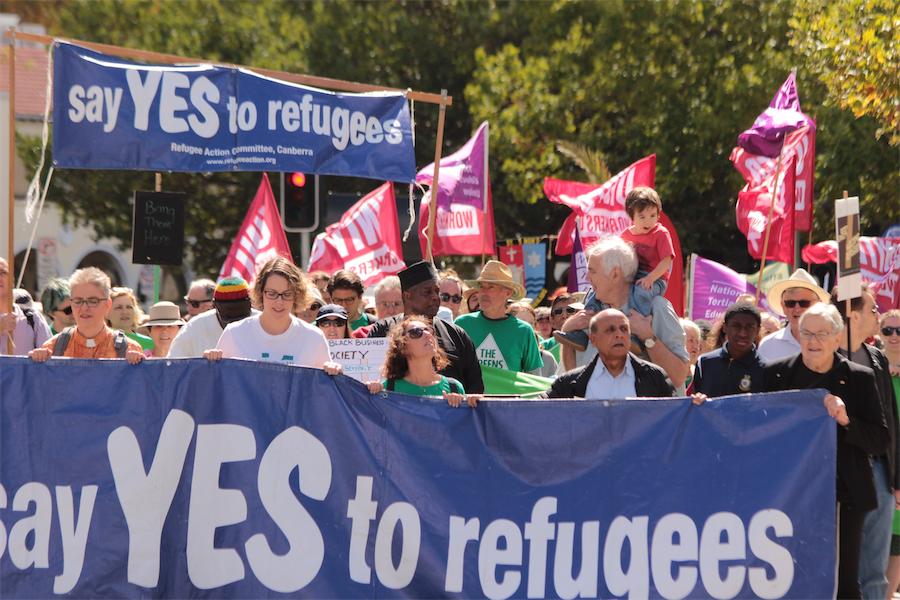
Here in Canberra, a wide range of organisations including the Anglican Diocese of Canberra and Goulburn, the United Church, Vinnies, Unions ACT and many other unions and community groups have endorsed this year’s Palm Sunday rally under the straightforward slogan “Refugees and Migrants Welcome Here”.
Perhaps the dark age can be avoided.
The Palm Sunday Rally will be held at Civic Square, 1pm, Sunday, March 29.
John Minns is emeritus professor in Politics and International Relations at the ANU and a member of the Refugee Action Campaign.
News all day, every day at CityNewsQBN.com.au.




Leave a Reply