Music / To Be Human: Canberra Symphony Orchestra, Australian Series. At National Museum of Australia. November 12. Reviewed by ROB KENNEDY
This concert raised a question many across the world are asking since artificial intelligence has exploded: is it a tool or a threat?
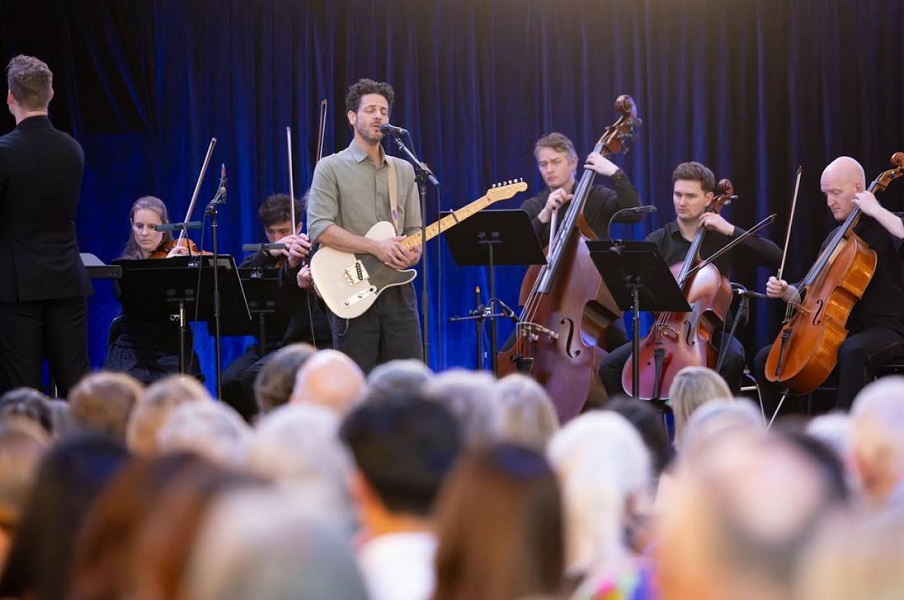
The humans to present this concert were Joel Bass, conductor; Lior, vocals and electric guitar; Ade Vincent, piano and electronics, and the CSO Chamber Ensemble.
Artificial intelligence (AI) has become so ubiquitous that many of us simply accept it without understanding how it works. It has infiltrated almost everything to the point that we are not even aware if we are using it.
But is it changing how we relate to the world and the very act of thinking and creating?
Joel Bass stepped in for Jessica Cottis, who was under the weather. But Cottis was there and spoke about the music. Bass is currently the assistant conductor of The Australian Ballet.
The concert opened with a work by Indigenous Australian composer Elizabeth Sheppard, her Kalgoorli Silky Pear. Originally written for the ANU School of Music’s 1770 Henrion square piano, which has a haunting harp-like quality. This version for strings breathed with a human touch through its romantic setting.
Rich in complexity and deep emotions, it seemed to sing an old song wrapped in a new design. Its warmth and beauty were without doubt the notes of a highly sophisticated human composer. The performance and conducting matched the quality of the music.
Happy Death day Mister Robot! by the late local composer Michael Sollis, whom this program was dedicated to, with Edward Neeman on piano accompanying the strings, began with a harmonic on solo violin above a threatening piano pushing out a low repeated octave.
It wasn’t long before what sounded like a jazzy upbeat, almost robot-like sound took over.
One could hear and feel a confused and dangerous entity trying to break free. But then a soft, sensual lead on solo violin spoke of a human connection before it ebbed to a slow, quiet finish.
The final work by Lior & Ade Vincent, To Be Human, in seven movements, is meant to show what is missing from AI music.
This idea might have been better represented without the use of a computer, a MIDI controller, and drum machine with live looping on a digital piano.
None of which are AI, and it’s not uncommon to hear this equipment in classical music concerts today, but it detracted from the intention.
With Lior on electric guitar and Vincent on piano and electronics, Vincent spoke of the separate composing process with Lior and how they mapped their emotions throughout, which they found aligned afterwards.
This very atmospheric composition, with recorded vocals, singing, and speaking, boomed strongly in this large, echoing space.
While not pop but contemporary, there was clearly much thought put into its construction. The overall work did not best represent the idea as too much of it reminded of the sort of style heard in some computer game music.
It was at points overly sentimental, but the sound quality could not be denied, to which many in the audience gave a standing ovation.
News all day, every day at CityNewsQBN.com.au.


Leave a Reply