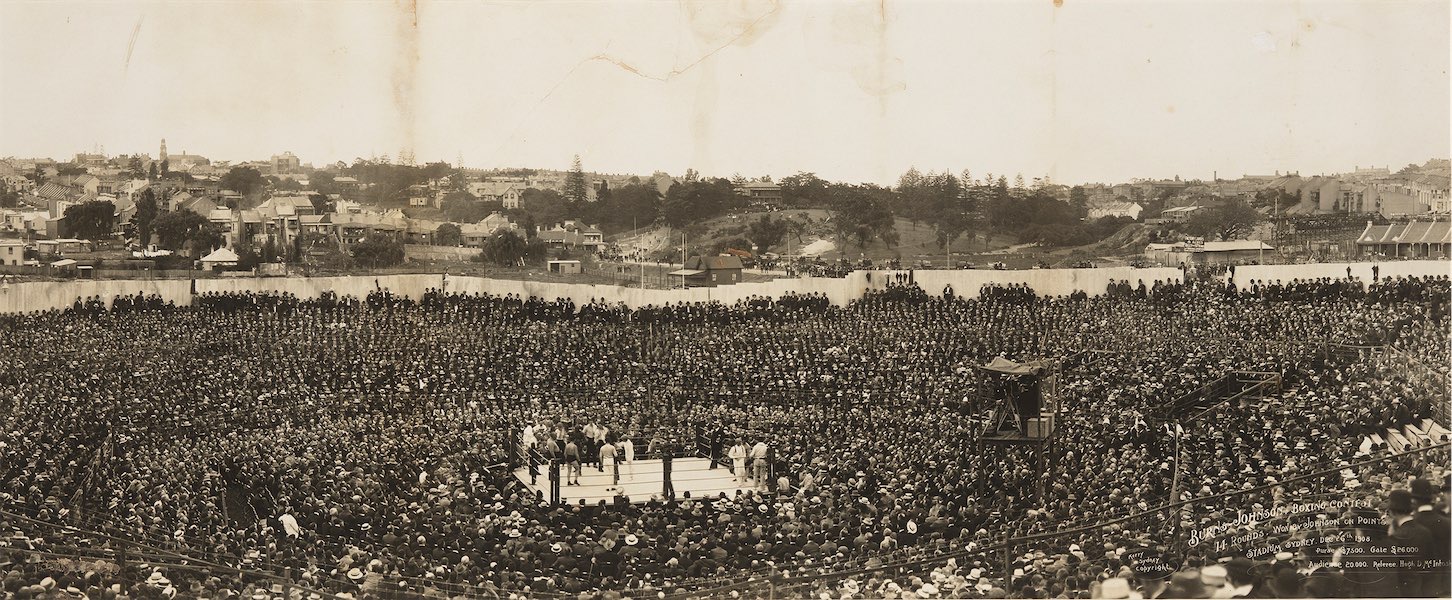
The world’s first ‘black vs white’ heavyweight title bout between champion Tommy Burns and challenger Jack Johnson, in Sydney, on Boxing Day, 1908 was to forever change the face of boxing, say ROSS FITZGERALD & DICK WHITAKER.
Bare-knuckle fighters were the boxing norm from the early days of the sport up until 1867.
This was when the so called Marquess of Queensberry rules were established, requiring boxers to wear gloves, plus timed rounds and regulations involving fighters who were knocked down.
The first recognised heavyweight champion under these rules was James “Gentleman Jim” Corbett, who knocked out John L Sullivan to win the title in 1892.
Other fighters followed who were all famous names back in the late 1890s to early 1900s and these included Bob Fitzsimmons, James L Jeffries, Marvin Hart and Tommy Burns.
They all had one major thing in common – they were white. Black fighters were just beginning to emerge with the first “black/white” heavyweight title bout fought between champion Tommy Burns and challenger Jack Johnson, in Sydney, on Boxing Day, 1908.
The Burns/Johnson fight was to forever change the face of boxing with several factors coming into play that eventually propelled the sport into the modern era.
Johnson was black, and Burns was white. This colour distinction was of prime importance at the time, presenting a seemingly insurmountable barrier that prevented black fighters from ever becoming World Heavyweight champion.
The Burns /Johnson fight finally, and permanently, brought this barrier down. The fight was, in many ways, extraordinary.
In addition to the colour bar, champion Burns was Canadian and the shortest heavyweight – only 5’7” – to win the title.
The referee, fight promoter Hugh D McIntosh, had never previously officiated in a boxing match, let alone a world championship bout. This situation arose from a dispute about the referee that was raised at short notice before the fight.
Johnson refused to accept the initial nomination, “Snowy Baker”, on the grounds that he (Johnson) did not like blonds – and Baker was undeniably a blond. Because there were difficulties in finding a replacement McIntosh took on the task himself.
And the fight was professionally filmed – reportedly the first World Heavyweight Championship fight to be captured on motion picture film. Remnants of this film exist today and are of considerable historical interest.
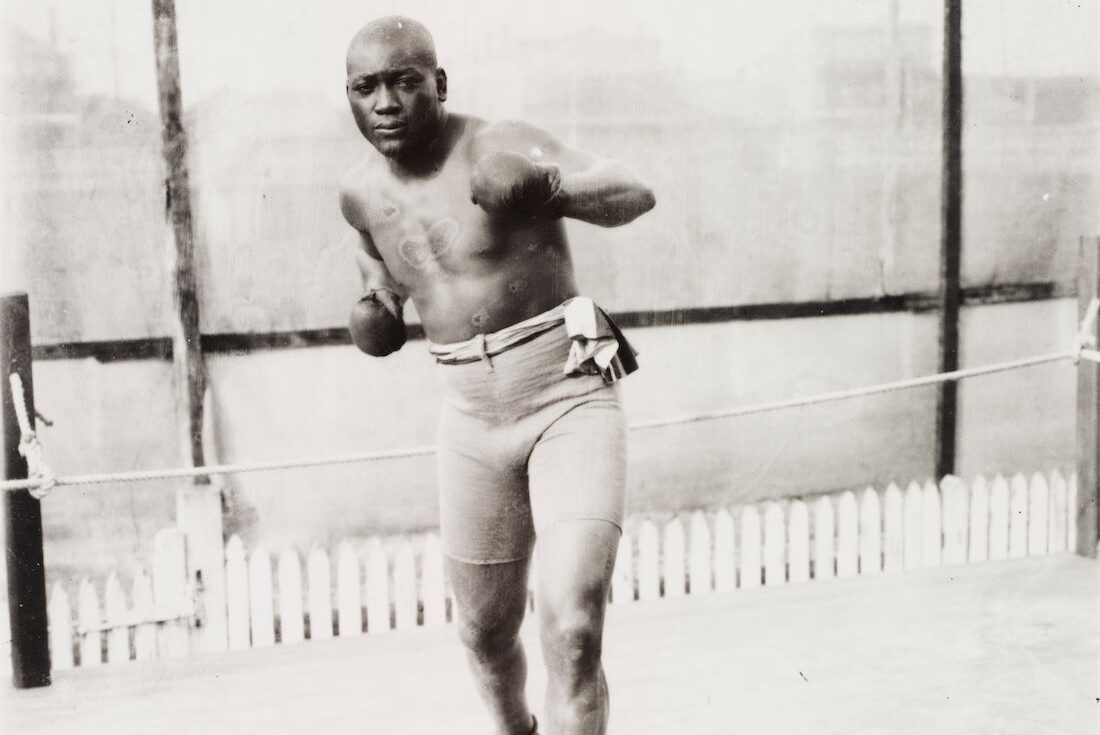
In the lead-up to the fight Burns had taken his championship title around the world over the previous three years, successfully defending it 11 times. Johnson had followed Burns around the globe during this period, attending all his fights and loudly mocking him in public, in an attempt to force acceptance to a title fight.
Finally, after several delays, this strategy paid off and a date and time were agreed to. It was December 26, 1908, at Rushcutters Bay, in Sydney, in a stadium that had been built by the promoter Hugh D (“Huge Deal”) Macintosh.
The purse offered to the fighters was considerable for the day. Burns was promised £6000, and Johnson, as the challenger, £1500. AI notes that “this was a record amount for a single fight at the time”.
The bout had generated massive interest, both in Australia and internationally, with a deep undercurrent of racism dominating all aspects of the fight.
It was considered inconceivable that a black man could ever win, or ever be allowed to win, the much-coveted World Heavyweight boxing championship and Burns himself considered that he would surely and rightfully become victorious.
A crowd of 20,000 people turned up and the invincibility of the white fighter began to be doubted as soon as the combatants entered the ring. Burns appeared diminutive alongside the towering Johnson who was over 6’1” tall and tipping the scales at 192 pounds. Burns was 5’7” and weighed in at only 168 pounds.
Soon after the fight got under way it became obvious that Johnson was the superior fighter in every way – speed, power and ringcraft.
Johnson toyed with Burns, particularly in the clinches where he tied Burns up and mocked him, stating loudly that he was totally unimpressed with his opponent’s skills.
Johnson also chatted to the crowd, smiling broadly during many of the fistic exchanges. Johnson had numerous gold fillings in his teeth, and his facial expression was described as “a golden smile”.
“Poor little Tahmmy – who told you you were a fighter?” and “Poor, poor Tahmmy. Who taught you to hit. Your mother?”
Johnson did not appear to be trying all that hard until the 14th round when he suddenly changed gears and bombarded Burns with a series of devastating punches, including massive uppercuts that snapped Burns head back on several occasions.
The New York Times later reported:
“The end came in the 14th round when the police, seeing Burns tottering and unable to defend himself from the savage blows of his opponent, mercifully stopped the fight.
“Previously it had been arranged that if the police interfered a decision would be rendered on points, and referee McIntosh without hesitation declared the big black man the winner, for all through the fight he had shown himself Burns’ master in every style of fighting.”
‘The fight? There was no fight’
The famous American novelist and writer, Jack London, had been despatched to Sydney to cover the fight for the New York Herald. He wrote:
“The fight? There was no fight. No Armenian massacre could compare with the hopeless slaughter that took place today.
“The fight, if fight it could be called, was like that between a pygmy and a colossus… but one thing now remains. Jim Jeffries must emerge from his alfalfa farm and remove the golden smile from Jack Johnson’s face. Jim, it’s up to you! The White Man must be rescued.”
The Jim Jeffries referred to was a World Heavyweight champion before Burns, and he remained champion up until his retirement, to his alfalfa farm, in 1905. He was a powerful and muscular man and London later described him as “The Great White Hope” who would return the championship to its rightful pace – that of the white man.
Two years later, on 4 July 1910, Jeffries came out of retirement and fought Johnson for the World Championship only to be knocked out in the 15th round. This triggered race riots across America during the following week.
Jack Johnson was arrested in October 1912 for “violating the federal Mann Act that prohibited transporting women across state lines for immoral purposes”.
This was seen by many as a racially-motivated charge that arose from his relationship with future wife Lucille Cameron and was designed to take the World Championship belt away from him.
To escape incarceration, Johnson fled overseas to various locations over the next seven years, including Europe, South America and Mexico. He eventually returned to America in July 1920 and served a year at the Leavenworth Penitentiary on the original 1912 charge of violating the Mann Act.
Jack Johnson was tragically killed in a car accident near Franklington, North Carolina, on June 19 1946, when he was 68 years old.
And in a final, remarkable twist to this already remarkable story, a posthumous Presidential Pardon was granted by Donald Trump on May 24 2018. This was 105 years after Johnson’s conviction and was an early example of President Trump’s presidential intervention in sport.
Johnson’s position in boxing history is assured. In the hotly debated historical rankings of heavyweight world champions he is consistently rated in the top 15 fighters of all time.
History professor Ross Fitzgerald’s latest books are Rogue: A Fictitious Memoir and Chalk and Cheese: A Fabrication.
Dick Whitaker is a leading Australian meteorologist and historian.
News all day, every day at CityNewsQBN.com.au.




Leave a Reply