By Jennifer Dudley-Nicholson
Changing one ingredient used to create green hydrogen could multiply its production up to 80 times, according to an experiment undertaken by Australian researchers.
The finding could help producers cut emissions from hard-to-abate industries including aviation, shipping and steel production, though more trials would be needed to prove the process worked outside a laboratory.
Researchers at RMIT University in Melbourne, in addition to two Chinese institutions, released the results of their experiments on Tuesday in a peer-reviewed energy and environment journal.
The results come after several large resource companies suffered setbacks in their efforts to produce the green fuel, with production facilities cancelled in states including Queensland and Western Australia due to rising costs.
Green hydrogen has long been forecast to play a role in cutting greenhouse gases from challenging areas of the transport industry, such as road freight and shipping, as well as reducing emissions from the production of iron and steel.
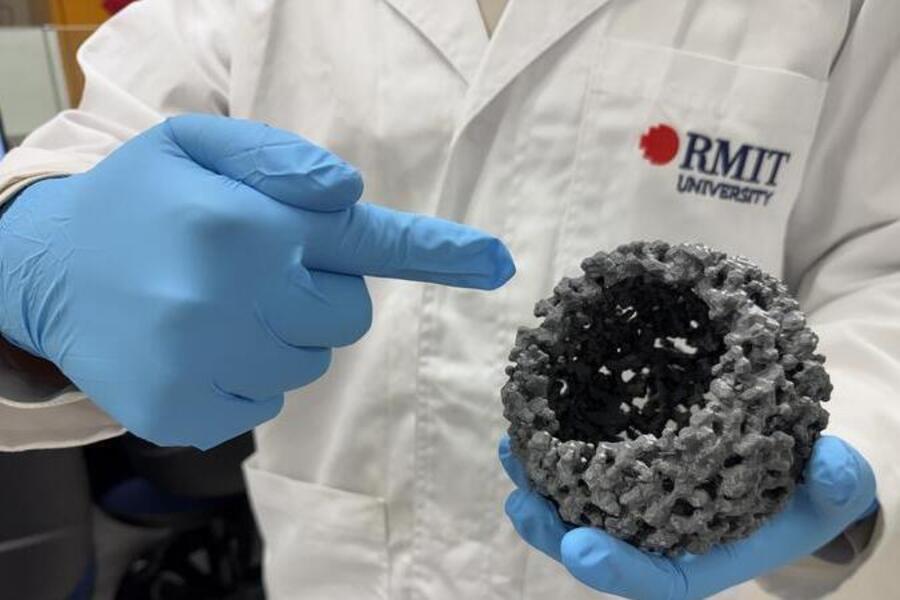
Researchers at RMIT, Zhoukou Normal University and Xinyang University investigated changing the properties of a compound used to produce hydrogen to make the process more efficient and affordable.
The material, called titanium dioxide, is inexpensive and typically used in coatings and paint pigments.
Scientists made a series of changes to the compound, including adding small amounts of nickel and changing how energy moves through it, RMIT material scientist and lead author Dr Derek Hao said.
Changes helped the material retain energy longer, particularly when exposed to ultraviolet light, and allowed it to produce 80 times more green hydrogen than untreated titanium dioxide in a lab.
“By showing how a common material can be improved to produce more hydrogen, the study points to a practical direction for future work,” Dr Hao said.
“If similar gains can be achieved under real-world conditions, it could help bring down the cost of clean hydrogen production at scale.”
The upgraded titanium dioxide performed consistently over repeated tests, according to the paper published in Applied Catalysis B: Environment and Energy, though the process would need to be replicated under direct sunlight and without the use of added chemicals in future.
Green hydrogen has proven challenging to produce in Australia, where projects planned for Western Australia, South Australia, Tasmania and Queensland have been cancelled.
But mining firm Orica announced its Hunter Valley Hydrogen Hub had reached a final investment decision on July 1, and would be used to produce 4700 tonnes of green hydrogen each year by 2029 and cut the company’s use of gas by 7.5 per cent.
News all day, every day at CityNewsQBN.com.au.




Leave a Reply