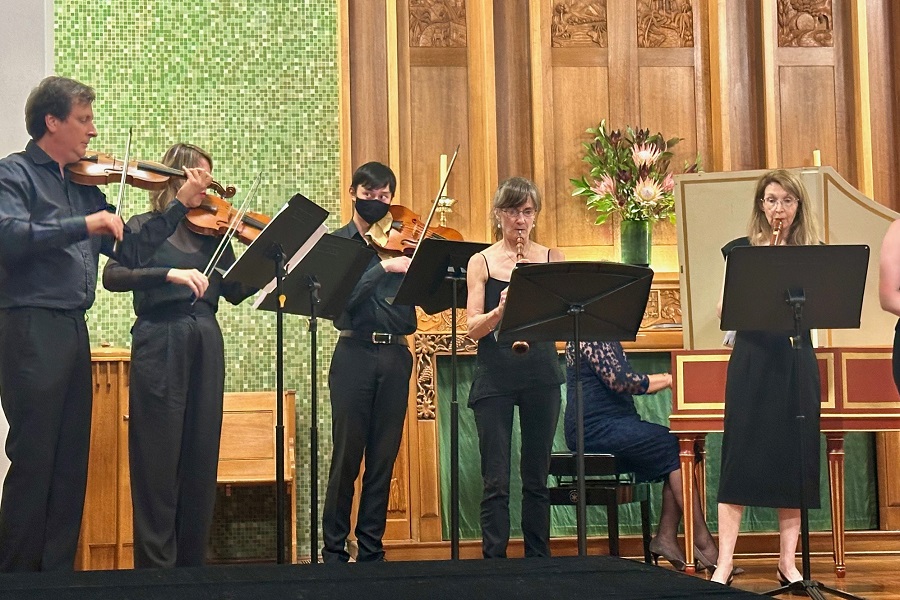
Music / Charms in Musick, Salut! Baroque. At Wesley Music Centre, November 13. Reviewed by MICHAEL WILSON.
Canberra’s specialist Baroque chamber music institution Salut! Baroque is remarkable in several ways.
The ensemble is now completing its 31st year of performing and music-making, under the wise and expert artistic direction of Sally Melhuish (recorder) and Tim Blomfield (cello). It continues to deliver a colourful variety of artistic collaborations and assemble fascinating programs across its four-concert annual season. And finally, performance quality is not only extremely high, but utterly consistent.
For this final concert of the 2026 season, the audience was challenged to think about the Enlightenment notion that music set to words and sung was a superior form compared to purely instrumental music. Can music without words convey fundamental human emotions, moral narratives or even new ideas?
The job of illustrating any fundamental contrast fell to soprano Anna Fraser, playing her parts in a program of well-known and more obscure composers, predominantly from the 17th and 18th centuries. Alternating between sung and instrumental pieces, the menu of nine works also employed various combinations of the nine instrumentalists.
Beginning with an Air by Handel, Guardian Angels, Oh Protect me, Fraser’s authentic Baroque soprano technique (marked by the restrained use of vibrato, purity of sound and deliberate, overt dynamic contrasts) lit up the Wesley church space, matched exquisitely in duet with Baroque oboe (Jane Downer). Because of Wesley’s high timber ceiling and narrow nave, high notes with a bright timbre (reeded instruments, flutes, recorders, soprano voices) can tend to flatten as they reverberate, but this ensemble’s energy and technique seemed to anticipate this and there was no sign of this phenomenon.
Unfortunately, a mark of greatness for a Baroque harpsichordist is that they go unnoticed. Monika Kornel executed a superb performance at the keyboard – constant, adaptable, precise and dynamic. Across a demanding program, she was steadfastly reliable, sensitive to the singer and to instrumental solos.
Stephen Freeman (violin) led subtly when the full line-up played, and all entries, cutoffs and tempo changes were executed precisely and with no fuss. Brad Tham (viola) exuded energy and joy, and Jude Hill (double bass) was a supremely sensitive presence in continuo and solo roles.
Highlights included two passionate and gutsy pieces – Che si può fare (I wooed her, I loved her) by Barbara Strozzi, and El Fuego (the fire) by Mateo Flecha – which suited Fraser’s vocal and theatrical abilities brilliantly.
There is no better composer for the recorder than Telemann, and his Concerto in A minor featured a sublime recorder duet between Melhuish and Alana Blackburn, underpinned by Blomfield’s cello. Pergolesi’s virtuosic demands on the oboist – navigating all possible reaches of technique on the Baroque version of the instrument – are extreme in his Aria Lieto Così Talvolta (thus happy at times), but Downer cheerfully answered the challenge.
So, what of the question posed by this program? Can chamber instrumental music reach the soul and speak to human needs and anxieties? Well, of course it can. But having a singer is always nice, too.
News all day, every day at CityNewsQBN.com.au.


Leave a Reply