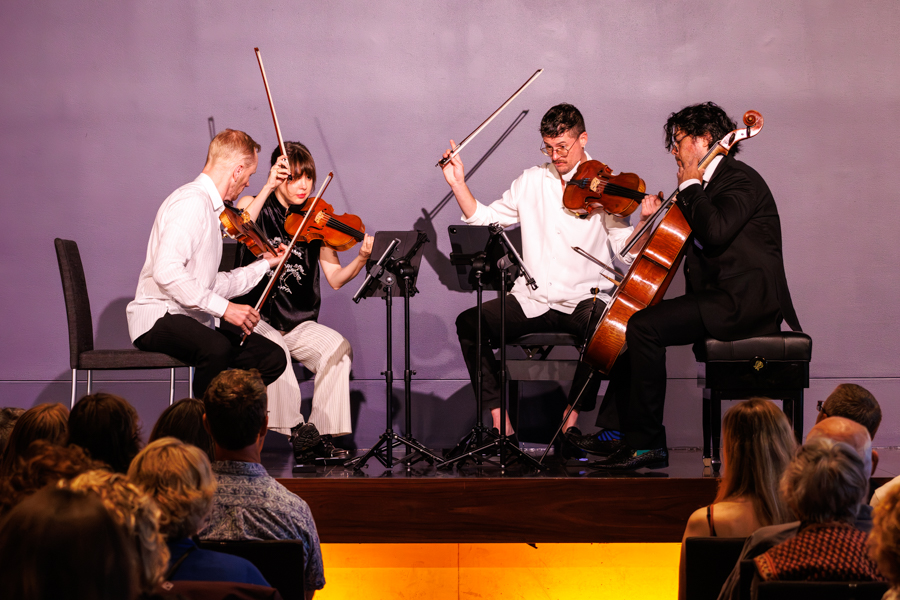
Music / Voyager, Australian String Quartet. At Gandel Hall, National Gallery of Australia, October 25. Reviewed by MICHAEL WILSON
There is certain repertoire in the classical music canon that can successfully survive a performance by a second-rate ensemble.
The music of Hungarian composer and ethnomusicologist Béla Bartók is not in this category. It is as technically challenging as it is original and affecting. Luckily, his String Quartet No. 4 was in the hands of Australia’s premier string quartet and they did a breathtakingly fine job with it.
Bartók’s work formed the centrepiece of this program named in recognition of the Voyager interstellar space probes launched by NASA in 1977. But it started with Irish composer Garth Knox’s 2015 work Satellites – a highly original and experimental journey in three movements on the theme of manmade objects in near-Earth orbit.
The setting is aboard the International Space Station, with the second movement evoking three sunrises observed in a day (and a spacewalk!) and the third movement conveying the different directions of travel experienced in space.
Knox uses plucked rhythms, discord, broad glissandos, soundscape and percussive elements to paint the scene of a very foreign – and daunting, if not hostile – environment, but there are also folk music phrases and intervals which connect the experience to what’s going on below on Earth.
Sawing bowed techniques up and down the fingerboards of the ASQ’s four eighteenth century Guadagnini instruments created an eerie, restrained and less resonant feel. In the conclusion, whipping the bows through the air produced whooshing sounds which added to sense of speed (although a well-known local luthier in the audience, aware of the physics involved, had a look of mild horror on his face).
Then to the five-movement Bartók work, percussive statements between the violins (Dale Barltrop and Francesca Hiew) opened the conversation, then established a driving rhythm with nods to the folk melodies of Eastern Europe. The work is marked by sections where each instrument goes off on its own journey, coming together again either rhythmically or melodically (or both) to provide structure and narrative.
In the second Prestissimo movement, a syncopated exchange between the cello (Michael Dahlenburg) and viola (Chris Cartlidge) was like two cats on the fingerboards. The anchoring third movement was just superbly played – gypsy violins over a cello solo, and then marcato interjections by the first violin playing high and the second violin lower in its register.
Beethoven’s String Quartet in B-flat Major concluded the stormy Canberra afternoon, with the ASQ performing the original (and, in 1825, very controversial) version with the Grosse Fuge as the final movement.
A late and incredibly complex work, with the profundity and courage that Beethoven developed after deafness descended, the six movements all contrast with each other. The fourth movement – a German dance – has the four instruments handing off to each other in the most charming play.
This performance was technically superb, especially with the massive physical challenges of each piece. It was also spirited, entertaining and full of beautifully-wrought contrasts of tempo and dynamic.
News all day, every day at CityNewsQBN.com.au.


Leave a Reply