By Ben McKay
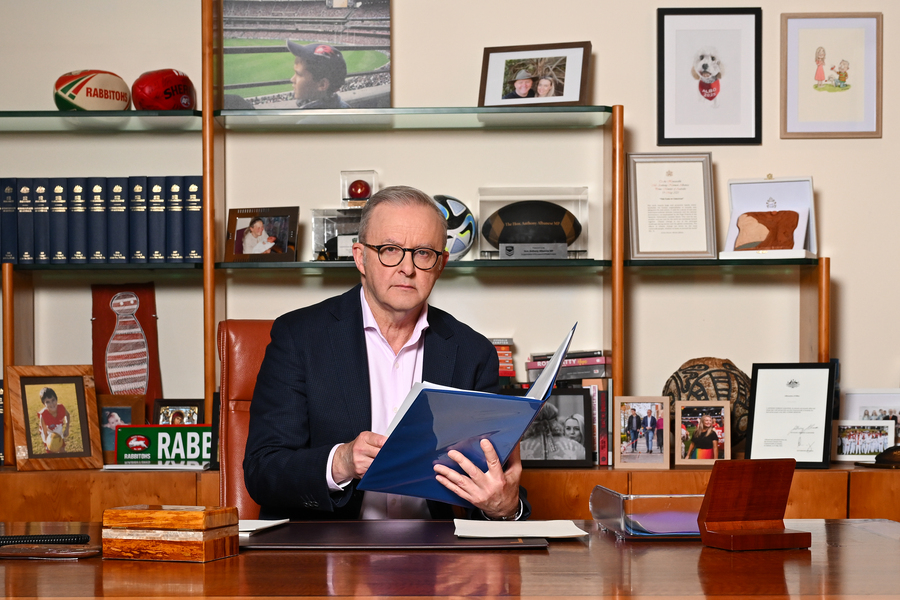
Anthony Albanese has allocated himself more political staff and is paying them more than his predecessors, while reducing the hire count for the cross bench.
A new Centre for Public Integrity report into political staffing allocations over the last 13 years shows a top-heavy prime minister’s office, with a ballooning proportion of well-paid senior roles.
Three quarters of Mr Albanese’s current 59 political staff are categorised as senior, compared to 61 per cent when he took the role, and under half during Tony Abbott’s prime ministership.
Annual salaries, not including travel and other allowances, afforded to senior staff range from $156,510 to $317,152, while non-senior staff top out at $167,530.
Political staff – who are employed over and above the regular allocation of electorate officers to every MP and senator – and their pay bands are set at the prime minister’s discretion.
Using this power, Mr Albanese has also grown the prime minister’s office to the largest it has ever been.
The prime minister’s office had 51 staff at the 2022 election, it spiked at 65 before the 2025 election, before settling back to 59.
That is more than the entire crossbench combined, with the Greens enjoying 17 extra staff, One Nation five, and 17 independents (including one-person parties), totalling 30 extra staff.
One independent – former Labor Senator Fatima Payman – has been denied any extra staffing resources, in what she believes is retribution for leaving Labor.
Mr Albanese has starved the cross bench of staff compared to his predecessors.
Each crossbencher enjoyed the support of an average 2.6 extra staff when Mr Albanese took office in 2022, when he immediately cut that to 1.4. It is now 1.5.
Political staffing allocations are on top of the regular five electorate staff (or more if the MP is servicing a large electorate) to which every MP and senator is entitled.
Asked about the fairness of that allocation, Mr Albanese referenced his 2023 decision to expand electorate officers from four to five.
“It’s not the system that I created. It’s one I inherited, and we increased the staffing for every member of the House of Representatives and the Senate,” he said.
Crossbenchers say extra staff are vital as they need to get across vast amounts of legislation without a party apparatus to help them.
Independent Kooyong MP Monique Ryan said staffing for parliamentarians was “an important integrity measure”.
“(It) should be decided by an independent authority, not by our prime minister,” she said.
“It should be not a political question. It should be a question of equity, and parliamentarians should be given sufficient staff to be able to do their job properly.”
Tasmanian Senator Jacqui Lambie agreed it “needed to be taken out of the PM’s hands”, as does the Centre for Public Integrity.
Mr Albanese also stands accused of using staffing as a bargaining chip in negotiations, including to the opposition for support on key votes.
News all day, every day at CityNewsQBN.com.au.



Leave a Reply