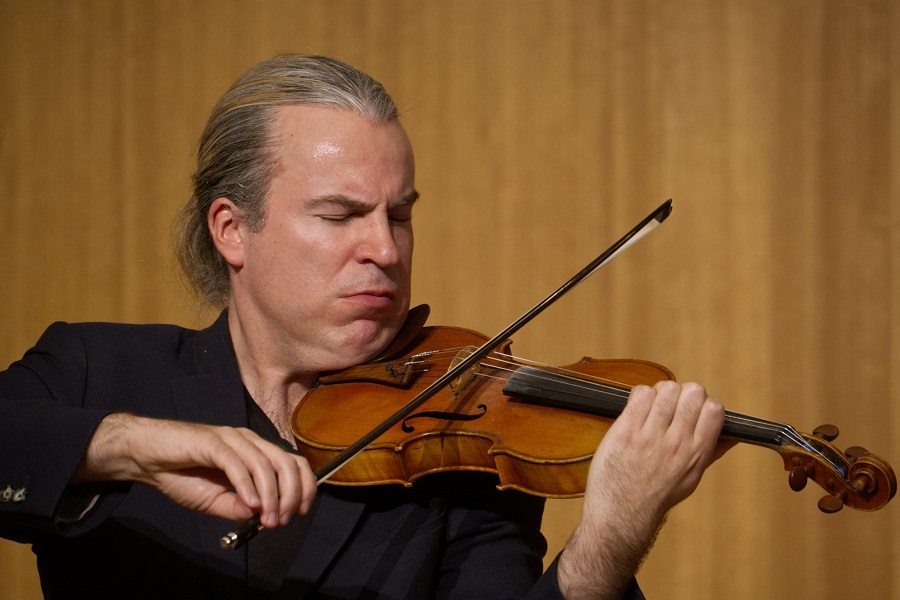
Music / Part II, Bach Partita and Paganini Caprice Cycles, Daniel Röhn, Wesley Music Centre. October 25. Reviewed by DAVID WHITBREAD.
Wesley Music Centre doesn’t disappoint.
When an artist with such an international reputation presents a solo recital, expectations are high. And Daniel Röhn exceeds them splendidly.
As he said, it started with the serious bit and moved into the fun stuff. What an understatement in both cases.
He began with JS Bach’s Partita No. 1 in B minor, an eight movement tour de force. It was not unlike the familiar solo cello suites, but for solo violin.
Bach followed the partita’s four movement form – allemande, courante, sarabande and gigue – but substituted the gigue for a bouree. The eight movements come from a ‘double’ (from the French) of each, elaborating on the chord progressions from the preceding work.
A grand theme began the opening allemande, performed with rhythmic firm vibrato, accurate trilling and turns. The double courante was performed at startling speed with nicely shaped lines. The sarabande was almost entirely in two distinct voices with multiple stopping throughout and quite incredible to hear – and see – it coming from only one instrument. The final double bouree demonstrated great dynamic contrast.
This is artistry rarely heard so distinctly and consistently. Röhn uses the full length of his bow – and maintains strength across its length. He achieves a mighty volume from his instrument, even in his secure double stopping.
All works in this recital were played from what must be a prodigious memory. And I’d have to say with a no-nonsense presentation style. Daniel is not ‘showy’ – his movement is contained and always in service to the composer. You witness him crafting the sound and shaping each line with intelligence and accuracy.
After a short break, he returned to the Wesley stage to perform four of the Paganini Caprices. ‘Fun stuff’ they certainly are – but they take the technical demands on the violinist up a notch.
It is masterful programming to pair them with the Bach Partitas. You witness almost a century of musical development from the Partitas of 1720 to the Caprices written over almost 20 years up to 1818.
Interestingly, for a solo violin, they feature many of the same techniques of rapid notes and double or multiple stopping. Spread chords across the four strings. Different lines on two adjacent strings. The difference being in the harmonic and melodic complexity – and the speed!
Paganini himself was a noted violinist of his age, so players are put through their paces by these works. Once again, Röhn meets the challenges with artistry and supreme musicality.
From the opening of No. 8 in E flat major, he demonstrated incredible dexterity, his left hand and fingers leaping along the neck and fingerboard, his bow reaching dazzling speeds.
No. 19 in E flat major continued the beautifully held long notes on one string which sang, while another string had light running passages played underneath. Fantastic descending and ascending sequences, often in parallel thirds or even octaves on occasion. Crystal clear harmonics.
No. 18 in C major started and finished with almost a horn call that seemed to be all on the G string. It featured delightful German folk-like dance rhythms with the bow fair hopping along.
No. 5 in A minor finished the recital with a flourish at simply incredible speeds and completed the drama of the set.
The small but appreciative audience, which included many violinists and violists from Canberra, were enraptured. Don’t miss the next parts in this inspired series.
News all day, every day at CityNewsQBN.com.au.


Leave a Reply