By Helen Musa
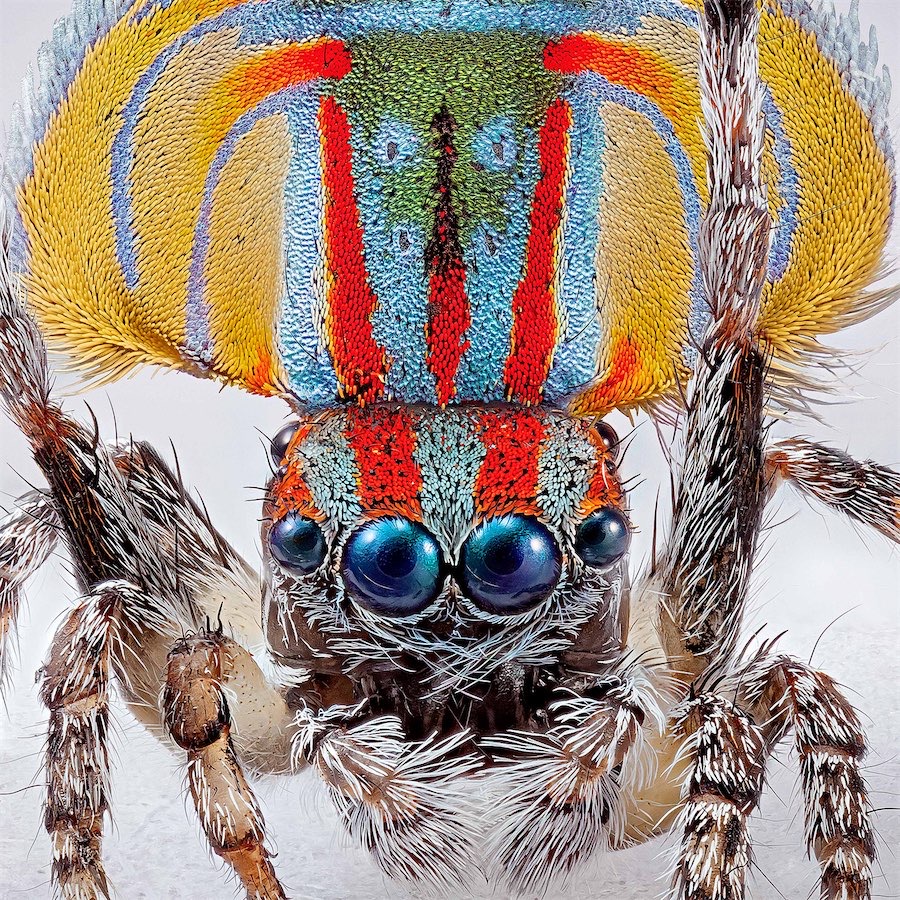
The male Maratus spider may well be the sexiest insect in the world, if viewed properly, far sexier than the peacock after whom the tiny arachnid has been nicknamed.

The peacock merely struts his stuff, but the Maratus spider, opening his glorious fan tail to attract the attention of his camouflaged yet more powerful female counterpart, actually dances his way into her affections.
So says leading Colombian-Australian artist Maria Fernanda Cardoso, who posits the idea that spiders were creative artists millennia before the human species was even thought of.
Cardoso’s theories are being put to the test in her photographic exhibition Spiders of Paradise at Canberra Museum + Gallery. The show has been developed and toured by the Museum of Contemporary Art Australia.
The exhibition is specific to the Maratus spiders endemic to this region, with Maratus harrisi having been discovered in Namadgi National Park.
Audiences will be able to view videos of a real spider’s tantalising dance.
Small matter that arachnophobia still rates among the top three universal phobias, after ophidiophobia, fear of snakes, and acrophobia, fear of heights, CMAG is determined to take humans, young and old, into the spidery world.
Alongside the exhibition, veteran dance teacher Jane Ingall will conduct workshops where under-fours can imagine dance movements drawn from spiders, leg and arm movements, maybe even a finger dance, and another inspired by spiders making homes in leaves.
Cardoso has lived in Sydney since 1997. Her work is held in the Museum of Modern Art and the Tate. Noted installations include While I Live I Will Grow (2018), commissioned by the City of Sydney Council as part of the Green Square Public Art Program, and Cemetery: Vertical Garden (1999), commissioned by the Museum of Modern Art, New York, for the exhibition Modern Starts: People, Places, Things.
Cardoso is not at all afraid of spiders. As a child in Bogotá, she tells me, her father collected egg sacs from spiderwebs from around the house and fed them to the fish.
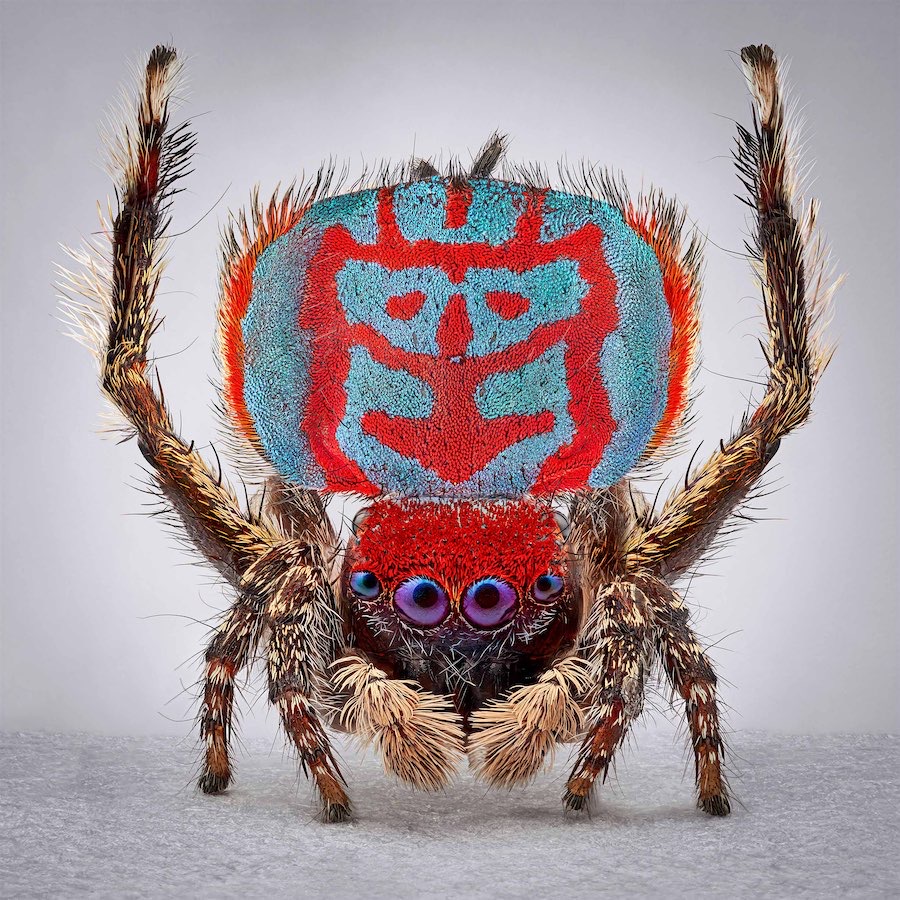
Besides which, her favourite Maratus spiders, commonly called Peacock Spiders because of their brilliant fans, are so small she believes they surely can’t terrify anybody.
“When you look at them, they are magnificent, sophisticated and beautiful as their fans change,” she says. “It’s fascinating how the male spiders use their patterns to seduce the female of the species.
“My idea is to put them on an equal footing with humans so that they can look each other in the eyes.”
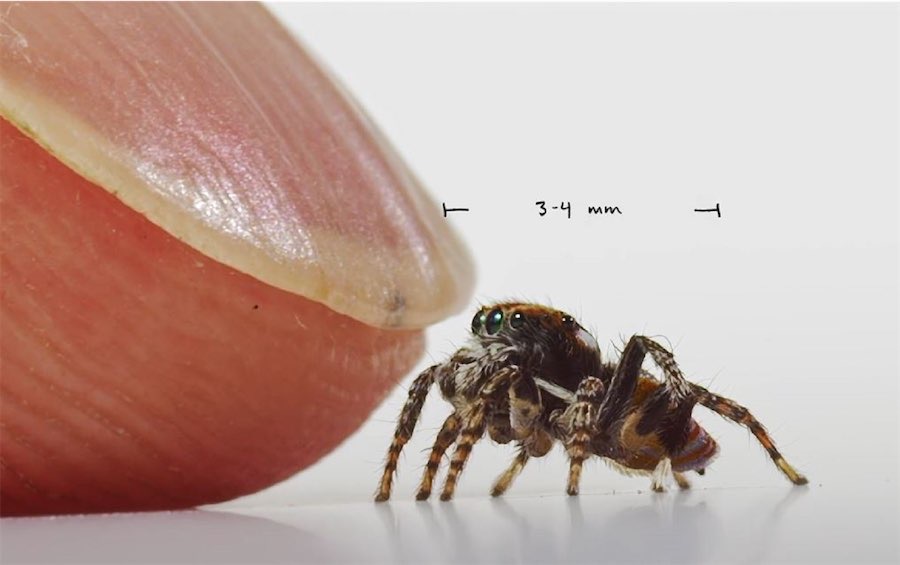
Of course, the spiders have a great advantage over humans because most of them have eight eyes, so even though they are only between one and four millimetres long, they are highly visual animals and, in her view, true artists, “deliberate in the use of gesture, form, colour and pattern”.
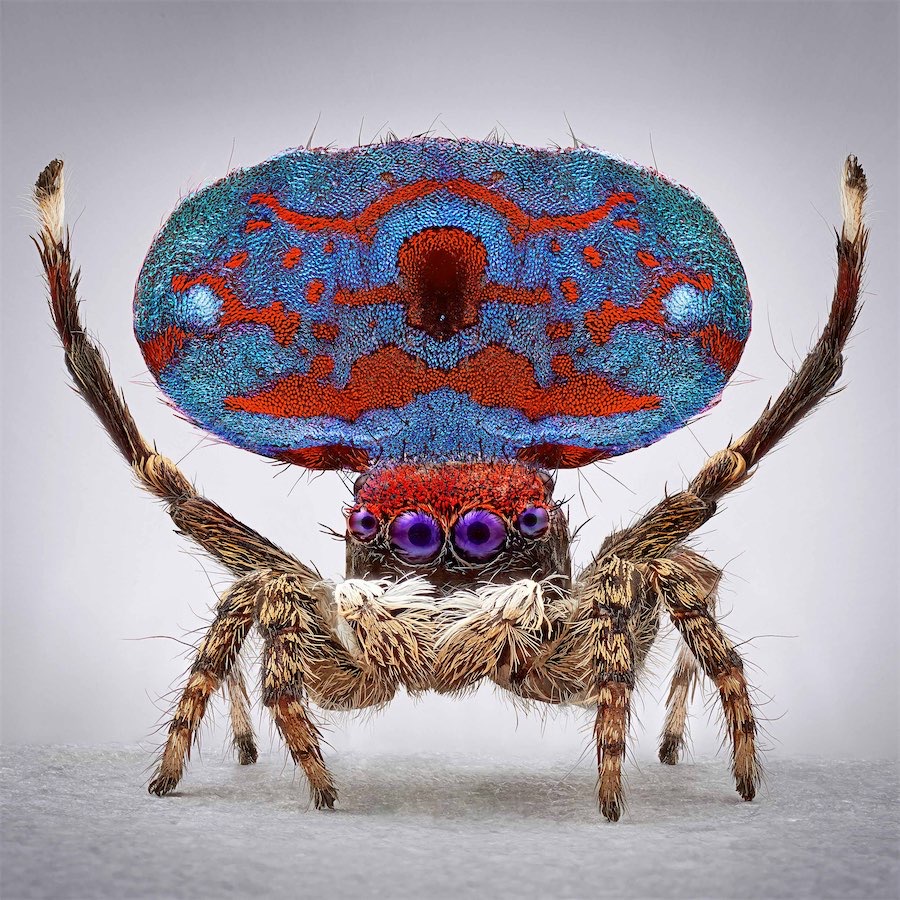
“It’s common for the males to have a tail that opens up like a fan, risking their lives to be flamboyant, while the female is more cautious.”
Quick to defend the species, Cardoso says it’s a myth that female spiders always eat the males, unless, of course, people forget to feed them.
The exhibition, on which she has worked for 10 years, consists of 17 1.57-metre x 1.57-metre, large-scale photographs showing one female and 16 males. The challenging technique involved using more than 1000 individual photos to make every detail come to life, focus-stacking under a microscopic lens. It came out mostly perfect except for the hairs, which she spent months touching up manually.
As well, Cardoso tells me there is a large-format video, On the Origins of Art¸ in which viewers will be able to feel the vibrations of sounds travelling through the ground when the spiders dance, yet another way of getting humans to feel what the spiders feel.
Fascinated ever since her husband showed her a YouTube video of Maratus spiders, it is more than display that intrigues her, it is the movement.
She had seen some spiders performing the rare courtship dance at a museum and also noticed that the Maratus are hunter spiders, not web builders, so they have to navigate space in quick jumps.
“They are visual artists and they are true performing artists… and they know how to sing and gesticulate in choreography where each dance is slightly different from the others,” she says.
“So who says that humans invented art?”
Maria Fernanda Cardoso: Spiders of Paradise, Canberra Museum + Gallery, May 29-August 23, free entry.
News all day, every day at CityNewsQBN.com.au.



Leave a Reply