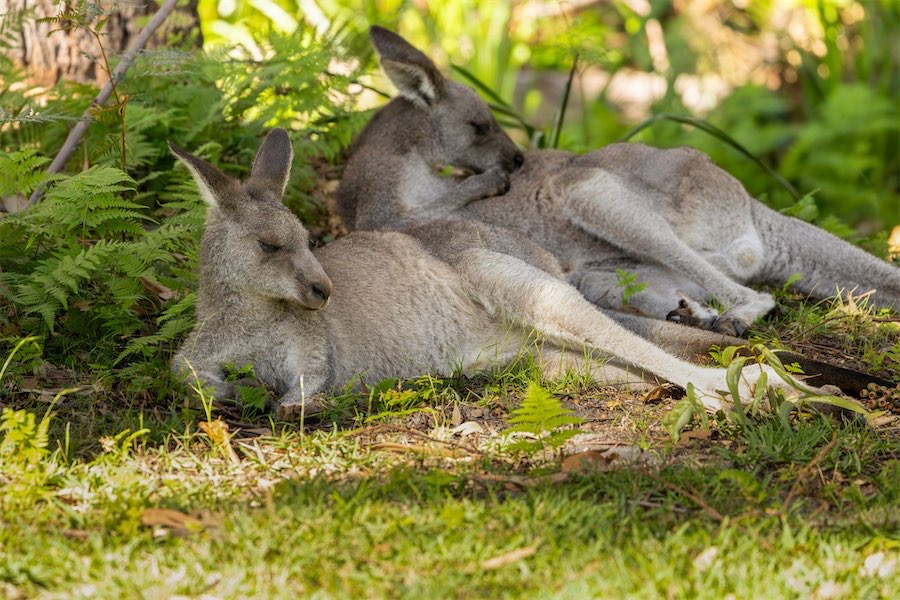
“What’s required is that a significant majority of Canberrans welcome Eastern Greys into their gardens as eaters-down of lawns, trimmers of hedges and such. Frankly, I cannot see that happening,” laments IAN MacDOUGALL.
One night in 1930, a Tasmanian farmer Wilf Batty, of Mawbanna, heard a commotion in his chook house and, rifle in hand, went to investigate.

A short time later, he shot dead the last wild thylacine, or “Tasmanian Tiger”.
Six years later, the last known member of the species died at Beaumaris Zoo in Hobart. Only two months before, the thylacine had been granted protected status.
For all the previous history of Tasmania, going back to Captain Cook’s time, there had been open season all year round on these apex predators.
A study published in 2025 proposed that gene losses that accumulated throughout the thylacine’s evolutionary history made the species more susceptible to extinction.
The authors suggest that genetic traits that would have made the thylacine more capable of adapting to environmental changes were lost and that these losses may have contributed to their eventual demise.
It is my contention here that, thanks to both declining numbers coupled with likely gene loss, the total extermination of the Eastern Grey kangaroo is most likely far closer than we Canberrans think, or for that matter any of the local politicians we elect to the House of Assembly. And so, Chief Minister Andrew Barr and his government and ALP-Greens cronies have likely turned us all into a collective Wilf Batty.
In the Darwinian contest for “survival of the fittest”, it is the predators on the kangaroos that select out the least fit of them: the oldest, the slowest, the weakest. They are very good at it, because their lives depend on it.
Likewise, in this natural contest, the strongest of the prey animals: the females best able to protect themselves and their young; the males best able to defend their family group and give the predator a thorough kicking, operate to select out the least “fit” of the predators. Natural selection is thus a two-way street.
Enter the shooter, likely riding on a quad bike, or in a 4WD utility, and the last kangaroo predator left. Gene selection in or out of the hunted population now plays no significant role.
So come the arrival by natural mutation of a virus or bacterial species already here, or transported in by a migratory bird, of the kangaroo equivalent of COVID-19, AIDS, bird ‘flu, tuberculosis or whatever, the national kangaroo population could be so polluted by genes that long-term decline leading to extinction could likely be the only future for the species.
At the present time, no farmer or grazier ever gets prosecuted for shooting kangaroos without a permit, or even with one, but for shooting in the wrong place at the wrong time.
National parks and reserves are commonly regarded as refuges for pest species, such as rabbits, ‘roos, and wombats. As one farmer’s wife put it to me once: “They all want shooting out. Really!”
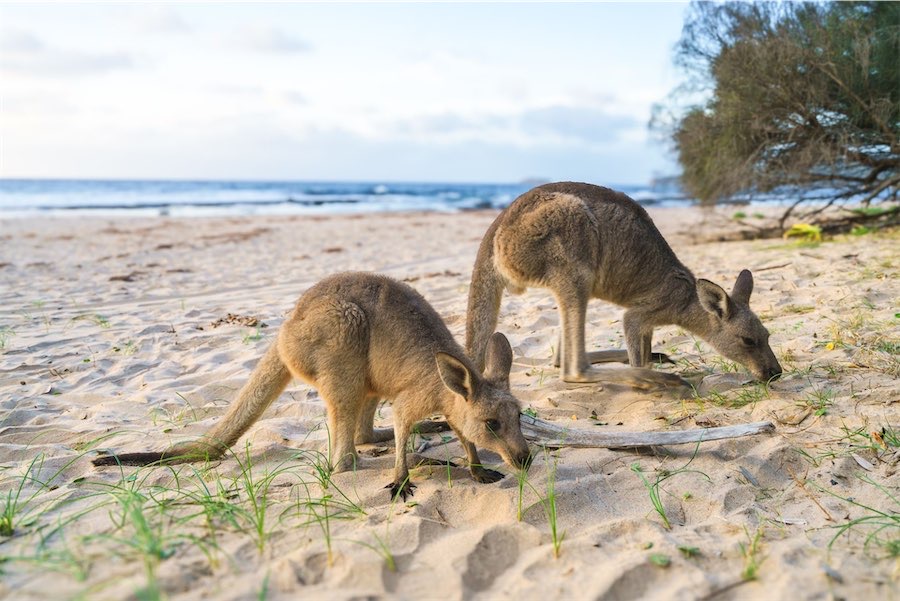
These days, I am reluctantly forced to the conclusion that there is no future for the Eastern Grey kangaroo as a species.
Random mutation will still go on, but increasingly, the selection will be random also, leading to increasing genetic scrambling and accelerating decline of the population; as the bushfires in the ever-thickening pyrophytic bush around Canberra steadily increase in frequency and intensity.
The only significant “predator” left is the automobile, and its insurers will be the main lobby in favour of continued shooting and the random gene selection that goes with it. I take government denials on this with an enormous shovelful of salt.
What is required is that a significant majority of Canberrans welcome the Eastern Greys into their gardens as eaters-down of lawns, trimmers of hedges and such. Frankly, I cannot see that happening either.
As the Eastern Greys approach and pass their point of no return on their way down the road to extinction, too few will see that future unfolding for them. And our ALP-plus-phony-Greens government will have turned us all, whether we like it or not, into a collective Wilf Batty.
Ian MacDougall, a former science teacher at Narrabundah College, has a BA from Sydney University and has studied physics, chemistry, biology and geology at tertiary level.
News all day, every day at CityNewsQBN.com.au.



Leave a Reply