By Eleanor Wilson
The first evidence of dinosaur blood has been unearthed in a 115-year-old fossil by an Australian-led global research project.
Researchers from Perth’s Curtin University collaborated with palaeontology teams from across the globe as part of an Australian government-funded study probing soft tissue preservation in fossils.
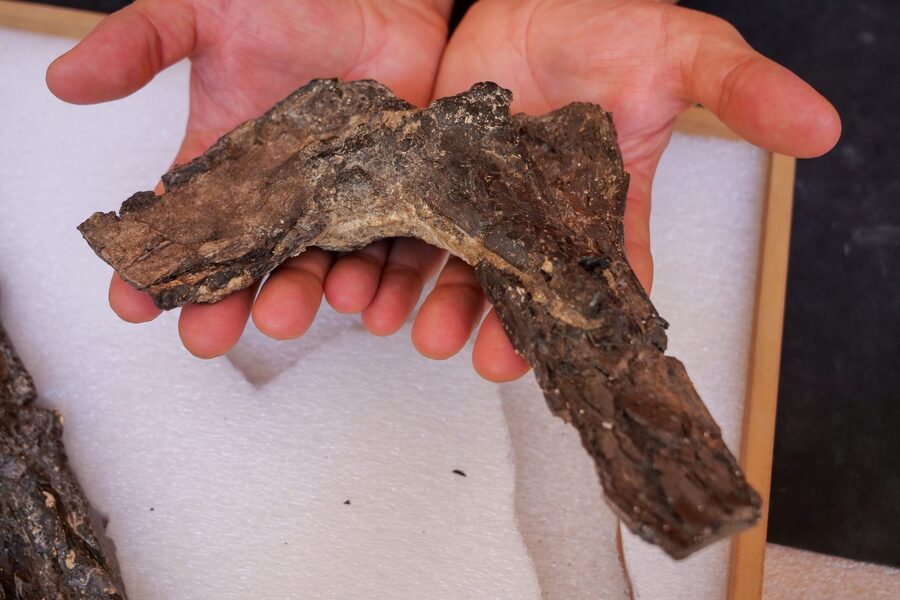
The National Museum of Brazil sent the aratasaurus bones from an existing collection to the study’s lead author Professor Kliti Grice more than a year ago.
They were dug up 18 years ago from a mineral-rich area of northeastern Brazil, where they had been fossilised in the manganese oxide mineral hausmannite.
The theropod dinosaur’s rapid burial within weeks of its death, paired with the microbially-rich hausmannite, acted as a time capsule to preserve numerous blood cells within vascular canals, Prof Grice said.
While previous studies have reported possible red blood cell structures in fossils, this study is the first to chemically prove the presence of haemoglobin-derived molecules inside the cells of any fossilised specimen.
The limb bones were analysed for more than nine months by teams in Perth, Japan, Brazil and the US to chemically prove the presence of haemoglobin-derived molecules inside the cells, as well as amino acids of collagen.
“I knew very early on what I was dealing with without even looking under the microscope. I was pretty excited,” Prof Grice told AAP.
”To detect intact heme-derived molecules in 115-million-year-old red blood cells is astonishing: this really is a landmark discovery.”
The findings extend the known fossil record of blood and challenge longstanding assumptions that certain biomolecules such as haemoglobin cannot survive deep time, she said.
“There’s so much other stuff in (the sample) that is unbelievable, there could be a whole suite of papers following this one,” Prof Grice said.
Prof Grice believes the revelation opens exciting new avenues for molecular-level palaeontology that could lead to further discoveries about the ancient animals’ blood, metabolism and activity levels.
“It’s really pushing the limits back for these molecules in deep time, that these can be preserved and we can try to understand why they’re preserved and how they’re preserved,” she said
“We could really unlock information from such specimens … and start to look at evolutionary pathways.”
The Founding Director of Curtin’s WA-Organic and Isotope Geochemistry Centre, Prof Grice hopes the discovery can demonstrate the success of revisiting fossils that are collecting dust in museum drawers.
“Unlocking museum collections and bringing modern molecular and analytical techniques to specimens may well ask completely new questions of fossils that have never been studied for decades,” she said.
News all day, every day at CityNewsQBN.com.au.





Leave a Reply