Music / Septimus Kelly: Australia’s Chopin Wesley Uniting Church, November 14. Reviewed by HELEN MUSA
Australian War Memorial artist-in-residence Chris Latham has found a perfect balance of ingredients in the latest iteration of his Flowers of War/Peace project, which sprang in 2015 from his long-running Gallipoli Symphony.
This event, not quite a concert but more like a theatrical presentation, was dedicated to cementing the musical reputation of Sydney-born composer Frederick Septimus Kelly, who was also an Olympic gold medal-winning rower and died in World War I.
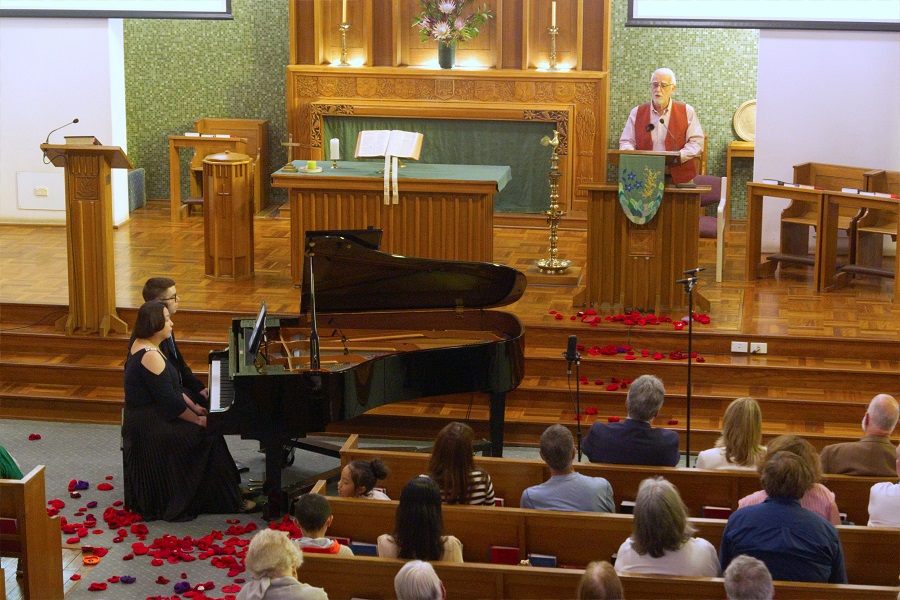
The scene was set as the Wesley Church floor was scattered with crocheted red poppies, two screens above for the screening of a film, a lectern at the rear and a grand piano centre stage.
The sense of theatre was further emphasised by the division of the event into Acts I and II.
After a brief introduction, Latham read a speech by playwright, author and journalist Thérèse Radic, co-author with British Olympic gold medallist and commentator, Martin Cross, of the book, To Gallipoli and the Somme: F. S. Kelly; War Hero, Olympic Champion and Pianist Composer.
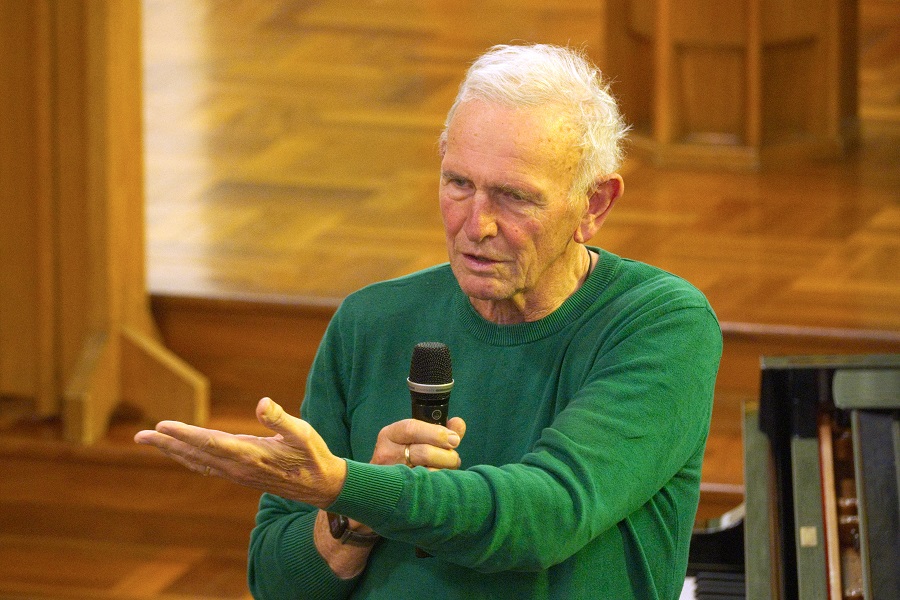
Cross, visiting Australia for the three-city event in Sydney, Canberra and Melbourne, made a striking appearance as he outlined Kelly’s uneasy balance between sportsmanship and composition. Cross had no doubt that Kelly would have wanted to be remembered as a composer.
Singapore-based academic and filmmaker Michael Walsh was also on hand to introduce a screening of the documentary Elegy, filmed on location in Skyros, Greece, by Dan Frodsham. It tells the story of Kelly’s musical tribute to the much-loved British poet Rupert Brooke, a fellow member with Kelly of the Latin Club of British artist-intellectuals serving in the war.
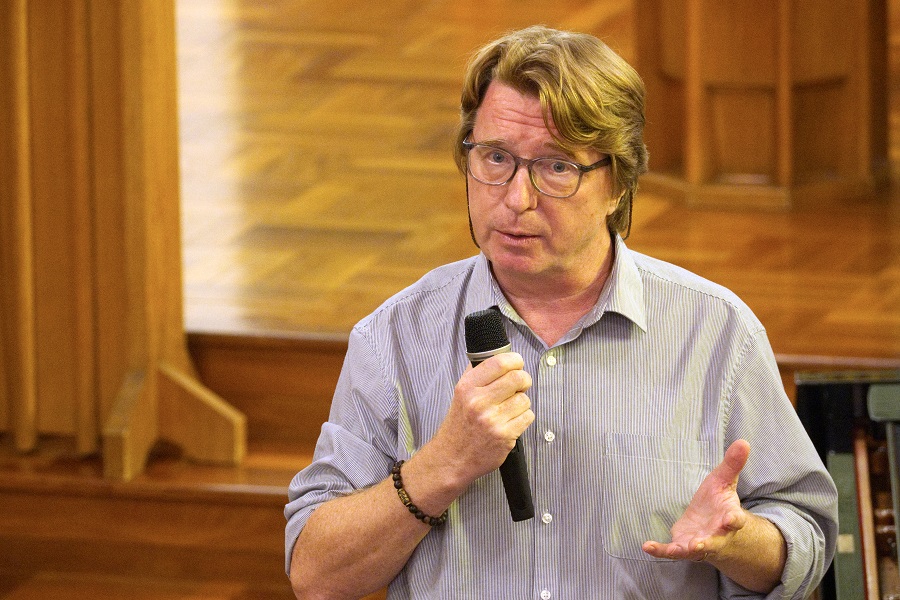
Walsh’s inspiration to make the film had come from hearing Latham perform the unbearably poignant Elegy for Rupert Brooke live on the violin. The elegy, as Greek Ambassador Stavros Venizelos rose to say, evoked the scent of sage and pine on the island where Brooke was buried.
Act II, the concert proper, saw Australian theatre legend Carrillo Gantner take to the lectern to narrate from Kelly’s notebooks and diaries, introducing piano duo Edward and Stephanie Neeman as they performed six of his waltzes under the headings Youth, Chopin, Studies, Eton/Oxford/Germany, Olympics, Kelly the Pianist/Composer and War Breaks Out.
Gantner’s animated, penetrating voice ran the gamut from humorous observation to black despair as Kelly drew closer to the ravaged fields of the Somme.
Latham’s aim to have Kelly styled Australia’s Chopin emerged clearly, but this fluidly played and balanced music was not pictorial, except for a passionately performed Waltz Pageant No. 2, signalling the violent outbreak of war.
The Chopin connection became much more evident when Edward Neeman took to the piano solo, performing works under the chapter headings Gallipoli, The Somme, and France and The Last Battle of the Somme.
Beginning with the dramatic, almost funereal Monograph 16, Neeman went on to play a deeply felt rendition of Kelly’s unfinished Sonata in F minor, given to his publisher before he left for France.
The opening movement was so passionate and fiery that it is hard to describe, except to say that it matched the horror and chaos Gantner had conjured up from the notebooks.
The grand second Adagio movement followed, but when it came to the fragmentary final Allegretto movement, Neeman brought it to an abrupt stop exactly where Kelly had left off.
The lights dimmed, but not for long, as he concluded with a terrifying performance of the demanding Study No. 12, one of Kelly’s études which surely invites comparison with Chopin.
News all day, every day at CityNewsQBN.com.au.



Leave a Reply