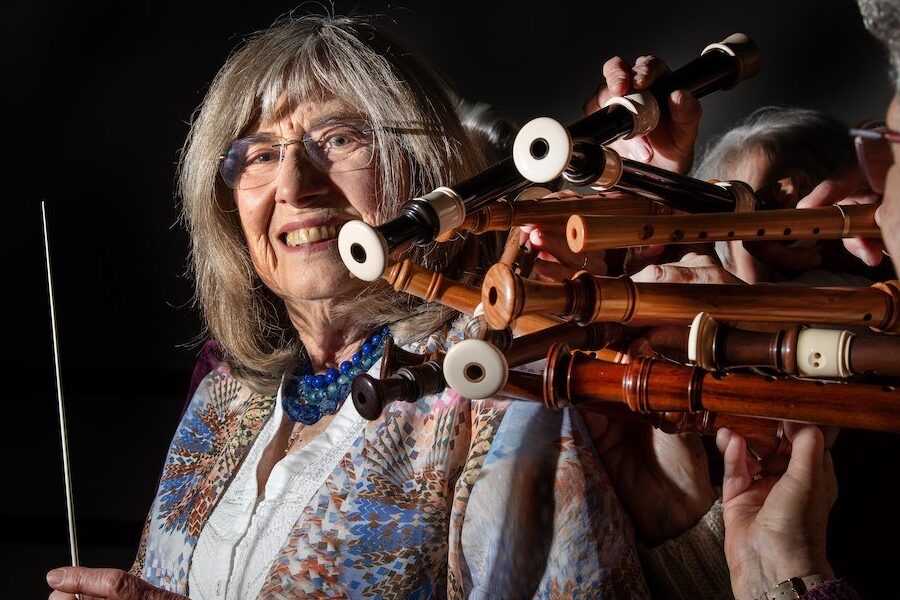
Hundreds of Canberrans have learnt to read music and play recorder thanks to Margaret Wright. DAVID TURNBULL continues his series of stories of remarkable Canberrans.
Margaret Wright has spent her life giving to others.
Even as a teenager, she voluntarily ran a playgroup and a teen club in Redfern two afternoons a week “to keep kids off the street”.
And now, nudging 86, she is still sharing her passion for music as the conductor of the Canberra Recorder Orchestra.
“I’ve always been keen to help people,” Margaret says.
“In Redfern I had table tennis, chess, music, painting, anything that would get the young ones interested enough to come along. Outside, there was nothing.”
Margaret was born in Gordon in Sydney in 1940 into a musical, artistic and literary family. Both her parents wrote in their spare time.
Her father was a professional jazz saxophonist, who ran his own barber shop during the days to make ends meet.
Her mother was a poet. She wrote her entire life and Clingan Street, in the ACT’s poet’s suburb of Wright, is named after her.
“Mum and dad always encouraged us to write to draw and to play music.
“We all learned how to read music and play recorder at an early age, and that love has stayed with me.”
Margaret’s first job happened by accident when her mother noticed an ad in the Sydney Morning Herald for an illustrator in the Zoology Department at Sydney University.
“I had to draw the tiny skeletons of Australian geckoes and was later elected a Fellow of the Linnean Society of London when my work was published.”
Margaret studied to be a teacher at Sydney Teachers’ College and taught grade 6 in North Sydney and even today – 63 years later – she is still in contact with some of the girls.
Late in 1963, she sailed to England and played chess on the deck with the artist Jeffrey Smart, whose voice she recognised from the ABC radio program the Argonauts.
She also played with Bruce Beresford who was heading to London to start his film career.
Like many young Aussies, Margaret went on a European adventure.
“I hitch-hiked with another Aussie girl from London to Marrakesh and as far as Moscow, zigzagging across the continent, haunting art galleries on the way.
“I met my English husband, a teacher of Classics, in London, and we had two daughters, before returning to Australia in 1969.
They settled in Canberra and are still living in the same house.
“We had a son, and even raising our three children, I was busy.
“I played recorder and violin in community groups and taught English to migrant women in their homes as part of the Ellnor Grassby initiative.
“In 1980 I upgraded my teaching qualification to B.Ed at CCAE and taught in Urambi Primary school in Kambah for 10 years.
During those 10 years, as part of the daily timetable, just as her father had taught her, Margaret used the recorder to teach 7- and 8-year-olds how to read music and play.
Yes, it was three-note nursery rhymes to start, but as they learned more notes they moved on to renaissance composers and more complex pieces by Vivaldi and Bach.
Margaret never spent any time in the staff room; she gave herself completely to her students.
They had music lessons every day, and she also offered free music tuition before and after school and at breaks.
To say it was successful is an understatement.
The recorder group of about 20 children, the Urambi Consort, won every eisteddfod it entered.
Dressed in elaborate Elizabethan costumes made by the parents, the Urambi Consort performed at ministerial events, at the Australian Society of Musical Education Conference in Alice Springs, and even at the Sydney Opera House.
By then, of course, the children were playing much more complex pieces by renowned composers and audiences were stunned.
What the Urambi children achieved was so highly regarded that Film Australia made a documentary about them entitled Music the Wright Way.

And in 1991, Margaret was awarded a Churchill Fellowship to study the art of teaching recorders in the UK for three months.
“You know, I travelled all over England, but no-one did what we did– set aside a bit of each day for music.
“People forget, learning music is learning another language, and you need to do it every day to make progress.
“Some people might think that I do something special, but I just filled the classroom with enthusiasm.”
But what is it that Margaret finds so special about the recorder as an instrument? It’s worth noting, of course, she did study violin at the conservatorium of music.
“Everyone thinks they know recorders, that they’re just a child’s instrument.
“But they’re wrong.
“The recorder is a beautiful instrument with a fine repertoire by composers such as Bach, Vivaldi and Telemann.
“There are 10 different sizes from the small ones that fit so comfortably into a child’s hands to sub-contra bass recorders taller than a man.
“And the tone is so delicate.”
In 1993, Margaret was forced to retire when her husband fell seriously ill.
But when he recovered, she was straight back into it when the University of the Third Age (U3A) invited her to teach recorders to retirees.
For 10 years she ran six graded music classes a week with people progressing from group to group.
Today, hundreds of Canberrans have learnt to read music and play recorder thanks to Margaret Wright.
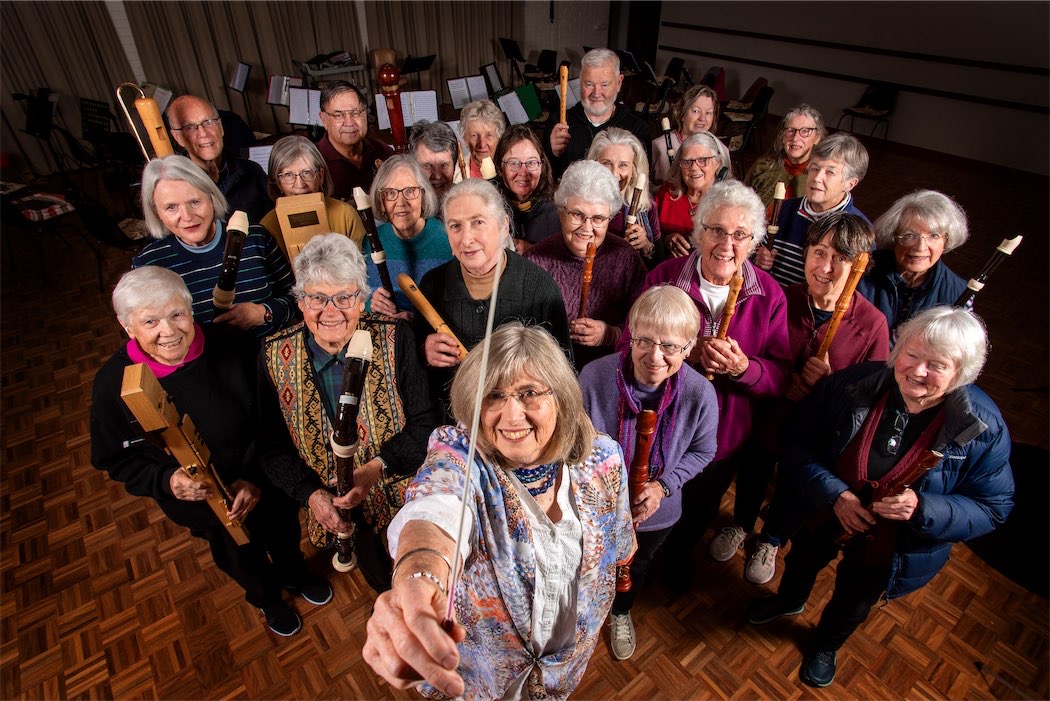
The Canberra Recorder Orchestra grew out of the keenness of people to play more complicated music on all 10 sizes of recorders
“We raised thousands of dollars to buy the huge recorders – the equivalent of double basses or tubas in symphony orchestras
“We continue to meet each week in a hall at the Woden Seniors’ Club and play Mozart, Vivaldi, Handel and Rachmaninoff, folk songs and sea shanties.
“Composers in England write music especially for our Recorder Orchestra that is published with a dedication and sold worldwide.”
The Canberra Recorder Orchestra has performed in the High Court of Australia, the Wesley Music Centre, and in churches, schools and retirement facilities all over the ACT.
In 2011 Margaret Wright was awarded the Medal of the Order of Australia (OAM) for a lifetime of giving to others, especially through music.
Journalist David Turnbull is writing a series of profiles about interesting Canberrans. Do you know someone who deserves a moment in the spotlight? Share the name in an email to David via editor@citynews.com.au
News all day, every day at CityNewsQBN.com.au.




Leave a Reply