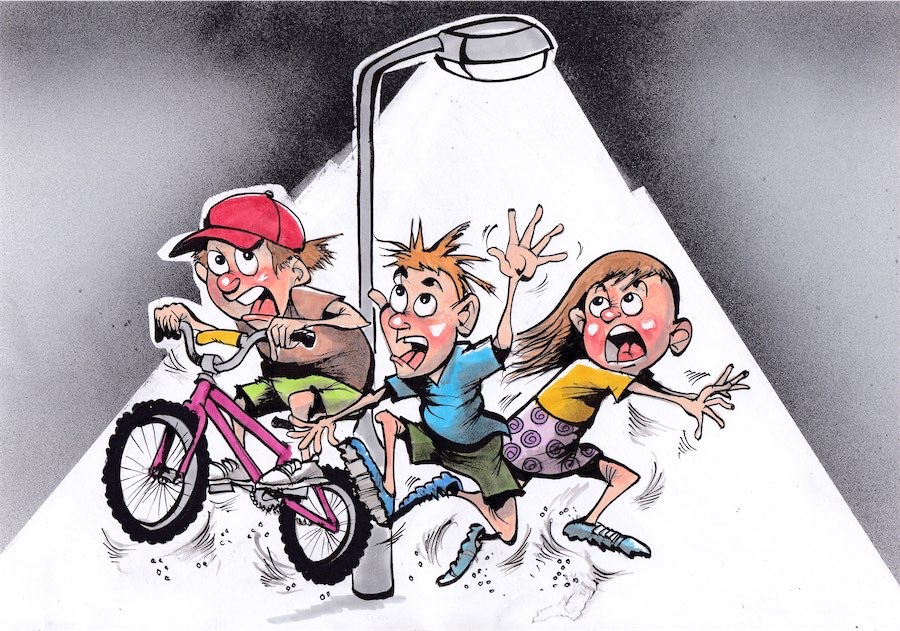
“We didn’t wear watches and we didn’t have phones so there was no way for parents to tell us it was time to come home. Streetlights were a curfew warning you to be home in time for tea,” writes PAUL DORIN.
Remember a time in suburbia when parents exercised a truly astonishing level of confidence.

Children vanished straight after school on their bikes, roaming the neighbourhood for hours with no tracking and no particular concern from anyone.
The main universal rule was to be home before the streetlights switched on, and you were simply expected to know when that was, no matter how far from home you had drifted.
You and your mates would be ambitiously constructing a bike ramp out of borrowed milk crates from the corner shop and fence palings someone had “found” leaning against a rickety fence. Structural engineering standards were simple in those days. If the ramp looked vaguely stable, it was considered safe enough.
And if you were still out the moment the streetlights flicked on, everyone would suddenly be dashing home as fast as they could. Because if your mother had to stand on the front path and yell your full name across the neighbourhood, your chances of being allowed to do it all again the following afternoon dropped dramatically.
We all spent our childhood outdoors. Entire neighbourhoods of kids emptied into the streets every afternoon, not as part of some modern parenting philosophy encouraging “unstructured outdoor play,” but because staying home carried the genuine risk of being asked to do homework or help bring the washing in.
Besides, home was boring. It mainly functioned as a refuelling station for Milo and sandwiches. Parents knew approximately where you were in much the same way early Google Maps tracked your location.
Summer afternoons meant playing backyard cricket until somebody cracked a window and more often than not, I was the culprit.
Our beautiful neighbours Joe and Maria eventually had aluminium security grills installed on their downstairs windows purely as a defensive measure against my wildly inaccurate legside sweep shots. In hindsight, I was probably single-handedly keeping the local glazier in business.
If we weren’t destroying suburban property values with cricket balls, we were rolling down sandhills wedged inside old truck tubes with absolutely no understanding of concussion or spinal safety.
During nesting season, local plovers effectively declared war on neighbourhood children, yet we continued teasing them despite repeated dive-bombing and escalating fear. Australian childhood in the suburbs was essentially a long-running experiment in poor judgment and minor injuries.
We didn’t wear watches and we didn’t have phones so there was no way for parents to tell us it was time to come home.
Streetlights weren’t just pieces of suburban infrastructure; they were a curfew warning you to be home in time for tea. The second those lights flickered on; you were late. As fast as your legs could pedal, bike tyres screeched, kids dropped whatever they were doing and disappeared down driveways at full speed, as if the suburbs had suddenly issued an evacuation order.
You’d come bursting through the back door, nearly tearing the flyscreen off its hinges in the process, almost out of breath as you raced to wash your hands, as if dinner might be cancelled if you didn’t make it to the table on time.
Sitting there, still mentally outside and trying to get my breath back, mum would calmly ask: “What did you get up to all afternoon?”
And without even thinking, you’d answer with the universal word kids use for everything: “Nothing”.
Not because nothing happened, but because there wasn’t enough energy left to explain everything that did.
Paul Dorin is the CityNews cartoonist.
News all day, every day at CityNewsQBN.com.au.




Leave a Reply