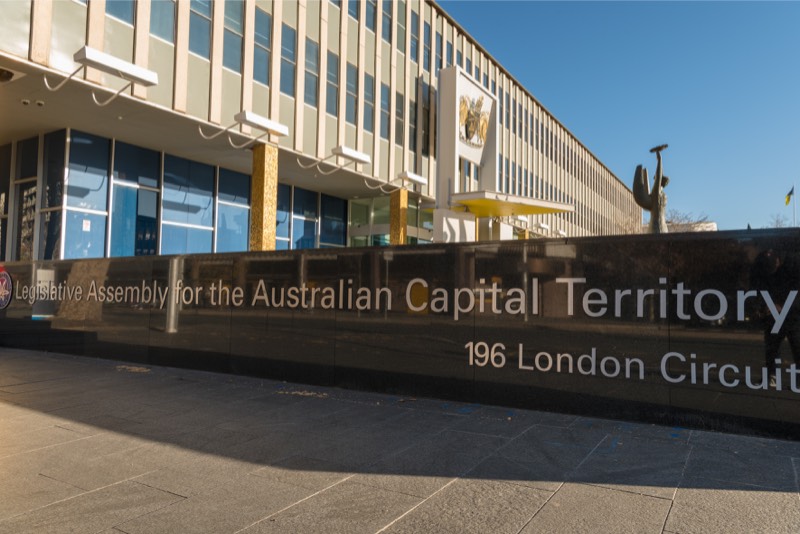
“Our Chief Minister, Andrew Barr, lifted his eyes from his phone to comment along the lines that the car park was probably a ‘drive through’, and that in the ACT weren’t car parks used as recreational areas? Then laughed at his own joke.” Letter writer DIANNE DEANE went to the Legislative Assembly.
On March 25, I attended the ACT Legislative Assembly to hear the reading of two community petitions.

One related to the forthcoming closure of the Kaleen Sports Club, the other dealing with the long-abandoned Hawker Tennis Courts.
Many thanks to Andrew Braddock (Greens) and Peter Cain (Liberals) respectively for sponsoring these petitions.
Petition sessions provide elected members with an insight into what matters to their communities and a vehicle to give voice to them. Petitions are a key democratic mechanism for people to have a voice to their elected members and for members to understand what is really important in their electorate.
It was therefore incredibly disappointing to find only 13 out of the 25 elected members in attendance and the Minister for Sports was notable for his absence.
During the reading of the petitions, nine members were constantly on their phone or computer. However, thanks to Fiona Carrick (Independent) and Jo Clay (Greens) for speaking in support of them.
Jo Clay raised the community’s strong concerns that the proposed Development Application for the Kaleen Sports Club site, substituted the current recreational space of 3823sqm with only 733sqm, which somehow included the underground carpark.
Our Chief Minister, Andrew Barr, lifted his eyes from his phone to comment along the lines that the car park was probably a “drive through”, and that in the ACT weren’t car parks used as recreational areas? Then laughed at his own joke.
Ms Clay replied that for the ACT people the loss of sporting facilities was definitely not a joke!
I was sitting next to a man who was going to lose a business he had developed for over three decades; a popular hub for the Yerrabi and wider Canberran community providing sports competitions for about 1500 people a week over that time.
Three other successful businesses at the club are also going to be wiped out. So, no Mr Barr, it is certainly nothing to joke about and demonstrates your disdain for the people of Canberra.
Dianne Deane, via email
The rail line to Goulburn does have a real future
Mike Quirk (“High speed rail arrives again, but will it ever leave?”, Letters, CN April 2) says that once Canberra-to-Sydney high-speed rail arrives, the Canberra-Goulburn section of the existing rail line could become redundant.
It could, but it might not as well. The ACT, NSW and Commonwealth governments should be open to both possibilities in their current consideration of what improvements to make to the existing rail service.
The purpose of high-speed rail is to decentralise future employment growth and future population growth to regional centres. Between Canberra and Sydney that’s Bowral-Mittagong and Goulburn.
The overseas record is that it’s the in-between places that grow fastest under the impact of rapid, convenient connections in both directions. Examples are Nagoya between Tokyo and Osaka in Japan and Montabaur and Siegburg between Cologne and Frankfurt in Germany, two villages that have turned into employment hubs.
Who’s to say that with HSR in place Goulburn won’t see dramatic growth, whether residentially based or job-driven or both? In which case there could be many more people wanting to live in a Canberra-Bungendore-Goulburn corridor that could be well serviced by a Canberra-Goulburn rail shuttle.
And who’s to say also that a future, much larger Canberra region won’t benefit from a better functioning rail corridor that could once again see freight trains?
The reason a positive or neutral – rather than negative – attitude to the future of the rail line matters now is that modest improvements to the Canberra-Goulburn infrastructure are needed urgently. That’s not because the current service is slow, even though it is, but because the trains are full and the single track line can’t readily accommodate higher train frequency.
Over the past two years, as air travel has plummeted amid high fares and flight cancellations, publicly available NSW TrainLink patronage data show Canberra-Sydney rail has recorded seat utilisation of over 90 per cent.
What the ACT government can do is offer to fund, or part fund, a couple of passing loops between Queanbeyan and Tarago that would allow trains travelling in different directions on the single track to cross. This would be in return for NSW increasing the number of daily trains from three to say five.
What the ACT shouldn’t let NSW and the Commonwealth get away with is any argument that the Canberra-Goulburn section can have no place in a high-speed rail world and that even limited infrastructure spend now will be a waste of money.
Phil Potterton, director, Grove Transport Economics
CIT Bruce ditches active seniors
A group of long-standing, senior-aged members of the CIT Fit & Well Centre at Bruce are campaigning against proposed changes by the CIT that will restrict their access to a higher intensity level of exercise class that provides distinctive health, fitness, and social connection benefits to the group.
Removing these classes is removing a unique health maintenance and improvement service to the over-60s community.
There are virtually no fitness class options outside of CIT that offer the same level of physical intensity for specifically over-60s in a group environment, during the day and at a reasonable cost.
The CIT fitness program provides safe and appropriate access for older people who may not be similarly catered for in a commercial gym or may not feel comfortable in such a venue.
The health and social wellbeing benefits the classes provided to people in this group far outweighs the small cost for CIT to deliver the classes.
We are asking CIT management to reconsider their decision and for the ACT Government to recognise the social value and health benefits these classes provide to active seniors in the community and support their continuation.
David Maplesden, via email
Goodbye to views of Black Mountain
I am writing with an open invitation to mark the glorious completion of an era of development for Canberra.
Ever since height restrictions on Northbourne Avenue developments were freed up, the unimpeded view from the centre of the basin between Black Mountain and Mount Ainslie has been progressively walled off. This glorious wall of magnificent development is approaching a stage of wonderful completion!
As I write, a unit block north of Haig Park is being prepared, which will finally, some might say “mercifully”, restrict the view of the long slopes of Black Mountain, which Australians have had for countless millennia, to glimpses between the tower blocks.
No more will Black Mountain tower, once a proud symbol of technical prowess, loom like an impotent ghost over us, soon only to be viewed by the owners of high-level apartments.
Canberra has finally grown up, realised that its imposition upon the visual experience of landscape can know no bounds, and has redirected the attention of anyone looking south on Northbourne to the masterly flagpole of Parliament House in the distance. This is fitting for the national capital city, and must be enthusiastically applauded!
This redefinition of the history of Canberra to emphasise the machinery of political power over the natural amenities so ably under-exploited for millennia is hereafter undeniable.
The government must be congratulated for choosing this development route – a statue or at least a commemorative plaque is perhaps fitting for the visionaries.
This is a glorious moment for Canberra, and the residents who have so competently stabilised the political environment and thus made the conservation of development momentum possible can justifiably be proud of themselves.
Peter Anderson, via email
Remind you of anyone?
Re the article on citynews.com.au about the ex-Bangladeshi PM, under International Crimes Tribunal death sentence for ordering the killing of protesters against her regime, says she “was seen as a champion of democracy when she first assumed power”, but “her second coming… marked the beginning of her transition into an autocrat” and “have since morphed into something that demonstrates all the ‘hallmarks of fascism’.”
Remind you of anyone?
Richard Johnston, Kingston
The ANU’s silence is still deafening
The ANU deserved to feature prominently in the damning ABC Four Corners program Campus Chaos on March 30.
The unacceptability of this university’s handling of its major restructuring plans since 2024 and its entrenchment of chronic on-campus destabilisation was reinforced by revelations about its likely reliance on exaggerated claims of a financial crisis to justify the whole Renew ANU debacle.
Despite more insights into poor governance issues and the hefty use of consultants who seek to corner contracts and also infiltrate decision-making structures of universities, ANU’s top leadership declined to participate in the program.
Fortunately a final report on ANU finances from the Commonwealth Audit office should be available mid-year.
ANU’s lack of public engagement became a reminder about how, over the past few months, it has not bothered to communicate with the broader community, let alone its donor cohort, about its new curriculum structures, academic priorities and staffing arrangements across the whole humanities/arts spectrum, including the performing arts.
Neither the website for the Renew ANU juggernaut nor ANU’s general site provide any up-to-date facts or direction about what is being offered, what was remodelled and what academic disciplines and study pathways have been scrapped since October last year.
Those on and off campus deserve more clarity about what is now happening at the national institution that is also a critical part of our local knowledge economy.
Hopefully Senator David Pocock can continue to extract basic information out of ANU in Senate Estimates and other committee hearing processes.
Four Corners showed that the governance and operational issues he has been pursuing since late 2024 about ANU’s questionable decision-making and restructuring program are valid and require urgent and significant rectification action, not just by ANU but also by other universities, federal and state governments, the tertiary sector regulator and the planned independent Australian Tertiary Education Commission.
Sue Dyer, Downer
There’s a silver lining to the fuel crunch
The article on fuel types was timely (“Fuel for thought: E10, the facts and the figures”, CN 8/4).
However, while switching to the cheaper ethanol blend E10 may save regular fuel in a shortage, as Prof Aman explains, because E10 contains less energy than other fuels you must burn more to travel the same distance.
And while E10 is generally safe for engines made after 2000, there are important exceptions, including all vehicles that require premium fuel.
The silver lining in the fuel crunch is rising interest in electric vehicles. A 2017 Australian Automobile Association report, Benefits of Reducing the Age of Australia’s Light Vehicle Fleet, found Australia’s passenger and light commercial vehicles were older than those in comparable OECD countries, and that a younger fleet would deliver safety gains, lower emissions, and health benefits. With modern electric vehicles now widely available, those findings are even more relevant.
While the ACT has the youngest fleet and the highest EV uptake, only around four per cent of vehicles are battery electric, so there is still ample scope for modernisation.
The current push by a coalition of 30 organisations across the energy, automotive, finance, disability, environmental and consumer sectors to retain the EV discount in the Albanese government’s May budget should be heeded
Anne O’Hara, Wanniassa
What was the plan for kangaroo culling?
Many thanks to the CityNews for publishing Robyn Soxsmith’s concise summary of the main findings of Dr Varvaro’s doctoral thesis regarding the ACT government’s kangaroo killing program (letters, CN April 2). This thesis scrutinises the ACT government’s systematic suppression of all options for challenging the killing program. It also reveals that there was never any plausible conservation justification for the slaughter.
We already knew from Freedom of Information documents released after the ACT government’s first slaughter at Googong Dam Reserve in 2004 that the slaughter was initiated not on the basis of any conservation argument but at the behest of local sheep farmers complaining about kangaroos eating grass.
Varvaro’s thesis confirms that there was still no conservation research supporting the killing when the ACT government drafted its first Kangaroo Management Plan (KMP) in 2010. From Varvaro’s findings, we assume that any studies published since that time, suggesting that kangaroos might have negative environmental impacts, are most likely to be partisan or commercially motivated.
Meanwhile, the one study (by CSIRO in 2014) that did examine the relationship between kangaroos and biodiversity found not only that kangaroos on ACT reserves appear to have no negative impact on biodiversity, but that biodiversity is better off where kangaroos are present than where they are not.
Frankie Seymour, Queanbeyan
Budget should herald a fair go on tax
Columnist Michael Moore is right about the inequities in Australia’s tax system (“Looking for the courage to right the tax wrongs”, CN April 2). As he notes, current settings enable a transfer of wealth from those who can least afford it to those who are already wealthy.
In 2008, former Treasury Secretary Ken Henry led the “root and branch” review of the tax system and has since continued to argue for reform to address intergenerational unfairness.
A key recommendation was a stronger framework for taxing mining profits, ensuring the nation receives a fair return from its natural resources rather than relying on a shrinking base of income taxpayers in an ageing population.
More recently, economists Ross Garnaut and Rod Sims have proposed two new levies on fossil fuel companies: a Polluter Pays Levy on fuels consumed domestically and a Fair Share Levy on gas producers’ cashflow, similar to Norway’s system. Together, these could raise about $35 billion annually between 2026 and 2050.
Industry opposition is unsurprising, but the evidence is clear. Analysis by The Australia Institute shows that some of the largest oil and gas companies have paid no Petroleum Resource Rent Tax on nearly $300 billion in income since 2013–14.
With the May budget approaching, there is a clear opportunity to correct this imbalance and ensure Australians receive a fair return.
John Godfrey, Cape Paterson, Victoria
Fixed-rail doesn’t work in the garden city
Re Richard Johnston’s column “Secret tram plan to Woden makes no sense” (CN March 26).
When the Gungahlin tram was proposed I analysed its published business case, finding the ACT Government only made it “stack up” by including the “value” of a community health benefit if passengers walked to the tram stops.
Since building that billion dollar tram, Canberra public transport journeys have fallen from six per cent to five per cent. Hardly planet-saving numbers.
Fixed-rail transport is not practical in Canberra’s extensive garden city layout. Most commuters live and work in varied places that are not on any direct public transport route, so they commute by car. They save so much time by doing that, they are willing to bear the cost.
As planning expert Richard Johnston rightly states, bus routes can be varied at any time without the need for costly track work and wiring changes. Canberra’s use of time-dependent unique school bus routes each day demonstrates that clearly.
The capital cost of the tram to Woden ensures that Canberra rates will keep rising and the budget will stay in the red for our grandchildren to pay off. The proposed first stage to Commonwealth Park is a real white elephant if ever there was.
However, I must question Mr Johnston’s idea of electrifying Canberra’s buses. Canberra’s new battery buses carry three to three-and-a-half tonnes of battery all the time, far heavier than a tank of diesel (that can be filled in a matter of minutes), which equates to 30 or 35 passengers. This increases their operating cost and wear over that of lighter diesel buses.
Diesel bus “emissions” can be reduced with inexpensive retro-fitted AdBlue urea exhaust conditioning. I expect Canberra buses may have been, retaining all their route flexibility benefits, and servicing their measly five per cent of passenger traffic without burdening mug ratepayers with further rate extortion.
Alternatively, all Canberra citizens could live in 20-storey Shanghai towers, along the tram routes, where the kids can play on the one-metre by five-metre balcony, rather than having a backyard. Mr Barr might take up that idea. He could just keep aspidistras on his balcony.
Anthony Hordern, Jamison
Tram critics ignore land-value capture
Local expert correspondents criticising ACT light rail, and favouring buses, appear to concentrate on poor cost-benefit outcomes based on projected tram usage.
They appear to overlook the “land-value capture” that trams provide, and as espoused by Perth academics, Newman and Kenworthy in their 1991 study, Towards a More Sustainable Canberra, accepted by the National Capital Planning Authority.
Trams run on fixed tracks, forever enhancing the value (and hence the rates income) of residential and commercial land at or near the stops, along with the amenity of public places there.
Buses, even those travelling in dedicated lanes (which need expensive strengthening), can, and do have their routes summarily changed or cancelled, upsetting land values etcetera.
In the Central National Area, trams on the optimum Stage 2B (Commonwealth Park to Woden) tram route should serve and enhance visitation to the many national attractions there, and precipitate more of them.
So, the route should include Acton Peninsula, more of the National Triangle and Barton. This symbiosis of trams and places, and their optics, would clearly deliver significant economic benefits, and enhance pride in the national capital, while saving Commonwealth Avenue’s important bridges and trees.
Jack Kershaw, Kambah
Three ways the ACT Government can cut fuel use
Here are three ways the ACT Government can cut fuel use, traffic congestion, pollution and health costs, and increase public transport, walking and cycling.
- Increase parking fees. When the federal government introduced pay parking in the Parliamentary Triangle it reduced car travel, generated ongoing revenue, and increased walking and cycling. Bus trips to and from the Parliamentary Triangle increased by 47 per cent.
- Convert under-utilised bus lanes to transit lanes, to get more people to work, more quickly, in fewer cars. The government estimates that replacing Adelaide Avenue’s transit lanes with light rail would reduce network-wide public transport travel by 5 per cent.
- Expand the Sustainable Household Scheme to cover practical, reliable non-electric bikes, and make our bikes more practical and more reliable.
Each extra kilometre we cycle generates about $3 worth of health benefits. Savings in health system costs might exceed the cost of expanding the Sustainable Household Scheme.
I would like to provide this advice to the government-funded Conservation Council. Because the council provided false and misleading information in an application for a court order, I can’t do that until the case goes to court.
Leon Arundell, Downer
Some people have no concept of left wing
Ian Pilsner shares a frustration held by many conservatives and letter writers to CN in his letter of April 9 when he refers to a column written by John Minns headed “Does dawn of the far right bring a new dark age”. Ian raises the point that there is never a mention of the far left, only of the far right.
This could be because non-conservative voters and commentators see themselves as of the centre or mainstream. They have no concept of left wing, and everyone with an opposing view must be right wing or extreme.
Most mainstream media including the ABC and most social-media platforms, including Google, espouse this philosophy.
For example, Google describes journalists such as Andrew Bolt and Paul Murray as conservative or right-wing commentators, but commentators such as Laura Tingle and Sarah Ferguson are described as Australian journalists – not left-wing or non-conservative journalists.
Paul Temby, via email
News all day, every day at CityNewsQBN.com.au.



Leave a Reply