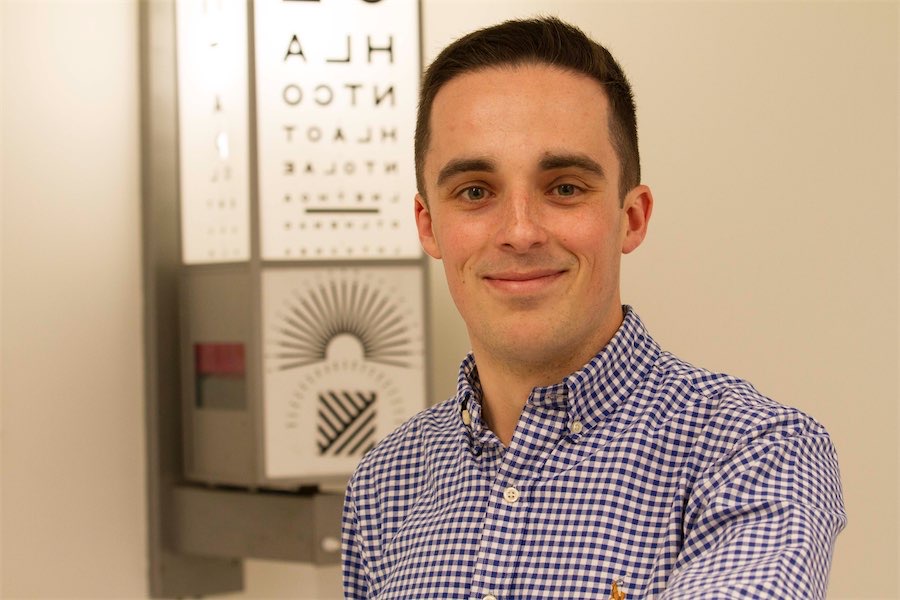
Sad childhood memories have led Canberra Hospital ophthalmologist Dr Thomas Rogerson to an important humanitarian effort in Laos, reports ROD HENSHAW.
IT was Tom Rogerson’s childhood in the south-east African country of Malawi that laid the foundations for a career in medicine, specialising in ophthalmology, where today he serves as a registrar at the Canberra Hospital’s eye clinic.
Those early years in Malawi also set Tom on a course that would later see him providing valuable humanitarian aid in a bid to prevent – or treat – any number of mainly young people suffering from a variety of ophthalmic problems who would otherwise not have access to such a service.
The heartbreaking memories of Malawi are indelible – seeing poverty and deprivation an Aussie kid would seldom have to bear witness to.
His parents were medical practitioners who were working there – his father an infectious diseases doctor who was treating malaria and his mother a neonatologist, specialising in care for newborn babies.
As a child, driving through Blantyre and around the outskirts, you would see parents selling their children for food,” he vividly recalled.
To Tom, now 29, it sparked an insatiable desire to do his bit to make a difference, in whatever way he could.
“Malawi is often ranked as the poorest country on earth, poorer than North Korea, Rwanda or Sierra Leone,” he said.
“The sort of poverty that we experienced was devastating. We lived through a famine while we were in Malawi where my family would have to slaughter our pets in order to feed ourselves.
“That motivated me to pursue that passion for service and passion for my community in a variety of different ways.”
Back in Australia, Tom threw himself into a number of volunteering roles, from helping out in the Mary Magdalene soup kitchen in Adelaide to later joining other professionals in the Sight for All Foundation after getting into medicine.
“As an ophthalmologist you have a massive capacity to impact people through your outreach trips,” he said.
At the time of publication, Dr Rogerson was heading up a team of 10 professionals and support staff on an ophthalmic research and humanitarian aid trip to Laos, in south-east Asia.
He said Laos was chosen notably to observe the dramatic ophthalmic-related changes that had taken place since a previous visit in 2012, which disturbingly, showed a dramatic downturn in general eye health, particularly the incidence of myopia (short sightedness).
“In 2012, children in rural areas in Laos had the lowest ever recorded prevalence of myopia,” Tom said.
“That was interesting because there is a current epidemic with myopia that we’re seeing in south-east Asia.”
He said he was vitally interested in finding out why that situation had changed in the past 11 years and, more importantly, what can be done to remedy or at least slow the decline in eye health. Attacking short-sightedness was high on his list of priorities.
There was one major cause for that decline, which was also common in many countries in south-east Asia.
Over the last 70 years the prevalence of myopia had increased from around 20 per cent to more than 80 per cent of young adults aged around 20 years.
Dr Rogerson believed over more recent years, the environment had played a big part in the situation in Laos.
“In 2012 when we were there, we were primarily seeing children who did all their reading from a blackboard and they would engage in lots of outdoor play. They had very high rates of UV light exposure, (being) outdoors a lot of the time,” he said.
“And all of these things are very protective against the development of myopia.
“Now we have good reason to believe that partly due to the rising prosperity and the increase in national wealth in that country, these children are doing more and more ‘near work’.”
During the month-long visit to Laos, Tom and his team will have their work cut out but he said he was determined to leave with a number of goals ticked off encompassing areas of eye health, with myopia just a part of the equation.
“We don’t just want to count a bunch of kids that need glasses,” he said.
“We want to put in place a structure that will allow these kids to continue to be cared for.
“Also to allow for the Laotian people to carry out these studies themselves.”
From an academic viewpoint, Tom and his colleagues are eager to get a better understanding of the driving causes of short-sightedness on a global scale.
“While there are all sorts of treatments available, the bottom line is prevention. That’s better than anything we have,” he said.
While the Laotian humanitarian project is substantially funded by Lions Clubs International, the Sight for All Foundation appreciates all donations.
Donate at sightforall.org
News all day, every day at CityNewsQBN.com.au.


Leave a Reply