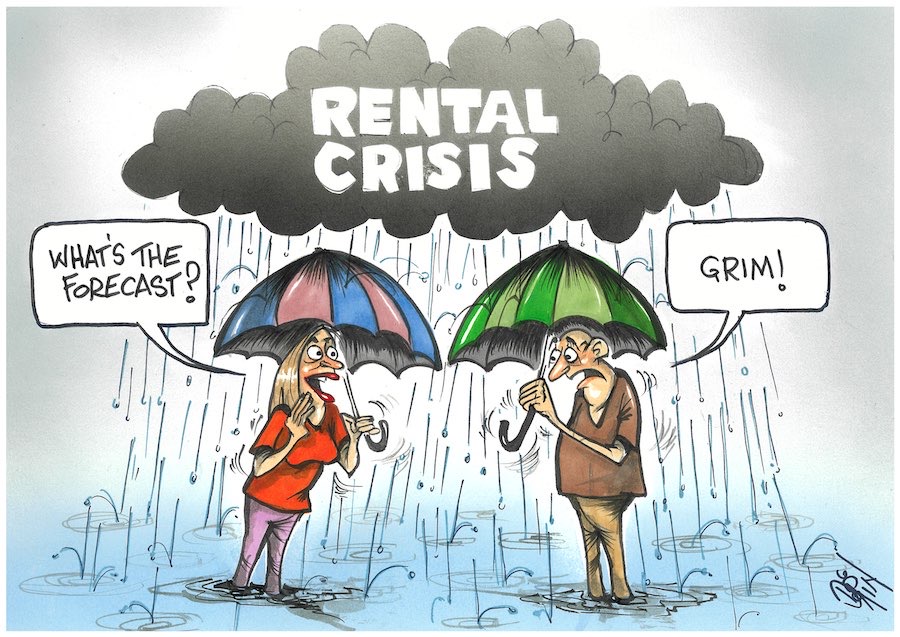
Sleeves up, the big rental biffo is about to begin
Cartoon: Paul Dorin
“Simple economics tells us that where demand exceeds supply, prices increase. The practical on-the-ground effect of this mismatch is likely to be frenetic activity at property inspections, applications for properties and rising rents,” writes political columnist ROBERT McMAHON.
Donald Horne, in his landmark critique of Australian culture, The Lucky Country, quipped that “sport to many Australians is life and the rest a shadow”.
Dr Robert McMahon.
In the 60 years since Horne offered his insightful commentary, much has changed within Australia; but one thing has remained constant – our love of sport.
Which is just as well as we have so many forms and codes to be consumed. Cricket, netball and no less than four forms of football (the last one properly called soccer).
But we are about to get a new sport. While it won’t be a spectator sport, it will be no less competitive. Australia’s new sport is going to be people searching and applying for rental housing. And, as a result of the Albanese government’s changes to negative gearing and capital gains tax, it could become very combative indeed.
Before Treasurer Jim Chalmers even stepped forward to the dispatch box to hand down his Budget, housing supply in Australia was already running short of population growth.
In the 12 months to September 2025, Australia’s net population increased by some 420,000 people, comprising new migrants of around 310,000 and 110,000 Australian-born babies. Assuming 2.5 people per household, this works out to about 170,000 new households needing accommodation. Over the same period though, only about 158,000 net new dwellings were added to the national housing stock.
This simple arithmetic mismatch forms the playing field for Australia’s new adventure sport – of which Australian tenants will be the unwitting players.
Masked under the mantra of “intergenerational equity”, the Albanese government has recently made fundamental changes to negative gearing and capital gains tax offsets for ordinary PAYG (you and me) taxpayers. In the case of negative gearing, businesses still retain this benefit; but apparently it’s only unfair to young people for PAYG taxpayers to utilise it.
Notwithstanding the government’s assertion that its “reforms” were for the purposes of adding to the housing supply, the Treasury Secretary told a slightly different story at the post-Budget Business Economists breakfast. Jenny Wilkinson stated that the real purpose of the tax changes was to re-distribute existing housing stock to first home buyers and, by happy (not so) coincidence, to generate additional revenue. As she was reported to have quipped: “Revenue needs to be raised somewhere”.
In the period following the Budget, we have seen less a “re-distribution” and more a hammer blow to the sale of residential property, with auction clearance rates falling below 50 per cent in many capital city markets and property commentators predicting that this is likely to worsen to 40 per cent. These figures are a reasonable current proxy for confidence in the housing market with buyers now either pulling back on plans to purchase and sellers sitting on existing homes. In these circumstances, it’s difficult to see how “re-distribution” can occur.
What’s more, the resultant uncertainty to the housing market created by the Budget is causing new investors to press pause on housing acquisitions and construction activity, waiting to see where the market will land and whether a profit can be turned.
The Master Builders Association has suggested that the result could be “an investment strike” – hardly a recipe for increasing housing supply.
Which brings me back to Australia’s new sport. If our existing new housing stock was alreadyfalling short of our population growth, exacerbated uncertainty in the housing market is unlikely to do much to correct historic shortages in its construction.
Add to this that the acquisition of new rental (existing) properties will be financially penalised by the tax system, and an already tight rental market is highly likely to become even tighter in the months to come.
The result could be that tenants – many of them new immigrants to our shores – will increasingly compete for what is a reduced rental housing stock.
Simple economics tells us that where demand exceeds supply, prices increase. The practical on-the-ground effect of this mismatch is likely to be frenetic activity at property inspections, applications for properties and rising rents.
While this may well be a boon for landlords grandfathered under the existing arrangements, it’s hardly a desirable outcome for young people, students, immigrants and low-income workers whose income prohibits them from buying into housing re-distributed from would-be landlords.
Time will tell whether this perverse effect becomes large enough to prompt an Albanese government back-down akin to the Hawke government’s 1987 reversal of its 1985 negative gearing reforms. In the meantime though, I would not want to be a tenant taking the field in a future housing market.
Dr Robert McMahon PSM is a visiting fellow at the Australian National University, adjunct professor at the University of Canberra, and former assistant secretary of the Department of the Prime Minister and Cabinet.
Political columnist MICHELLE GRATTAN says Peter Malinauskas has challenged the prevailing political mood on migration, warning a race to slash numbers would amount to economic self-harm.
Pauline Hanson’s “I don’t back down” approach faces two very different tests as One Nation fights Andrew Hastie while standing behind its controversial Victorian leader, writes political columnist MICHELLE GRATTAN.
"There should have been a strong response to the video the day after it appeared, a joint response from Albo and Angus (and Matt) showing a united disgust at the 'traitor' allegation," writes HUGH SELBY.






Leave a Reply