Music / Schubert Songs: The Beloved Colour. At The Street Theatre, October 7. Reviewed by MICHAEL WILSON
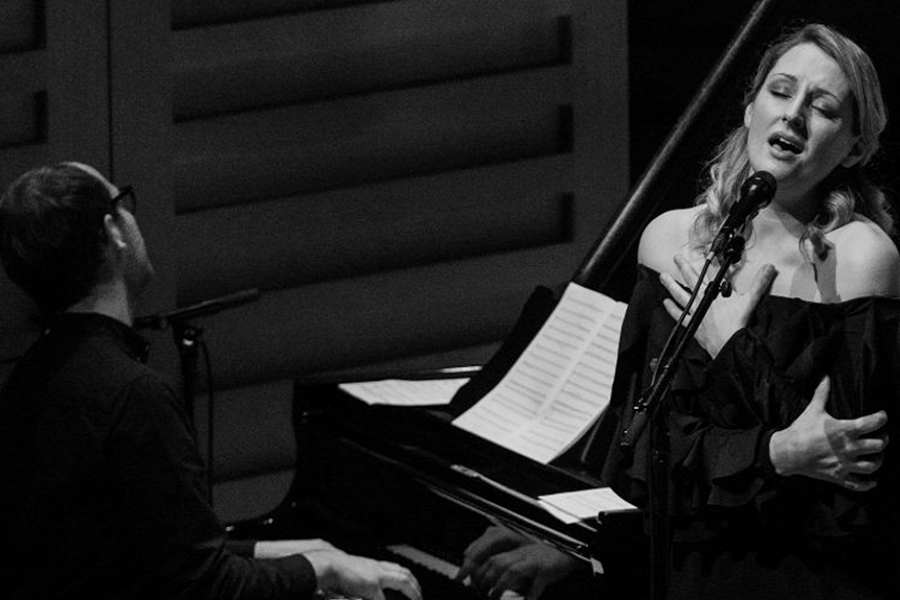
Marking a proud 50th anniversary of Art Song Canberra (which started life as the ACT Lieder Society), two internationally accomplished London-based artists, Alice Zawadzki (voice) and Fred Thomas, (piano) wove a mosaic of moods through the songs of the undisputed master of the lieder genre, Franz Schubert.
In lieder and most other art song, the singer and pianist are equal and interdependent. Many of Schubert’s over 600 songs are at least as challenging for the pianist as they are for the singer.
And yet the piano must provide the foundation for the expression of the poetry, and must be uniquely sensitive to the singer’s phrasing, technique and need to breathe. Not every great pianist can do this. So the pairing itself is crucial.
It pays these days for any musician to have multiple abilities and be comfortable with crossing and mixing genres. Even by this measure, Alice Zawadzki is extraordinary.
Trained as a classical violinist, she then got into singing as a jazz vocalist, and quite recently adapted to learn classical technique and take on the daunting and exacting catalogue of German lieder.
Fred Thomas’ accompaniment was flawless: technically excellent and in full emotional sympathy with the song texts and how he and Zawadzki had together planned to interpret each of the seventeen songs included on the program.
Thomas played three short Schubert interludes on his own, but he resisted changing gears when playing on his own, maintaining the calm and almost mystical atmosphere he and Zawadzki had created together.
Zawadzki’s voice has the tonal colour of a true contralto – warm and rich, reminiscent perhaps of Janet Baker. It was her extraordinary vocal control that stood out most.
In a carefully chosen selection of Schubert repertoire evoking darkness and light – and states of consciousness between wakefulness and sleep – Zawadzki’s voice was at times so quiet that it was barely detectable, conveying fragility, reflection and sorrow and provoking deep emotion. Her ability to adjust tone to create different atmospheres was masterful and almost magical.
Highlights included Nacht und Träume (Night and dreams), where Zawadzki’s ability to change and contrast volume, tone and intensity at will was jaw-dropping.
Der Leiermann (The hurdy-gurdy player) brought a folksong feel to the room, while An die Sonne (To the sun) was meditative and warm.
In Meeres Stille (Calm sea), Zawadzki’s physical control of her voice could be observed through her whole body, especially in the softer passages.
While the Street One performance space had been decorated and lit brilliantly to resemble a Viennese salon, it is far from an ideal place to perform art song.
Its dead acoustic and cavernous ceiling required the singer and pianist to be amplified, and some digital reverberation had been added which gave the sound a somewhat jarring and artificial feel.
Nevertheless, the pure artistry and excellent preparation by both Zawadzki and Thomas made it possible to overlook these impediments.
News all day, every day at CityNewsQBN.com.au.



Leave a Reply