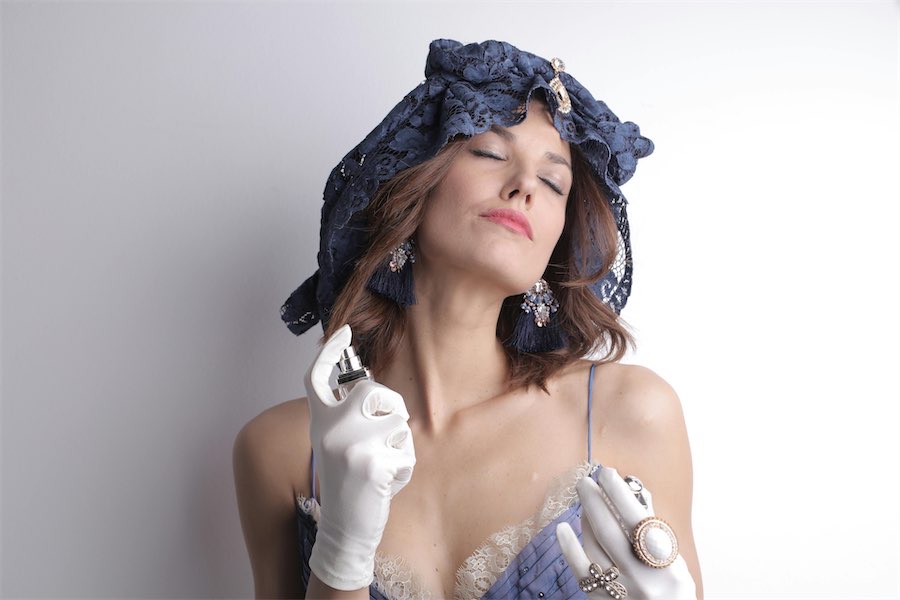
“Perfume isn’t only about how others perceive you – it’s also about how you feel. A fragrance can alter mood, confidence and self-perception almost instantly,” writes Whimsy columnist CLIVE WILLIAMS.
To attract men, I wear a perfume called ‘New Car Interior’–Rita Rudner
You might wonder why women wear perfume – and, like make-up or fashionable outfits – there isn’t just one reason why women wear perfume.
Men think it’s worn to attract them, but the wearing of perfume has biological, psychological, cultural and social roots.
Scent is one of the oldest forms of communication. Humans subconsciously respond to olfactory cues – clean skin, subtle sweetness, or warmth – as signs of health and genetic compatibility. Perfume can enhance or simulate natural body scent, amplifying those cues. While the “pheromone” idea is often overstated, pleasant smells do activate the brain’s reward and emotional memory centres (especially the amygdala and hippocampus), deepening social and romantic connections.
So, originally, fragrance likely had attraction and social bonding functions.
Perfume isn’t only about how others perceive you – it’s also about how you feel. Smell directly influences emotion; a fragrance can alter mood, confidence, and self-perception almost instantly.
For many women, wearing perfume becomes a ritual of self-composure – the final step before facing the day, like an invisible shield.
Certain scents trigger memory associations: warmth, safety, luxury, sensuality, freshness. A woman might wear perfume to evoke or embody a particular state of mind. So, perfume can be a psychological anchor – “This scent is me at my best.”
Perfume is also a form of aesthetic expression and social identity. Different scents signal different personas: floral (romantic), woody (sophisticated), citrus (energetic), oriental (sensual).
Fragrance connects to ritual and heritage – many women wear the scent their mother or grandmother wore. In modern life, perfume can signal taste, refinement and individuality, much like fashion or art. So it’s a personal signature, an invisible extension of one’s identity.
Perfume also functions as subtle social communication. In close spaces (offices, gatherings, dates), scent can make someone more memorable and distinctive. It can project mood or intention – light and fresh for approachability, deep and musky for confidence or sensuality.
Some women consciously use fragrance to control the social atmosphere – choosing calming, elegant, or assertive scents depending on context. So, scent becomes a nonverbal message: “This is how I want you to feel around me.”
Women wear perfume for several reasons: Biological: to enhance natural scent and appeal; psychological: to boost mood and self-confidence; cultural: to express identity or memory, and social: to influence perception and presence.
In essence, perfume is the invisible language of self-expression – a blend of personal ritual, emotional regulation and subtle social signalling.
On a lighter note: An American suffers a serious heart attack while out grocery shopping. The store clerks call 911 when they see him collapse to the floor.
Paramedics rush him to the nearest hospital where he has emergency open-heart bypass surgery.
He wakes in the ICU to find himself in the care of nuns at the Catholic hospital he has been taken to. A nun is seated next to his bed holding a clipboard loaded with several forms, and a pen. She asks him how he’s going to pay the $50,000 bill for his treatment. It soon becomes clear that he has no insurance or assets.
“Do you have a relative who can help you with the payments?” asks the nun.
He says: “I only have a spinster sister who’s a nun.”
The nun reacts angrily: “Nuns are not spinsters! Nuns are married to God.”
The patient sighs with relief: “I hadn’t realised that. Could you please send the bill to my brother-in-law.”
Clive Williams is a Canberra columnist
News all day, every day at CityNewsQBN.com.au.





Leave a Reply