On a wing and a prayer: defence plan doubles down on the past
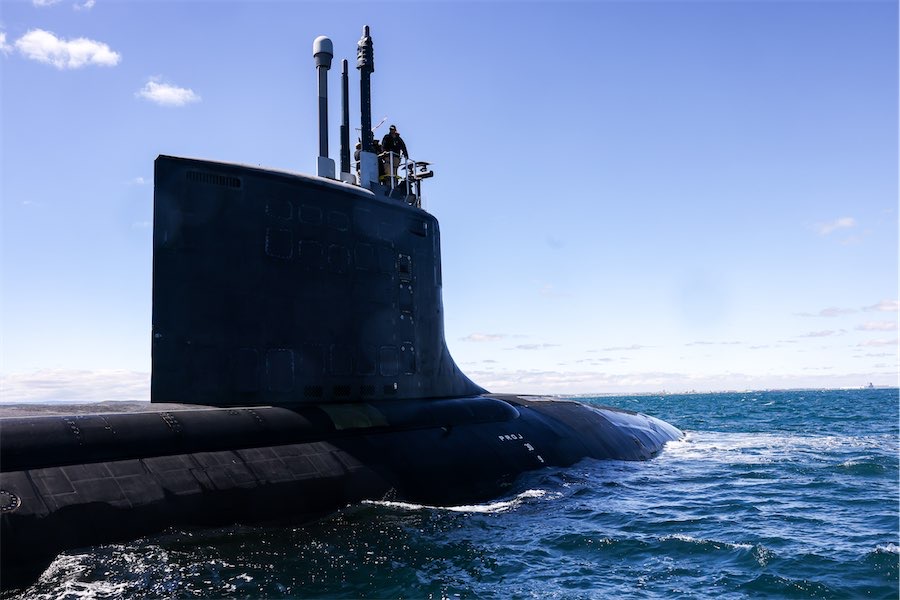
Nuclear submarines submarines offer formidable range, stealth and intelligence capabilities in the current strategic environment. But they are not invulnerable, and their relative advantage is likely to erode over time. (Colin Murty/AAP PHOTOS)
The decision to centre the National Defence Strategy on nuclear submarines looks less like prudent hedging and more like a high-cost gamble, says Prof CLIVE WILLIAMS.
Defence Minister Richard Marles unveiled Australia’s second National Defence Strategy (NDS) and its accompanying Integrated Investment Plan (IIP) on Thursday.
Clive Williams.
The document builds squarely on the 2024 “strategy of denial,” reaffirming rather than revising that framework and doubling down on long-range, high-end capabilities such as nuclear-powered submarines (SSNs) under AUKUS, new surface warships and hypersonic strike systems.
An extra $53 billion over the decade pushes defence spending toward 2.4-3 per cent of GDP.
There is continuity here, and that has value. Sticking with the denial framework signals resolve to allies, avoids another strategic lurch, and reinforces deeper integration through AUKUS.
The increased emphasis on sovereign industry and northern basing also reflects a more realistic appreciation of Australia’s strategic circumstances. There is, too, some recognition – belated but welcome – of the need to expand uncrewed systems in response to a rapidly evolving battlespace.
But the strategy’s central focus remains deeply questionable.
It continues to prioritise a small number of extraordinarily expensive, crewed platforms at a time when warfare is increasingly being shaped by mass, dispersion and low-cost attrition. The balance remains tilted toward the “few but exquisite” rather than the “many, cheap and replaceable” model now proving decisive in contemporary conflict. Nowhere is this more evident than in the commitment to SSNs.
These submarines offer formidable range, stealth and intelligence capabilities in the current strategic environment. But they are not invulnerable, and their relative advantage is likely to erode over time.
Advances in autonomous underwater vehicles, distributed sensor networks, AI-enabled detection and inexpensive mine warfare are steadily increasing the risks to even the most sophisticated platforms. In such an environment, concentrating so much capability – and national investment – into a handful of assets risks turning them into very expensive losses.
The opportunity cost is equally stark. The SSN program will absorb vast financial, industrial and human resources over decades. Nuclear engineers, submariners and sustainment personnel will be drawn into a single demanding enterprise, limiting Australia’s ability to scale the very capabilities that recent conflicts suggest are decisive: long-range strike missiles, uncrewed air and maritime systems, and large, resilient munitions stockpiles.
A strategy of denial ultimately depends on mass. It is difficult to generate that mass while funding a fleet that can only ever be counted in single digits.
Recent conflicts, particularly in Ukraine and the Middle East, underscore the growing effectiveness of relatively inexpensive, expendable systems. Ukrainian sea drones damaging or destroying Russian naval vessels and massed loitering munitions overwhelming air defences point to a clear trend.
While Australia’s maritime environment is different, the underlying lesson is transferable: precision, scale and replaceability are becoming as important as platform sophistication. Sea and air denial against a capable adversary is unlikely to be achieved by a few exquisite systems alone.
There are also significant industrial and workforce risks. Australia is attempting to build and sustain a nuclear-powered submarine capability from a very limited base while relying heavily on partners whose own shipyards are under strain. AUKUS timelines are already under pressure. Delays or political shifts – either domestically or in the US – could leave Australia with large sunk costs and a diminished capability outcome, rather than the seamless transition often implied.
That reliance on the US raises a further concern. The SSN pathway binds Australia more tightly to US strategic settings at a time when American policy is becoming less predictable and, at times, more confrontational. Rather than enhancing strategic autonomy, this level of dependence risks narrowing Australia’s options in a crisis and entangling it more deeply in great-power competition.
The 2026 NDS is therefore evolutionary rather than adaptive. It layers new technologies on to an existing framework, but stops short of rebalancing toward the forms of lower-cost, high-volume warfare now emerging. Redirecting even a portion of the planned SSN investment toward thousands of long-range missiles, uncrewed systems, hardened northern bases and sovereign munitions production would produce a more resilient and credible denial posture, one based on depth, redundancy and rapid reconstitution.
Australia’s geography still favours denial. But denial in the future will depend less on a few highly capable platforms and more on the ability to generate sustained, distributed and affordable combat power. In that context, the decision to centre the strategy on nuclear submarines looks less like prudent hedging and more like a high-cost gamble.
This NDS has largely chosen to double down on the past rather than prepare for the future.
Professor Clive Williams MG is a former Australian Defence intelligence officer (clive.williams@terrint.org)
"Those who want to froth about the inadequacy of this sentence would do well to note that there is no rehabilitation in our ACT prison system. That is the fault of the current ACT Government," writes legal affairs columnist HUGH SELBY.
"Jim asks his acolytes to swap their livery for Nick Cave T-shirts and their rung on the ladder to be shared by those with fewer opportunities." writes Kindness columnist ANTONIO DI DIO.
"Once infrequent, there are now more motions passing through the ACT Legislative Assembly than through the portaloos at the Multicultural Festival," writes SHUSH CAPITAL in this week's KEEPING UP THE ACT.





Leave a Reply