Is anyone left to protect the interest of workers?
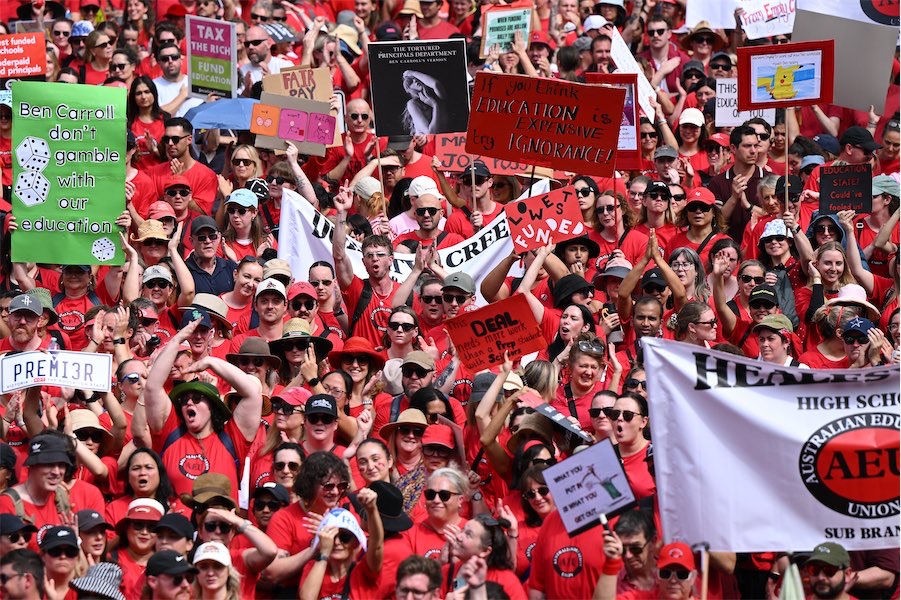
A file photo of striking teachers… There is growing dissatisfaction as standard-of-living expectations are not met. Photo: James Ross/AAP
“A vacuum has been created through the unions’ lack of influence even over Labor governments. It is big business lobbyists that fill the gap. Their role is to ensure that business profits increase,” writes MICHAEL MOORE.
The growing disparity between ordinary workers and the ultra-wealthy will only change if there is organised resistance.
Michael Moore.
In the past, such resistance has most effectively been through union power.
Increases in GDP and economic growth have for too long favoured the wealthy and failed to deliver benefits to the general population. The increasing disparity creates frustration and discontent.
There is growing dissatisfaction as standard-of-living expectations are not met. Younger generations are blaming later ones. It is popular, for example, to argue that baby boomers have had it easy and are the luckiest generation.
Blame settles on the politicians of the time who have failed to take effective action to counter the growing disparity, and to take care of those who are seriously disadvantaged. The focus may be on a particular issue. Generational inequity increases as homeownership becomes out of reach of those who do not have the support of the bank of mum and dad.
The disparity gap grows. The blame falls on successive governments.
This blame then leads to the success of populist leaders who exacerbate the situation by making promises on things they simply cannot deliver.
In the US, growing dissatisfaction with the populist Donald Trump comes particularly from the shrinking middle class. His supporters in the past had hoped to tap into the sort of wealth he had generated for himself.
In Australia, Pauline Hanson’s appeal is generating seats in a range of parliaments. Voters are often keen to punish the incumbent politicians rather than be taken in by her appeal. Many forget her key support comes from Gina Rinehart, the wealthiest person in Australia. Her influence is much more likely to deliver in the Rinehart interest rather than the interests of workers.
So, who is protecting the interest of the workers? The smell around the CFMEU throughout Australia has infiltrated the attitude of workers across the spectrum.
In August 2024, just 13.1 per cent of workers in Australia were trade union members. In 1948 Australia was the most unionised country in the world, with membership at around 65 per cent. In 1992 40 per cent of employees were trade union members.
Unfortunately, rather than the private sector, the higher levels of unionised workforce are in the government jobs – in areas such as nursing, teaching and public service.
Even more telling is in August 2024 only 3.7 per cent of employees aged 15-19 years and 7.3 per cent aged 20-24 were trade union members. This bodes ill for the future. Without worker support, particularly outside the government service, the unions will not be able to significantly influence governments.
A vacuum has been created through the unions’ lack of influence even over Labor governments. It is big business lobbyists that fill the gap. Their role is to ensure that business profits increase and they do this with financial and regulatory support from government.
As an example, it is pertinent to ask why has the current government, with the support of the Coalition opposition, so strongly resisted Senator David Pocock and the Greens’ demands for a tax on natural gas?
As Alan Koler, writing recently for the ABC, pointed out – it is “business milking the economy”. Reflecting on the prime minister’s thoughts at the Business Council of Australia dinner on how to improve “Australia’s poor productivity”, Albanese argued for “a positive partnership between government, business and the community to keep our economy strong”.
Mr Koler explained how big businesses are “milking the economy” and that big business groups “generally oppose every wage rise, then and now, and their members are responsible for price rises”. The formula allows a transfer of wealth from workers to big business and their shareholders.
He added: “The recent slump in productivity growth has been the decline in real wages, and the fact that per capita household income has been negative for years after inflation – it simply is not true that struggling financially spurs people to be more productive; the opposite happens”.
Many argue for hope in improved productivity through artificial intelligence. However, I wonder how many readers can recall the introduction of information technology, that computing would do things more efficiently and the general population, therefore, would have more leisure time.
Instead, the information technology giants became unimaginably richer while ordinary folk worked harder and longer in the name of productivity.
Michael Moore is a former member of the ACT Legislative Assembly and an independent minister for health. He has been a political columnist with “CityNews” since 2006
"To be credible, the ACT Government has to stop its obfuscation and commission an independent assessment to evaluate if bus rapid transport could deliver the benefits of light rail at lower cost," writes planning columnist MIKE QUIRK.
The attack on Helen Haines has forced politicians to confront the ugliness of political discourse, but lasting change will require a broader reckoning with society’s growing incivility, writes political columnist MICHELLE GRATTAN.





Leave a Reply