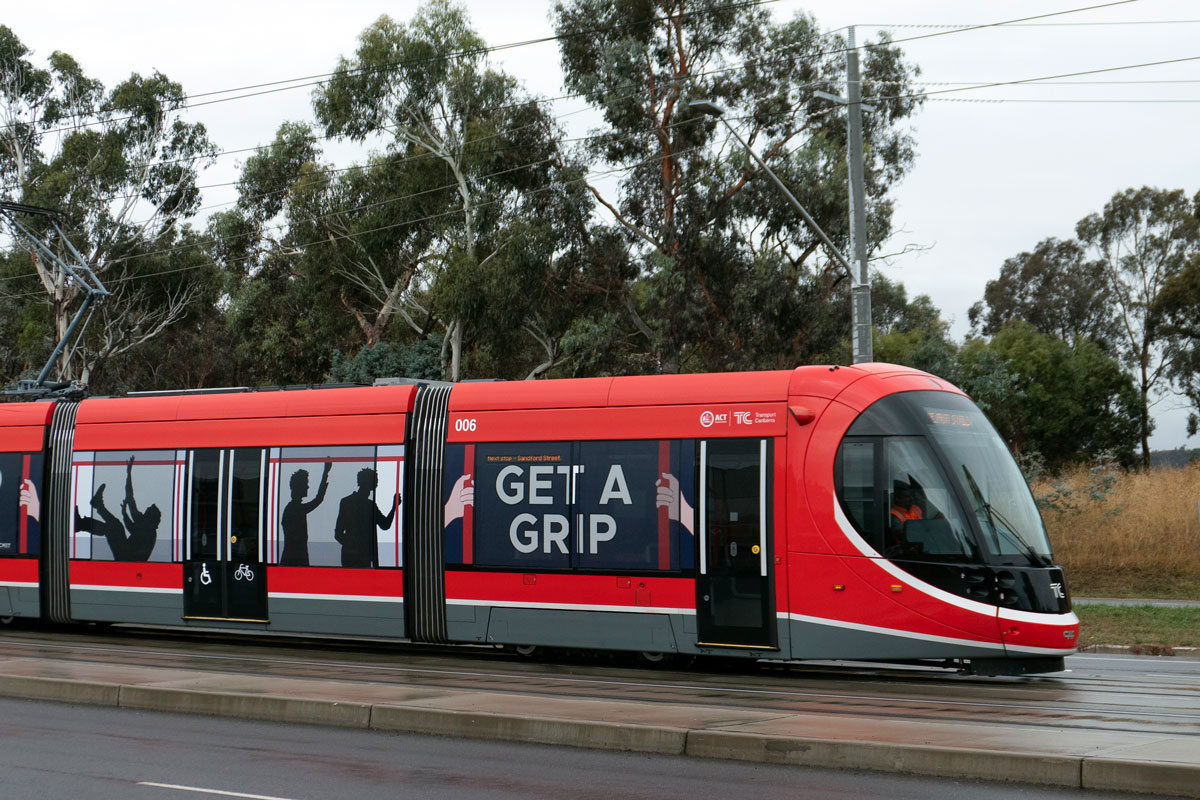
“The obsession with light rail has more than likely been at the expense of the education and health systems and the adequate provision of social housing,” writes former planner MIKE QUIRK.
The vision in the ACT Transport Strategy 2020 is for “a world-class system that supports a compact, sustainable and vibrant city” to be achieved by providing “flexible, reliable and sustainable options for Canberrans to make their journeys”.
These include a shift towards public transport, cycling and walking, and low-emission forms of transport.
All well and good but the strategy to encourage the use of these transport modes has been ineffective.
In Transport for Canberra: Transport for a Sustainable City 2012–2031, these modes (for the journey to work) were targeted to increase from 15.4 per cent in 2006 to 30 per cent in 2026 – 16 per cent would be by public transport, 7 per cent cycling and 7 per cent walking.
On Census day 2021 only 6 per cent took public transport and 6.1 per cent rode a bike or walked (10.9 per cent worked at home).
The 2022 ACT and Queanbeyan household travel survey, undertaken by Sift Research, also found a low use of public transport and low levels of cycling.
It found of the 1.43 million trips undertaken a day in the ACT, 75 cent were by motor vehicle, 18 per cent were walk trips, 4 per cent were by public transport and 3 per cent were cycling trips.
When compared to the 2017 Household Survey the results indicate a decline in the share of trips undertaken by motor vehicle (down from 77 per cent) and public transport (down from 7 per cent) and an increase in walking trips (from 14 per cent). Cycling trips were constant at around 3 per cent.
Walk trips increased in every district (perhaps in response to increased working from home) while Gungahlin was the only district to experience an increase in public transport trips, although public transport only represented 5 per cent of trips in the district. Cuts to bus services in many areas (partially to fund light rail) and the absence of an employment location strategy have hindered attempts to reduce car use.
Clearly the transport strategy needs review as it is not achieving the desired changes in travel behaviour.
A review, undertaken in the context of alternative population and employment distributions, would assess how best to encourage higher levels of public transport, walking and cycling; the implications of electric and automated vehicles; the merits of increasing parking charges and reducing long-stay parking supply at major centres; strategies to encourage employment at locations well served by public transport and to discourage employment at locations difficult to serve by public transport; and the implications of increased working from home on the level of transport infrastructure needed.
The review would assess the efficacy of extending light rail and evaluate the claim of former transport minister Chris Steel that buses alone won’t deliver… “the mass transit we need to move more people as our city grows” made in the absence of any assessment of bus rapid transport (BRT) alternatives.
Could adopting the potentially more cost-effective BRT, operating on dedicated roads, be more successful than light rail in reducing car use and achieving sustainability aims by freeing up funds for the accelerated purchase of electric buses and for increasing the frequency and coverage of the overall bus network?
While the light rail from Gungahlin to Civic has contributed to an increase in public transport use in its corridor, there is a strong possibility that BRT would have achieved a similar increase in patronage particularly given the finding in the government’s 2012 submission to Infrastructure Australia that BRT would cost less than half and deliver similar benefits.
The extension to Woden will be substantially more expensive than the existing line as a result of the need for a new lake crossing and design issues. It will also result in longer public transport travel times between Civic and Woden, hardly conducive to increasing patronage.
The credibility of the federal government in its quest to limit infrastructure funding to projects really needed, would be enhanced if it withdrew support for the light rail extension, until a comprehensive and independent review of the transport strategy has been undertaken.
Light rail meets Minister Catherine King’s criteria of a large-scale project receiving funding commitment “without adequate planning, costings and programming to sufficiently manage the significant increase in delivery costs within a volatile market”.
As highlighted by Jon Stanhope and Khalid Ahmed in a series of articles in CityNews, the ACT government needs to better manage its finances. Addressing the future development needs of the city requires the best use of limited public funds. Spending more than is necessary on a solution reduces social and economic sustainability as it reduces funds available for other needs.
The obsession with light rail has more than likely been at the expense of the education and health systems and the adequate provision of social housing. Such is the legacy of the mediocre Barr-Rattenbury government.
Mike Quirk is a former NCA and ACT government planner.
News all day, every day at CityNewsQBN.com.au.



Leave a Reply